Is there any such thing? Let's investigate—for good or ill. A blog about fiction and literature, philosophy and theology, politics and law, science and culture, the environment and economics, and ethics and language, and any thing else that strikes our fancy. (Apologies to Bertrand Russell)
"Vishnu is pictured as the divine dreamer of the world dream. Vishnu sleeps on a great serpent, whose name is Ananta, which means "Endless." The serpent floats on the universal ocean, called the Milky Ocean. ... Vishnu, the God, sleeps, and the activity of his mind stuff creates dreams, and we are all his dream: the world is Vishnu's dream. And just as, in your dreams, all the images that you behold and all the people who appear are really manifestations of your own dreaming power, so are we all manifestations of Vishnu's dreaming power." Joseph Campbell
Here's a thought experiment: Try to imagine you're not a spacetime traveler.
Go ahead. It's hard but not impossible—just ask the ancient Hindus.
To do so, of course, you have to imagine yourself not having a physical dimensional body (a vehicle) existing in (traveling through) spacetime.
Now, imagine further that this non-physical, atemporal You wants to design a vehicle that could withstand the rigors of traveling through (traversing) the entirety (eternity) of spacetime. You fully understand the costs in self-consciousness, identity, and even entity integrity. What do You come up with?
We can infer from the paltry experience of the short-burst of consciousness that we've called our world lines that You would need some form of longitudinally adaptive, evolvingly self-regenerative, multiform becomingness. Some sort of foamy process not unlike Life itself.
Not sure? Well, let's recap. While not necessarily theoretically impossible, I've shown that it's damned hard to give a complete answer to the simple question, 'where are you now?' because you're travelling through three-dimensional space at mindbogglingly unbelievable speeds. And that doesn't even account for the time element involved—which itself, many believe, is emergent and thus has its own sort of velocity.
So, you are travelling through this four-dimensional spacetime thing along your own personal world line, the sequential path of personal human events that just is your history and your experience. Logically, of course, you can't reflect on the entirety of your personal history and experience until all the events that make up your world line are complete.
(That's, of course, that Gödelian principle once again, but in a relevant, meaningful sort of way. Am I saying there's no 'meaning' to life? Isn't that the question philosophy is supposed to answer? Well, more like it, philosophy is supposed to help us formulate the right questions and try to imagine what a good answer might look like. And in this instance, from the logical point of view, the question of the 'meaning of life' can only be answered from outside of life, from a 'meta-life' vantage point if you will. I.e., Only after it has been completed can the full meaning of a life (or all lives) be truly reflected upon. From the vantage of death or extinction. In fact, Whitehead's and Hartshorne's theology explicitly address this issue.)
From a purely physics point of view, your world line should be determinate. Predestined, as the theologians might say. Other external spacetime events impact it, other world lines intertwine with it, and other things interact with it, all in theoretically predictable ways given the laws of causality. If, with perfect knowledge we could analyze and identify all those factors, we could pretty much predict or lay out the course of your, or anyone else's, world line. (But we don't have such perfect knowledge, you might object. True. In metaphysics, however, part of the game is to imagine whether there is a possible world in which such knowledge, and thus such an answer, could be had.) This is a materialist, reductionist formulation. And just because your world line might be predictable doesn't mean it has meaning!
Whitehead (arrrggghh! not him again), by contrast, seems to make room for some degree of self-determination. Freedom of the will, as those same theologians might say. And what makes you free according to him? Feelings, nothing more than feelings. (Of course, for Whitehead 'feelings' has a special definition, but, summarily, it's a species of prehension.) Feelings are internal judgments which accept or reject (where possible) these interacting, intertwining, impactful events acting upon you on your world line journey through spacetime. His is an idealist, though non-reductionist materialism.
So, yes. Time travel is not only possible, it is inevitable. You are doing it right now. And now. And now. It is the basis of becoming. It is what becoming is. And becoming is the ground of Reality.
And what is the cost of travelling through spacetime, the cost of becoming? What is the cost of feeling? This is an easy one, readily observable from within our conscious experience: The degradation of the vehicle doing the travelling, i.e., the deterioration of your physical body.
First of all, I'd like to apologize. This series has gotten a little out of hand. I mean, five long posts on stodgy old A.N. Whitehead's philosophy? Gimme a break. And that little snit I had yesterday? I'm over it. Hope you are too.
Now that's out of the way, I want to take stock. And I promise to keep it short and non-technical—relatively so. So, where are we?
I've been tracing the "adventure of an idea" through history: the history of the idea of flux, or becoming, as the foundation for understanding everything. An archaeology of knowledge, to borrow a term from Michel Foucault. And interestingly, it's come full circle: from a provocative, almost poetic formulation in the fragments of Heraclitus, to its resurrection in the logic and methodologies of Hegel and Marx, to it systematic analysis and presentation in Whitehead's later work. Taking a last-minute detour (because I'm a fiction writer) by applying the general notions of prehension and concrescence to propose a specific theory of fiction.
That's not really a circle, though; it's more like a helix. And that proves instuctive.
As I mentioned in an earlier post, if a metaphysics is to work, it has to account for both rocks and creativity. It can't, like most scientistic, substance-based schemas, bracket inconvenient facts like Life and Consciousness and Thought. Process philosophy claims to give us a unifying paradigm for both inner and outer experience.
So, where are we?
In the early 20th Century, Hermann Minkowski proposed that space and time should not be considered as separate entities, but rather as a four dimensional unity: spacetime. Movement through spacetime could be represented by "world lines".
"...a world line of an object (approximated as a point in space, e.g., a particle or observer) is the sequence of spacetime events corresponding to the history of the object. A world line is a special type of curve in spacetime. ... A world line is a time-like curve in spacetime. Each point of a world line is an event that can be labeled with the time and the spatial position of the object at that time.
For example, the orbit of the Earth in space is approximately a circle, a three-dimensional (closed) curve in space: the Earth returns every year to the same point in space. However, it arrives there at a different (later) time. The world line of the Earth is helical in spacetime (a curve in a four-dimensional space) and does not return to the same point."
World Line of an Orbital Body
The point being: even if you sit still for a year while the earth revolves around the sun, you don't return to the same place in spacetime.
But, even more, you aren't really sitting still. You only have the illusion of sitting still. The rotational speed of the earth at the equator is over 1,000 mph. It slackens as you approach the poles, but that's beside the point. This rotating rock is travelling around the sun at over 66,000 mph. The sun itself is moving (and taking us earthlings with it) at about 43,000 mph. But even that is relative because the sun and its solar system is orbiting the black hole at the galactic center of the Milky Way at something like 490,000 mph. It's mind boggling. But there's more: the Milky Way and its attendant "local group" cluster is speeding away from the big bang at something like 1.3 million mph.
Vector me that, mathletes!
So, not only are you a verb (or, better, an adverb), you are a time traveller (or, better, a spacetime traveller).
Changing views of spacetime along the world line of a rapidly accelerating observer. In this animation, the dashed line is the spacetime trajectory ("world line") of a particle. The balls are placed at regular intervals ofproper time along the world line. The solid diagonal lines are the light cones for the observer's current event, and intersect at that event. The small dots are other arbitrary events in the spacetime. For the observer's current instantaneous inertial frame of reference, the vertical direction indicates the time and the horizontal direction indicates distance.
Given that, the question 'where are we now?' seems a silly one.
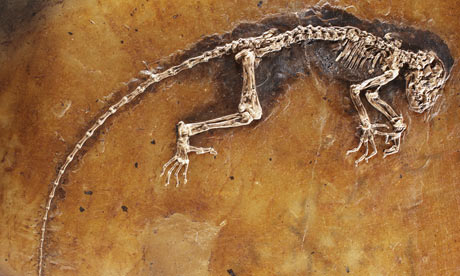
Say hello to Darwinius masillae! Her friends call her Ida.
She is a remarkably well-preserved 47 million year old fossil of an early primate.
"[S]he is the most complete and best preserved primate fossil ever uncovered. The skeleton is 95% complete and thanks to the unique location where she died, it is possible to see individual hairs covering her body and even the make-up of her final meal – a last vegetarian snack.
"This little creature is going to show us our connection with the rest of all the mammals; with cows and sheep, and elephants and anteaters," said Sir David Attenborough who is narrating a BBC documentary on the find. "The more you look at Ida, the more you can see, as it were, the primate in embryo."
"This will be the one pictured in the textbooks for the next hundred years," said Dr Jørn Hurum, the palaeontologist from Oslo University's Natural History Museum who assembled the scientific team to study the fossil. "It tells a part of our evolution that's been hidden so far. It's been hidden because the only [other] specimens are so incomplete and so broken there's nothing almost to study."
Here's a feature-chocked, explanatory Flash of the above picture. Here's a slide show.
Fossils are one of the ways we have to "travel" back in time. Ida gives us a snapshot of a creature that roamed the planet an unfathomably long time ago—for many people, their backwards time-horizon is somewhere between five and ten thousand years. Still, what if we could travel in time? What sort of protocols would we have to follow? In honor of the new Star Trek movie, this blogger over at Discover has tried to think it through:
0. "There are no paradoxes. 1. Traveling into the future is easy. 2. Traveling into the past is hard — but maybe not impossible. 3. Traveling through time is like traveling through space. 4. Things that travel together, age together. 5. Black holes are not time machines. 6. If something happened, it happened. 7. There is no meta-time. 8. You can’t travel back to before the time machine was built. 9. Unless you go to a parallel universe. 10. And even then, your old universe is still there."