Friedrich Nietzsche was the first (at least to my knowledge) to philosophize about I want to call the "Post-Human" in his novel (if that's what you want to call it) Thus Spake Zarathustra.
Zarathustra was written and published between 1883 and 1885. Charles Darwin's The Origin of Species (1859) and Descent of Man (1871) were in wide currency in European intellectual circles prior to its conception. There is no conclusive evidence, however, as to whether Nietzsche read these revolutionary scientific treatises, but there should be little doubt he knew of their impact.
There is tremendous disagreement about how to translate Nietzsche's term Übermensch. Some translate it as Superman others as Overman or Uberman or Superhuman or Beyond-Man. And these translations have led many, including Nietzsche's sister, to misconceive the concept as something to be applied to Great Men or leaders or even comic book heroes.
It is clear from the Prologue to Zarathustra that Nietzsche had in mind an evolutionary concept. In §3 he has Zarathustra state: "Man is something that shall be overcome....Once you were apes, and even now, too, man is more ape than any ape." And then in §4: "Man is a rope, tied between beast and overman—a rope over an abyss." (Kaufman translation)
Humanity is a rung on an evolutionary ladder that leads from earlier branches on the simian limb of the tree of life to some unknown future form. Being is always Becoming. The foundation of existence is change. Nietzsche is asking us to think about where this change, this becoming, might lead. That is, what comes after humanity, i.e, the Post-Human. And this is the key to understanding the Nietzschean philosophy in Zarathustra.
Nietzsche's Zarathustra proclaims that God—as the traditional, central source of meaning, value, order, and morality in human life—is no longer a viable concept in the scientific age brought about by the Darwinian revolution. Humanity is thus doomed to nihilism—a meaningless, valueless, chaotic, amoral existence—absent an equally powerful new source of meaning. He finds this in the Post-Human.
All human life and activity should point to the Post-Human, should proclaim it, should make way for it, should strive to bring about this next evolutionary form of life—to the best of its limited knowledge and ability. That is the meaning of life for Zarathustra and thus for Nietzsche: Evolutionary Progress.
And though we cannot know what form this Post-Human, this New Being, might take, Nietzsche has Zarathustra speculate on some of the Post-Human's characteristics.
The Post-Human will bring its own meaning to life through an act of will. The Post-Human is the one who not only recognizes but joyfully accepts and even wills that his/her/its life should repeat itself just as it has unfurled/as it is/as it will happen over and over infinitely. This is the action of the self-aware, self-critical soul existing in an Eternal Present. It is Amor fati. It is an acceptance of the conditions of existence—the physical body and the real world, not a pining for some afterlife.
We might even say that it is the Post-Human willing itself into being that gives meaning and purpose to our own collective existence.
The Post-Human, Zarathustra speculates, will laugh in derision at the poor, pitiable state of our transitional humanity and will dance in a childlike celebration of his/her/its embrace of, nay, its creation of the fate that brought it into being.
Showing posts with label Meaning of Life. Show all posts
Showing posts with label Meaning of Life. Show all posts
08 June 2020


17 March 2013
Being v. Becoming, Pt. 9: Is Time Travel Possible? And How Much Does It Cost?
So, how does it feel to be a time traveler?
Not sure? Well, let's recap. While not necessarily theoretically impossible, I've shown that it's damned hard to give a complete answer to the simple question, 'where are you now?' because you're travelling through three-dimensional space at mindbogglingly unbelievable speeds. And that doesn't even account for the time element involved—which itself, many believe, is emergent and thus has its own sort of velocity.
So, you are travelling through this four-dimensional spacetime thing along your own personal world line, the sequential path of personal human events that just is your history and your experience. Logically, of course, you can't reflect on the entirety of your personal history and experience until all the events that make up your world line are complete.
(That's, of course, that Gödelian principle once again, but in a relevant, meaningful sort of way. Am I saying there's no 'meaning' to life? Isn't that the question philosophy is supposed to answer? Well, more like it, philosophy is supposed to help us formulate the right questions and try to imagine what a good answer might look like. And in this instance, from the logical point of view, the question of the 'meaning of life' can only be answered from outside of life, from a 'meta-life' vantage point if you will. I.e., Only after it has been completed can the full meaning of a life (or all lives) be truly reflected upon. From the vantage of death or extinction. In fact, Whitehead's and Hartshorne's theology explicitly address this issue.)
From a purely physics point of view, your world line should be determinate. Predestined, as the theologians might say. Other external spacetime events impact it, other world lines intertwine with it, and other things interact with it, all in theoretically predictable ways given the laws of causality. If, with perfect knowledge we could analyze and identify all those factors, we could pretty much predict or lay out the course of your, or anyone else's, world line. (But we don't have such perfect knowledge, you might object. True. In metaphysics, however, part of the game is to imagine whether there is a possible world in which such knowledge, and thus such an answer, could be had.) This is a materialist, reductionist formulation. And just because your world line might be predictable doesn't mean it has meaning!
Whitehead (arrrggghh! not him again), by contrast, seems to make room for some degree of self-determination. Freedom of the will, as those same theologians might say. And what makes you free according to him? Feelings, nothing more than feelings. (Of course, for Whitehead 'feelings' has a special definition, but, summarily, it's a species of prehension.) Feelings are internal judgments which accept or reject (where possible) these interacting, intertwining, impactful events acting upon you on your world line journey through spacetime. His is an idealist, though non-reductionist materialism.
So, yes. Time travel is not only possible, it is inevitable. You are doing it right now. And now. And now. It is the basis of becoming. It is what becoming is. And becoming is the ground of Reality.
And what is the cost of travelling through spacetime, the cost of becoming? What is the cost of feeling? This is an easy one, readily observable from within our conscious experience: The degradation of the vehicle doing the travelling, i.e., the deterioration of your physical body.
Not sure? Well, let's recap. While not necessarily theoretically impossible, I've shown that it's damned hard to give a complete answer to the simple question, 'where are you now?' because you're travelling through three-dimensional space at mindbogglingly unbelievable speeds. And that doesn't even account for the time element involved—which itself, many believe, is emergent and thus has its own sort of velocity.
So, you are travelling through this four-dimensional spacetime thing along your own personal world line, the sequential path of personal human events that just is your history and your experience. Logically, of course, you can't reflect on the entirety of your personal history and experience until all the events that make up your world line are complete.
(That's, of course, that Gödelian principle once again, but in a relevant, meaningful sort of way. Am I saying there's no 'meaning' to life? Isn't that the question philosophy is supposed to answer? Well, more like it, philosophy is supposed to help us formulate the right questions and try to imagine what a good answer might look like. And in this instance, from the logical point of view, the question of the 'meaning of life' can only be answered from outside of life, from a 'meta-life' vantage point if you will. I.e., Only after it has been completed can the full meaning of a life (or all lives) be truly reflected upon. From the vantage of death or extinction. In fact, Whitehead's and Hartshorne's theology explicitly address this issue.)
From a purely physics point of view, your world line should be determinate. Predestined, as the theologians might say. Other external spacetime events impact it, other world lines intertwine with it, and other things interact with it, all in theoretically predictable ways given the laws of causality. If, with perfect knowledge we could analyze and identify all those factors, we could pretty much predict or lay out the course of your, or anyone else's, world line. (But we don't have such perfect knowledge, you might object. True. In metaphysics, however, part of the game is to imagine whether there is a possible world in which such knowledge, and thus such an answer, could be had.) This is a materialist, reductionist formulation. And just because your world line might be predictable doesn't mean it has meaning!
Whitehead (arrrggghh! not him again), by contrast, seems to make room for some degree of self-determination. Freedom of the will, as those same theologians might say. And what makes you free according to him? Feelings, nothing more than feelings. (Of course, for Whitehead 'feelings' has a special definition, but, summarily, it's a species of prehension.) Feelings are internal judgments which accept or reject (where possible) these interacting, intertwining, impactful events acting upon you on your world line journey through spacetime. His is an idealist, though non-reductionist materialism.
So, yes. Time travel is not only possible, it is inevitable. You are doing it right now. And now. And now. It is the basis of becoming. It is what becoming is. And becoming is the ground of Reality.
And what is the cost of travelling through spacetime, the cost of becoming? What is the cost of feeling? This is an easy one, readily observable from within our conscious experience: The degradation of the vehicle doing the travelling, i.e., the deterioration of your physical body.
18 December 2008
I Am the Slime...

According to two Scandinavian scientists, asking where or how life grew out of lifeless matter is like asking "when and where did the first wind blow that quivered the surface of a warm pond.” Rather, the important question is "why" it developed. And they've put forth a theory consistent with known physical laws.
According to the two scientists, son and father Arto Annila of the University of Helsinki and Erkki Annila of the Finnish Forest Research Institute in “Why did life emerge?” International Journal of Astrobiology 7 (3 & 4 ): 293-300 (2008)
"life is a very natural thing, which emerged simply to satisfy basic physical laws. Our “purpose,” so to speak, is to redistribute energy on the Earth, which is in between a huge potential energy difference caused by the hot Sun and cold space. Organisms evolve via natural selection, but at the most basic level, natural selection is driven by the same thermodynamic principle: increasing entropy and decreasing energy differences. The natural processes from which life emerged, then, are the same processes that keep life going – and they operate on all timescales.We are part of the natural cooling mechanism of the universe. We process energy from the sun and recycle/redistribute it into the environment:
“According to thermodynamics, there was no striking moment or no single specific locus for life to originate, but the natural process has been advancing by a long sequence of steps via numerous mechanisms so far reaching a specific meaning – life,” the researchers explained.
And because thermodynamics recognizes no specific moment, particular place, compound or reaction that would distinguish animate from inanimate, a search for ‘the birth of life’ seems like an ill-posed project, Arto Annila explained.
when systems (e.g. molecules) become entities of larger systems (e.g. cells) that participate in larger ranges of interactions to consume more free energy, entropy increases. Genetic code might have served as another primordial mechanism, acting as a catalyst that could increase energy flow toward greater entropy. Today, complex organisms have cellular metabolism, which is another mechanism that increases entropy, as it disperses energy throughout the organism and into the environment. The food chain in an ecosystem is another example of a mechanism for transferring energy on a larger scale.So, as my kids say, CHILL!
----------------------
You can read more here, here, here, or here without getting too esoteric.
05 February 2008
Baby Steps

Okay, this is not going to be my last shot at this idea, but I had a discussion with my 12-year old last night on the way home from baseball practice that began something like this: "Dad? What's going to happen to us when the sun burns out?" "I don't think we'll live to see that," I said. "I didn't mean me and you, stupid. I meant the human race, life on earth." (This kid is capable of sustained discourse, so we thought out loud as we drove and arrived at some interesting thoughts which I felt could help provide some perspective for this blog.)
"Yes, I agree, son, life on earth as we know it will at some time in the future end." "How?" We brainstormed: Asteroid/meteorite, like the dinosaurs. Ice age. Dying out of the core. Flooding. Environmental disaster. Cataclysm of another natural sort. Total war. Nuclear winter. Sun burning out. Moon crashing in or flying out of orbit. Etc. (You'd be surprised at the power of a 12-year old's imagination when he's thinking about destruction.) Leastways, we concluded, it's going to happen sooner or later.
"What then, dad?"
"Well, son, the large reptilians had their day ruling the planet until some cataclysm killed them all out—they think it was meteorite hitting the Yucatan. We are the mammalians and, as of now, the highest evolved form of life. What could come next?"
"Insects!"
"Good guess, son. And they would probably develop intelligence and grow large and dominate the planet in their own way."
"Cool. Hey, what if we built giant spaceships and started heading out to the stars looking for new planets to inhabit before then?"
"Brilliant question, son. Mars might be our first candidate."
"Oh yeah, I loved that rover we sent up there. I'd like to build robots like that one day."
"Great, son. Of course, if we wanted to go there we'd have to learn to live in a completely man-made environment."
"Like the Biodome?"
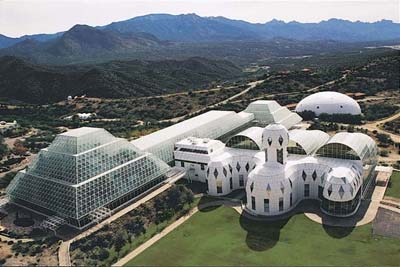
"Something like that."
"Boy, I sure would want to be around to see that."
"Well, I don't think it'll happen in either of our lifetimes, son, but what we can do is try to keep this in mind—let's call it "the project of humanity"—and live our lives trying to contribute to making it possible."
"Like inventing spaceships that can travel at the speed of light?"
"Sure, son, why not? Or, what about developing ways to keep us from getting sick? Or, what about achieving a politics that doesn't involve aggression and self-destructiveness? I mean, if we're all on one big spaceship and we start fighting among ourselves then we could destroy the ship."
"That's right, dad."
"And I think we would have to come up with some way of helping us remember from generation to generation why we're all sailing around in this great big spaceship. If we forget that we have this big survival project and that we're trying to seek out new worlds capable of sustaining life we're likely to get depressed or something."
"What about being able to morph so we can go down black holes into other dimensions and stuff?"
"Sounds about right, son, but ambitious. Just remember: baby steps. Think about what we can do with our lives to contribute to this big project of preserving life as we know it."
"Human life, dad."
"Right. But remember, distances in space are so vast that traveling around the galaxy or even farther will take enormous amounts of time. Generations upon generations. Tens of thousands of years—more than the life-span of human civilization. We're likely to evolve over that time and we'll have to have measures to adapt to space life."
"Wow."
"Just remember, son. Baby steps. Got any homework?"
26 December 2007
Life: Of Which Is Variety the Spice

One argument is that life, in all its myriad forms, is simply the expression of DNA's survival mechanism in the hostile/friendly [?] environment of planet Earth. That's an interesting form of determinism which incorporates our notions of free will into itself. That is, our exercise of free will is really an effort toward survival—of the individual, of the species, of DNA, of life itself—as conditioned by (in response to) our environmental circumstances.
Is that, indeed, the meaning of life? Is that the purpose? The survival of the species? Of DNA? Of life itself?
On other worlds, could we conceive something configured differently from DNA to be the foundation of all life? Competitive, though radically different, life forms?
Subscribe to:
Posts (Atom)