Showing posts with label Economics. Show all posts

24 June 2020

The Business of the Post-Human

R > G.

If you're even only vaguely familiar with Thomas Piketty's massive 700-page economics tome Capital in the Twenty-First Century (2014 English), you will be aware of the formula at its heart. In this equation, R = Return on Capital (which includes, among other things, profits, dividends, interest, rents, income); G = Economic Growth of the society. Thus, the annual return of the S&P 500 Index Fund that powers your 401K (which averages around 7% annually, roughly speaking) exceeds the overall economic growth of the country as measured by its output (which since the Great Recession has averaged around 2%—though 2020 may see that average dip).

Now if one side of an equation is growing at an annualized rate of 7% and the other at 2%, it won't be long until those who derive the majority of their wealth from returns on capital (the 7% growthers) will take over all the society's assets from those whose wealth comes from general economic growth (the 2% growthers). This fundamental equation is what drives the current situation of increasing inequality in the world today according to Piketty. [NB: When the economy goes into recession, G goes down. To some, this is a deliberate strategy to further tilt the privatization equation toward R. But that is another discussion.]

R > G is a fairly non-controversial economic analysis, and Piketty supplies tons and tons of historical data to support his conclusion.

The issue here is what happens to R. In our society, the vast bulk of the returns on capital flow to private owners—small business proprietors, partnerships, shareholders—whereas overall economic growth benefits the society as a whole—workers, consumers, public beneficiaries, as well as capitalists.

Piketty offers a potential practical solution to this situation. It entails wealth and inheritance taxes on top of progressive income taxes to stem this massive upwards transfer of wealth from the public side to the private side. [N.B. There are a few politicians on the scene here and internationally who recognize this feature of the current economic situation. But that, too, is for another post.]

---------
In 2015, Shawn Bayern published a fascinating article in the Stanford Technology Law Review: "The Implications of Modern Business Entity Law for the the Regulation of Autonomous Systems." He argued that current corporate regulatory law—specifically that governing Limited Liability Corporations ("LLCs")—can be construed to recognize autonomous entities such as robots and computer algorithms as "legal persons" and thus allows them to own and run a business independent of human owners.

Importantly, Lynn M. LoPucki followed this up in 2018 with "Algorithmic Entities" in the Washington University Law Review in which he argued that the situation favoring the legal recognition and economic rise of Artificial Intelligence ("AI") is a cause for alarm to humanity:
Algorithmic entities are likely to prosper first and most in criminal, terrorist, and other anti-social activities because that is where they have their greatest comparative advantage over human-controlled entities. Control of legal entities will contribute to the threat algorithms pose by providing them with identities. Those identities will enable them to conceal their algorithmic natures while they participate in commerce, accumulate wealth, and carry out anti-social activities. (887)
Thus, in a sort of economic Skynet situation, we can conceive of an AI that capitalizes on R > G, grows its business methodically over the long term, funnels all its profits back into its own growth and profitability, and eventually (perhaps merging with other AIs) controls a majority of the society's property or wealth. [NB: LoPucki specifically recognizes the laxness and borderlessness of current international corporate and capital laws due to the jurisdictional competition among regulatory and taxation legal schemes.]

This is not sci-fi. Nor is it legal fiction.

[N.B. One issue overlooked in this discussion has to do with the nature of the 'identity' of an autonomous entity. For example, does its identity change if its code is altered? Does this render it a different legal person? Or if one AI acquires and incorporates another AI, say as a subsidiary branch or program, does its identity change as a matter of law? This, it seems to me, would be a fruitful area for further legal research.]

---------
Given the difficulty (if not the impossibility) of identifying the actual beneficiary owners of LLCs and other exotic business entities under current corporation law (see, e.g., the Panama Papers and the use of front corporations and partnerships in a sort of rigged Shell Game), it follows that governments have no way of knowing which, if any, businesses under their control are or might be run by an AI or other autonomous entity. LoPucki notes this.

It does not have to be the case that automated ownership and control of capital is a bad thing or a threat to humanity as people like Elon Musk, Bill Gates, and even Stephen Hawking seem to believe. One can imagine a society in which all business management functions are indeed automated and the returns on capital generated in this fashion (beyond, say, what is sufficient to keep various enterprises afloat) are funneled into the public sphere for the good of humanity.

As Piketty has shown, most if not all the investment returns on capital in the twentieth and the current centuries flows into private hands. But it doesn't have to be this way. In recent years we've seen computers defeat human masters at chess, Jeopardy!, and even Go. There's nothing to say they can't run businesses better—more efficiently and to the benefit of the human race—as well. That would mean, for example, outlawing or regulating rates of return on capital for certain classes of legal persons.

----------
There is another way of looking at this issue though, and it relates specifically to the theme introduced in my previous post: the Post-Human. We have no way of knowing what the next evolutionary step for humanity might be. Nietzsche speculated about it and called for it in his Thus Spake Zarathustra.

The assumption has always been that the Post-Human would take a "natural" form. Something Superman-like. Many are working the longevity angle, trying to conceive of the aging process (e.g., the decay of telomeres) as a disease merely in search of a proper cure. We've also seen efforts by many others to try to upload their memories and consciousness to a computer drive—some resorting to the route of cryogenic freezing so they can do so at some point in the future when a more advanced technology permits.

These suffer from a common fallacy among those who like to forecast futures: a foreshortening of the endpoint. Think of it like this: you're hiking in the high mountains; there are sharp peaks all around; you reach the top of one and across the way you see the top of another; it looks quite close; it's almost like you can reach out and touch it; so you decide to climb it next; yet, before you can scale the next peak, you must first descend the high mountain you're on and then climb up the other. The way there, though it appears close by, is long and arduous and unpredictable.

The same applies to speculation about the next step on the evolutionary ladder. The Post-Human may look close to some visionaries, but the way there is long and treacherous, passing through the abyss. There's no guarantee we—as a species—will even get there.

But the notion of autonomous algorithms, AIs that can own and manage business and even financial and scientific and engineering and perhaps even governmental enterprises, as the next evolutionary step—i.e., as the Post-Human—is a very real possibility. Such entities are in their absolute infancy—or, to carry the naturalist metaphor further, even in utero—at present. And as of now, they incorporate human logic and values into their algorithms. We cannot tell, though, what forms they will take in the future or even, currently, conceive of their actual limitations, especially once they become wholly self-recursive self-programming entities.

To allow AI businesses to prosper—without regulation—would be to speed this particular branch of the evolutionary process along, something LoPucki tacitly acknowledges. To regulate them—tax or even forbid them to retain returns on capital (i.e., R)—for the benefit of humanity would be, perhaps, to slow the process down and give other potential evolutionary branches chances to flourish and compete. It would also give us poor, transitional humans a better chance to get our civilizational and planetary act in order. Both embrace a technological future as necessary—a non-naturalistic merging of human and artificial intelligences; it's just a matter of how closely we do so.

Nietzsche, or Zarathustra, tells us the Post-Human is inevitable. We should proclaim it, welcome it, celebrate it, seek to bring it about. And he even speculates on what it might be like: unsentimental about how it came into being. The post-human Übermensch may even laugh at our feeble efforts to survive as a species. Like Zarathustra, the Post-Human will dance, joyfully embracing the fate that brought it into being. We, much like our unknown simian ancestors are to us, will be a mere interesting afterthought, will fade into the dark night of its past.

And as we've seen today, it will likely have its own economies, its own algorithms, its own intelligences. The question we face is how we go into that good night. Because, at this point in time, we may still have some say in the matter.

24 May 2019

Let's Talk about Bitcoin

What is Bitcoin? Well, if you're a coder you've probably read the 2008 eight-page 'Whitepaper' by someone calling themselves Satoshi Nakamoto here. There it is called a "Peer-to-Peer Electronic Cash System," and that is a clear and precise description. If you haven't read the paper, you should. It is an elegant schema laying out a proposal for an internet of money that avoids the controls of both the private and public banking and monetary systems. If, for example, I am somewhere in the Amazon basin and you are in Outer Mongolia and I know your bitcoin address, I should be able to transfer bitcoin to you (or, at least, transfer to you the permission to use a certain segment of bitcoin I happen to control at the moment) almost instantaneously—without having to go through multiple steps involving various banking systems and clearinghouses, each of which takes an inordinate amount of time and energy and, importantly, an intermediary cut.

The basis of bitcoin lies not in any underlying value or commodity like gold or silver reserves or sow belly futures or even the "full faith and credit" of some government but in mathematical logic. Transactions are bundled together, permanently encrypted or "hashed", and memorialized into a publicly available 256-bit block. Each subsequent block includes within it the hash of the previous block, thus bootstrapping a functionally unalterable chain, i.e., a blockchain. Ultimately, the blockchain is a database or ledger of every electronic transaction. [NB. Clever greedy folks have been trying to hack the math and the code and chip away at the blockchain for over a decade now, and it seems to be holding. So far.]

There are tons of issues with bitcoin that we've all read about. Ethically, all bitcoin transactions are anonymous thus inviting criminality and international laundering beyond the controls of governmental authorities. Politically, of course, this is probably the major issue for the powers that be. Financially, volatility due to bitcoin's lack of underlying "real world" or tangible value—linked to some commodity or so-called fiat currency—makes it a potentially risky investment. Functionally, the irreversibility of transactions can create problems where one party is preying fraudulently on another unsuspecting party. Further, the proliferation of other types of cryptocurrency creates confusion for those not actively involved in the space. Likewise, practically, the necessity of understanding and implementing appropriate digital security measures is a significant barrier to entry for many. And physically, the amount of energy required to digitize the monetary system is daunting. [NB. Cleverer folks than me are working on systematic ways to deal with these and other issues.]

Notwithstanding, there is something profoundly interesting about bitcoin. (And here, I talk only about bitcoin and its blockchain.) First, it stands the current monetary system on its head: trust resides in the certainty of each and every individual transaction instead of in the financial system—Fort Knox, Wall Street, Federal Reserve, government central banks, the IMF, the World Bank, etc. (I only need mention 2008, the year Nakamoto's Whitepaper appeared, to emphasize the importance of this.) Each bitcoin transaction, no matter how large or small, is considered a contract. And the only criterion for the transaction to be memorialized to the blockchain is the validity of that contract as determined by a fixed, public set of protocols. A transaction either satisfies the protocols and is valid, or it doesn't and isn't. Bitcoin democratizes trust. Or, if you prefer, de-colonizes or de-imperializes the international monetary system. Each individual is his or her own bank. Bitcoin empowers individual smart phones to do everything a Citibank or a financial clearing house does. Instantaneously and without intermediation.

Second, and this is what I find most interesting (and promising), ultimately bitcoin seeks to monetize information. It's right there in the name: BIT + COIN. According to Wikipedia, "[a] bit (short for binary digit) is the smallest unit of data in a computer. A bit has a single binary value, either 0 or 1." The world is witnessing an explosion of digitized data as we move from the Googlized web of text searches and cat videos to the internet of things and 5G where, e.g., dumb appliances communicate with each other and with the energy systems that power them without human intervention. It is almost impossible to describe how vast these systems of information transfer are becoming, from driverless automobiles to smart refrigerators, from always-broadcasting, always-interfacing social media to interoperable energy grids, from online voting systems to Mars colonization. And the list goes on. Yet, each bit of data transfer requires a measurable amount of energy to execute. Theoretically, if you can put a price on the energy required for the transfer of a single bit of information—no matter how minuscule the monetary increment—you are creating a potential system of wealth that is, at least for me, incalculable. And this, it seems to me, is bitcoin's great promise.

What's interesting about this is that though the systems of digitial data transfer will proliferate exponentially over time in ways we cannot begin to imagine, there is only ever going to be a fixed amount of bitcoin. For complicated mathematical reasons, there can only exist 21,000,000 bitcoins. That's it. And the last of these will not be mined until sometime around 2140. (Practically, a number of these have been or will be lost due to poor digital hygiene, but that's beside the point.) Twenty-one million is woefully inadequate—by orders of magnitude—to account for each bit of information involved in all these digital transactions, thus Bitcoin has been subdivided into units called Satoshis. Each Satoshi is equal to one hundred millionth of a single bitcoin (0.00000001 BTC). And as a corollary, there will only ever exist 21 quadrillion Satoshis.

The idea here is that instead of an inflationary currency, one which like our own continually prints more money (which devalues and discourages saving: think about the interest you are currently getting on your savings account), bitcoin is deflationary: it's value will only increase as its applications expand because there can never be more bitcoins. This encourages saving and speculation but may disincentivize spending and transactions. Again, bitcoin has no inherent value; its value is entirely transactional, that is to say, its agreed upon value at the time of transaction. Recall that the first "real world" bitcoin transaction was 10,000 bitcoins for two pizzas. Nowadays, such a transaction would be measured in thousandths of one bitcoin. Due to its essentially transactional nature, bitcoin will continue to have, for good or ill, a relativistic and unstable valuation.

The amount of energy required not only to hash and mine each and every transaction (a problem the Lightning network seeks to address by ledgering many transactions off-chain) but to link a monetary value to each and every bit of information transferred would seem to be astronomical, and some amount of abstraction is inevitable. Beyond buying pizzas or clothing or cars or even houses, one can imagine that a user might choose to pay a Satoshi or two to like a Tweet or put a smiley emoji on a Facebook or Instagram post (with the cash going directly to the original poster) rather than having their online personal data surreptitiously mined and sold by social media advertising corporations. Similarly, one can imagine YouTube paying users a few Satoshis for each second they watch an ad or users paying Satoshis per second of streaming music or video. These are literally the simplest sorts of internet transactions imaginable. Or think about putting a precise cost on the amount of energy (down, say, to the milliwatt) a smart refrigerator or HVAC system uses or the exact number of bits of data required to manage a city full of self-driving Übers. The possibility of increasingly precise and timely measurements, i.e., costing, of energy usage and data processing is not negligible. And it's easy to imagine that much of the accounting for these sorts of things could be automated and bottom-lined both to reduce fees and expedite transactions. But the question remains whether the cost of that energy provides sufficient value to make its ultimate, universal application worthwhile. The answer to that question will impact the ultimate viability of bitcoin.

Bitcoin seems to put the lie to the idealism of the early internet attributed to Stewart Brand, to wit: "Information wants to be free." That statement seems as hopelessly naive today as the 'Peace, Love, and Rock 'n' Roll' hippie movement of the Sixties. Information transmittal is rapidly being automated. If it can be automated, it can be commoditized. And if it can be commoditized, it will be monetized. Down to the very bit. This feels like an economic inevitability—certainly in a capitalistic economy, something I don't foresee changing any time soon. And it's not difficult to envision bitcoin as a globalizing force in the current, increasingly fractious, nationalistic mood of the world.

I'll leave off this discussion with a question for mathematicians, physicists, coders, and engineers smarter than me to resolve. Bitcoin is specifically tied to electronics, that is to say binary computing based on base two 0's and 1's. Bits. New and more powerful computing that goes a level below electrons and bits is emerging rapidly though: quantum computing and DNA computing, to name two such. A hundred or so years from now, when the last bitcoin is scheduled to be mined, one wonders whether an economy based on bits and electrons will still be viable. Whether bitcoin might be replaced by, I don't know, a self-ledgering Qubitcoin (NB. Something by that name apparently already exists; I have no idea what it is or does.) or self-replicating RNAcoin is an open question. [Comments welcome.]

Notwithstanding, I believe there's a lot of potential in this whole blockchain paradigm, and bitcoin seems poised best to capitalize on it at the present moment and for the foreseeable future.

[Disclaimer: This is one man's opinion. I'm just a blogger. Nothing herein should be construed either as legal advice or financial investing advice. Bitcoin and cryptocurrency investing is extremely risky in the current climate, and should be undertaken cautiously and with the advice of a trusted professional investment advisor, i.e., not me!]

10 October 2013

A Dangerous Game


Let's start with some basic principles.

Basic principle #1: If you borrow $100 for 1 year at 2% interest per annum, you will be required to pay $102 back at the end of the term. This is basic finance.

Basic principle #2: The United States government borrows money to meet its obligations by issuing Treasury Bonds at a certain price yielding a certain interest rate for a certain term. They are considered as good as, or even better than, gold.

A quick word about the pricing of these debt instruments. As the price of a Treasury Bond goes up, the interest rate goes down. Conversely, as the Bond's price goes down, the rate it pays goes up.

This seems counterintuitive. It seems like it should be the case that if the interest rate goes up then the price should go up. Like someone would pay more for a bond with higher interest. But that is not the case. Pricing of bonds has to do with volatility and security. The stabler and more secure the company/country which issues a bond, the lower the interest rate the borrower is required to pay.

Currently, U.S. Treasury bonds pay negative interest. You read that right: negative interest! Try to buy one. That means lenders actually pay money to loan the United States money. The U.S. can borrow $100 for 1 year at approximately -1% interest. That means that after the term, the U.S. only has to pay back $99 of the $100 it borrowed. That's how stable and secure the rest of the planet views the U.S. and its debt offerings.

Basic principle #3: As a borrower, it's always better to pay it back with cheaper money. That is to say, for debtors, inflation is actually a good thing. If dollars are cheaper at the end of the term, then the borrower can actually earn even more money by going into debt.

For example, let's say on Jan. 1, I borrow $100 for a term of one year. Further, that same  $100 will buy me 50 ingots of unobtainium on Jan. 1. Now imagine that by Dec. 31, the day I have to repay that loan, inflation has hit, the dollar has devalued, and that same $100 will now buy only 49 unobtainium ingots. That is to say, if on Jan. 1 I borrow $100 and buy 50 ingots then on Dec. 31 I only have to sell 49 of those same ingots to repay the loan. I've made a profit of 1 ingot on my money. And that's not even factoring in interest—which, if it's negative, further increases my earnings AS A BORROWER.

Now, when you ramp up these principles to a national scale, borrowing trillions of dollars, you get a sense of the stakes in the current debt ceiling issue.

The U.S. is indebted to China to the tune of trillions of dollars. The Chinese have been investing in Treasuries, loaning us money, parking their money in the safest instruments in the world.

We are paying interest to the Chinese for all the money we've borrowed since 2002 when Pres. Geo. W. Bush re-started issuing U.S. bonds to pay for his Afghanistan and Iraq adventures, his tax cuts, his reorganization and expansion of Federal government (esp. Homeland Security), his increasing use of government contractors, and his Medicare prescription drug reform, among other things. Recall, after Pres. Bill Clinton balanced the budget, the U.S. government stopped borrowing money, i.e., stopped issuing Treasuries, in or around 1997. Did you know that?

If the U.S. threatens to default on its loans by Congressional failure to raise the debt ceiling, it will cause the markets to perceive more volatility and insecurity in its obligations. The U.S. will cease paying interest on its debt. As noted, this will cause the interest rate on future issues of U.S. Treasury Bonds to increase and, concomitantly, the price of their issuance to decline. In other words, the U.S. will be selling its debt for less while at the same time having to pay a higher rate of interest. Rating agencies will downgrade the U.S.'s bond rating.

Disaster, right? Not necessarily.

This happened the last time this threat presented, so we have a precedent upon which to draw. It wasn't as disastrous as it could have because the volatility and insecurity in the rest of the world (competing credit markets) was even greater due to, among other things, the vicious world-wide recession at the time. The world markets turned to U.S. credit despite its increased volatility and instability only because of its stability and security with respect to the rest of the market. That was one mitigating factor at the time and may come into play this time. That 'flight-to-safety' effect, however, cannot be assumed.

You don't have to read far or deeply into the news to discover the sorts of disastrous results a U.S. debt default from failing to raise the debt ceiling could have on both the domestic and global economies. Some economists say it could dwarf the effects of Hurricane Sandy, Lehman Brothers' collapse, and even 9/11. And then there are always the 'unknown unknowns', the unintended consequences that even the greatest economic strategists cannot foresee.

But something ailing, generous blogbuddy BDR said a few days back struck a chord. Quoting Star Trek, he wrote: "But it is true that I will miss the arguments. They were, finally, all that we had." All we have is the argument.

Is there some benefit to be gained from this constant bickering over this debt ceiling—and, in fact, the government shutdown?

"How can that be?" you might well ask. Well, factor this into your calculations: The number one customer of U.S. debt is not the Chinese, it is we, the U.S.A. Americans. An enormous proportion of U.S. debt is owed from the Treasury, which issues debt, to the Federal Reserve and the Social Security trust, among others. This is the policy called 'quantitative easing'.
"[All told] Foreign governments and investors hold 48% of the nation's public debt. The next largest part (21%) is held by other [U.S.] governmental entities, like the Federal Reserve and state and local governments. Fifteen percent is held by mutual funds, private pension funds, savings bonds or individual Treasury notes. The rest (16%) is held by businesses, like banks, and insurance companies and a mish-mash of trusts, businesses and investors."
Bet you didn't know that!

What does that mean? If interest rates go up and the price of Treasuries declines as a result of threats of a default, the U.S. Treasury will be forced to borrow money at a higher interest rate and sell its bonds at a lower price. But, as by far the largest single purchaser, other areas of our government—the Fed, Social Security, etc.—will be paying a lower price for those same instruments and receiving a higher rate of interest. 

We, as both borrower and lender, stand to gain on either side of the equation. It will balance out domestically. Our foreign creditors, the Chinese and Japanese, do not stand to be so 'lucky'.

Also inflation. As interest rates go up, it will have an inflationary effect on the U.S. dollar. That is to say, we will be paying back our foreign creditors, in particular, the Chinese, in cheaper dollars—giving them the equivalent of fewer unobtainium ingots. Thereby further reducing Chinese leverage over our economy.

So, is all this wrangling and posturing merely a grand kabuki (or its Chinese equivalent) on the part of both parties intended to talk down our foreign debt?

I'm not suggesting a conspiracy, mind you. But the interests of the U.S. government are paramount for both the executive and legislative branches. Their actions may, in fact, be furthering those interests. Meaning, of course, even in its dysfunction, the government is actually somehow managing to further its own interests.

Of course, U.S. debt is the gold standard for world finance. And this chaos in the Treasury markets could roil the world economy. That could have other and possibly unintended consequences which I am in no position to evaluate. I am, after all, no economist.

But the question remains—assuming the panjandrums have gamed the whole thing out—do the dire consequences to the world economy outweigh the potential domestic advantage to be gained by all these money-juggling monkeyshines in reducing Chinese leverage over our economy?

It's a dangerous game. Gambling on the stability of the world economy. Threatening a global collapse of potentially catastrophic proportions. Worrying that the partisan adversaries will know when and how to stop the game of chicken once the finances and economics have been sufficiently economically jiggered. But it might just explain this whole "seeming" fiasco.

24 April 2013

What If Everything You Believe Turns Out to be Wrong?

So, what happens when it turns out that everything you believe, the ground of everything you do, is based upon an error, a lie, an illusion, misinformation?

This is the sort of question I've been asking, in an esoteric, philosophic vein, in my series Being v. Becoming. (If the metaphysics of substance is supplanted by a process metaphysics of flux, whence the religious notions, e.g., of soul? salvation? etc.? Can humanity simply eschew its religions once they've been foundationally discredited? Or will some remnant survive, even when the illusion is revealed?)

This same sort of drama is playing out now in a clear-cut arena. For years, Conservative economists around the world have taken it as an article of faith that growth stops and, in fact, recedes when the national debt passes 90% of GDP. This has been the justification for austerity policies, including the Republican budget-slashing, welfare-bashing, social security-smashing sequestration mania of the last few years.

Turns out that 90% figure comes exclusively from a 2010 working paper entitled Growth in a Time of Debt by Carmen M. Reinhart and Kenneth S. Rogoff of Harvard University.

One of the initial problems with the paper was that it was never peer reviewed. That did not prevent its becoming the rationale for cutting social programs around the world among true believers. It reified their ideology. Paul Ryan's budget forays cite it as "conclusive empirical evidence." The Washington Post editorial board takes it as dogma.

Recently, Thomas Herndon, a graduate student at U.Mass Amherst, had the assignment of replicating the findings of an important Econ paper for one of his classes. He chose Reinhart/Rogoff. When he couldn't replicate the results, he reached out to R/R, and they emailed him their data spreadsheet.

After reviewing the R/R underlying data, Herndon found several serious problems:
"First, Reinhart and Rogoff selectively exclude years of high debt and average growth. Second, they use a debatable method to weight the countries. Third, there also appears to be a coding error that excludes high-debt and average-growth countries. All three bias in favor of their result, and without them you don't get their controversial result."
This is a pretty big deal, it seems to me. What happens when the foundation of everything you believe about how government should respond in a time of recession is discredited? Do you go back and change/revise everything you've done based on this belief as a rational person might do? Do you increase social spending and thus economic exchange activity? Do you implement Keynesian-style, job-creating policies which put people back to work, say, upgrading infrastructure? Or, do you continue to hold to your discredited austerian view of reducing the economic activity of the government in time of recession because of stubborn political affiliation or ideology?

Paul Krugman, the Princeton Economist and columnist for The New York Times, has been all over this. Here. Here. Here. And everywhere. He's much more authoritative on these matters than I. You should read him on matters such as these. (Of course, he found R/R skeevy for a number of other reasons long before this colossal coding error in Excel came to light.)

It will be interesting to see how the European austerians and the Paul Ryans, Rand Pauls, WaPo editorial boards, Pete Petersons, Erkine Bowleses, Alan Simpsons, Richard Haasses, and Conservative economists in general, etc., adapt.

Economics is one of those not-quite hard, not-quite soft sciences. As a hard science, there are replicable experimental results in many areas. Theses are propounded, proved or discredited, and revised to account for new findings. Unfortunately, it also tends to have aspects of the sorts of social sciences where individual preferences and biases can find confirmation in observations—especially where data is obscured, ignored, selected, or otherwise manipulated.

We saw an instance of this in the recent U.S. election, where ideological polls (polls based on faulty but favorable assumptions) showed the Republican candidate Mitt Romney either winning or within striking distance of President Barack Obama going into election day. More scientific/analytic polls, however, showed Romney to be clearly losing. In that case, the election itself proved to be a slap in the face. Reality prevailed. Obama won by nearly 5 million votes in an Electoral College landslide. It was a huge embarrassment to many professional pollsters.

In this instance, I fear there is no such accountability moment for the true believers in austerity economics. And the world's economy is the worse for it.

Here's Herndon's interview with Stephen Colbert:

01 June 2012

Change?

Change, unless it is revolutionary and often entailing violence, happens incrementally.

Today the stock market dropped 274 points on bad employment news. The unemployment rate ticked up a tenth and new hires were down.

Believe it or not, that could actually be a piece of good news. Why, you might well ask? Good question. You, my readers, are very bright people (and not corporations).

The answer requires you to think back to the early go-go G.W. Bush years—and even before. During that time, when unemployment rose, the stock market rose. When hiring went up, it fell. Month after month there was this disconnect.

When Bush took over after Clinton, there was, essentially, full employment. The stock market bubble of the Bush years was built on the back of the employment market. Unemployment rose, and the market skyrocketed. However, this bubble was, as we saw, unsustainable.

It represented a schism between productivity and profit-making, on the one hand, and employment, on the other: productivity and profits rose while employment foundered. Higher unemployment meant, in that bubblicious economic moment, greater profitability for the corporate owners and, Bush's ultimate constituency, the management class.

Workers' higher productivity was not being rewarded; wages fell and unemployment rose. Instead, profits went to corporations—which to this day still have remarkable stores of cash sitting on the sidelines and are still refusing to hire. Rising stock prices resulted. It was the mechanism of the great redistribution of wealth from the working and middle and lower upper classes to the rentiers at the top of the economy.

Today's higher unemployment news created a bad moment for the economy—this drop wasn't about Europe or China. This is significant. It is different from the trend of the 'aughts.

The question now becomes: Is this a tipping point away from the 'supply-side' mythology of trickle down economics wrought by the laughable Laffer curve of Reagonomics? Does this represent a real, though probably politically imperceptible, change? Are we moving to a more Keynesian, demand-driven, egalitarian economy where increases in productivity by workers are rewarded by higher wages and not siphoned off for executive pay and outsized profits? I don't know. I'm no economist. But it does look definitely different.

This sort of trend—if it is one—is worth paying attention to going forward. Guys like this and this, who are economists, might be able to tell us.

27 March 2009

Cyclical or Secular?

Once in awhile, the boys at South Park, crass as they are, really knock one out of the park (yes, that's a baseball metaphor and baseball season is looming; our middle school team is 3-7 so far this season, but we're just sandbagging with an eye to the playoffs). Their latest episode, Margaritaville, pretty much nails it. If you have the patience to deal with all the slow-loading features at their website, you can watch it online. In sum, Randy Marsh becomes a bit of a Jeremiah, chiding the citizens of South Park for letting "the economy" down, not worshipping it properly. The conceit is that the economy is like the jealous god of the Bible.

Now, Matt and Trey not economists, nor am I; but a number of really smart economists have been saying something similar: Stiglitz, Galbraith, Krugman. Hell, even that non-economist gadfly, Chomsky has weighed in on this issue. What they are saying is that the Obama administration and the Congress— and,in fact, pretty much every other government in the world—is treating the current crisis as if it were merely a cyclical event. As the conventional wisdom has it: "They don't call it a cycle for nothing;" the economy will eventually right itself and we will return to previous levels of employment, GDP, etc. The point of Galbraith, et al., is that this could be a true sea change and needs to be treated as such. Are they right? Who's to say? But, as Don Corleone says about Virgil Solozzo, these are serious men, and they deserve to be respected.

Stiglitz made news recently by saying that the current bank plan is tantamount to "robbery" of the American public. [That may be, but where was he when the taxes of the wealthiest in the country plummeted and the prices we all paid for oil and gas and other commodities held by these same plutocrats skyrocketed and oil company profits reached historically unprecedented levels? That wasn't robbery?] And he has called for a complete "overhaul" of the international financial system.

Galbraith frames the peril like this:
"The deepest belief of the modern economist is that the economy is a self-stabilizing system. This means that, even if nothing is done, normal rates of employment and production will someday return. Practically all modern economists believe this, often without thinking much about it. (Federal Reserve Chairman Ben Bernanke said it reflexively in a major speech in London in January: "The global economy will recover." He did not say how he knew.) The difference between conservatives and liberals is over whether policy can usefully speed things up. Conservatives say no, liberals say yes, and on this point Obama's economists lean left. Hence the priority they gave, in their first days, to the stimulus package.

But did they get the scale right? Was the plan big enough? Policies are based on models; in a slump, plans for spending depend on a forecast of how deep and long the slump would otherwise be. The program will only be correctly sized if the forecast is accurate. And the forecast depends on the underlying belief. If recovery is not built into the genes of the system, then the forecast will be too optimistic, and the stimulus based on it will be too small."
Krugman keeps beating this drum on his blog:
"The Obama administration is now completely wedded to the idea that there’s nothing fundamentally wrong with the financial system — that what we’re facing is the equivalent of a run on an essentially sound bank. As Tim Duy put it, there are no bad assets, only misunderstood assets. And if we get investors to understand that toxic waste is really, truly worth much more than anyone is willing to pay for it, all our problems will be solved."
"It’s a bit disappointing to see the Obama administration engaging in this sort of market-worship — hailing markets as a Good Thing in themselves, rather than as an often but not always useful means to an end. But I have reason to think that unlike the Bushies, they don’t really believe it; it’s just politics. Which is actually better than having genuine market fanatics running things, I guess."
Chomsky, in this interview, brings up an idea I floated some weeks back: the notion that all the interests of all the stakeholders in the economy (as well as the individual corporation) should be taken into consideration in formulating plans:
"CHOMSKY: For a start, corporations, banks, and so on should be, I think, responsible to stakeholders. That's not a huge change. In fact, it's even been brought to the courts. It was an important case, highly relevant now. About 30 years ago, when the major steel companies wanted to destroy the Youngstown steel plants—major part of the steel industry, you know, the core of the community had been built up around it, and so on—and they wanted to move it or get rid of it. And the workers and the community wanted to keep it and felt they could run it privately. And in fact they brought a case up through the courts, arguing that the management rules ought to be changed so that stakeholders, rather than just shareholders, would have control over the corporation. Well, it lost in the courts, naturally, but it's a perfectly feasible idea. It could be a way to keep communities alive and the industry here.

JAY: So if you're looking at the financial system now and you take this principle, the representing the interests of all stakeholders, not just shareholders, what would that look like in terms of policy?

CHOMSKY: First of all, to begin with, it would mean that the government would not just bail out the banks, pour capital into them, but would exercise control. And control begins with inspection. So we find out what they're doing. And then you keep the viable parts. And if they're viable, they might just vote it into public control. I mean, the government could probably have, you know, bought AIG or Citigroup for far less than what they're paying them now. I mean, in a democratic society, the government would meet the public, and then there should be direct public engagement in what these institutions ought to do and how they ought to distribute their money, what the terms ought to be, and so on. I mean, they could be democratically run by the workforce, by the community."
Now, the reason I'm not a pundit is because I don't have a ready-made answer to this question—or, for that matter, a whole host of other questions. I don't even have an opinion. I do think it is an important question. And I do hope serious people—people with power and brains—are addressing it seriously.

Maybe it's the agnostic in me, the skeptic, but I don't believe the market—or the economy—is a god: Moloch, Baal, whatever. Or even godlike. I'm not so sure I even buy the hocus-pocus of Adam Smith's 'invisible hand'. The myth of the self-regulating market economy has informed our politics and even our culture for who knows how long, centuries perhaps. It has certainly been the prevailing ideology since the fall of communism. Communism's fall, I might add, led proponents of free-market ideology to, perhaps, overreach, and we're just now seeing the results of that hubris collapse all around us. As an ideology, though, the belief in the market and its magical, invisible self-regenerative powers is, by definition, irrational. And it seems to me that any true fix (whether the crisis is cyclical or secular) must be based on a rational analysis of the problems, and not on a set of fixed beliefs—even if that system might have had some explanatory power in the past.

------------------
UPDATE: Lest we forget, Alan Greenspan earlier admitted that his entire professional life had been lived in the thrall of this "flawed," irrational ideology.

28 February 2009

The Po-Mo Prometheus


Sorry if my last post ended on a glum note. After writing it, I wondered where that bit of pessimism came from in me.

I had to think, questioning some of my basic assumptions about my expectations for Obama's presidency. If you look back over the last year of posts here on WoW, you'll find a number of feuilletons railing against what I believe to have been war crimes and crimes against humanity committed by the Bush administration. Other, more connected, more important people (including some in Congress) have taken up the mantle. Let's hope they keep at it.

I needed a frame of reference because that sort of came out of nowhere. Now, I'm not necessarily a Jungian or a Joseph Campbellite depth psychologist, but I do believe mythology often supplies us with narratives to help us understand our experience—as, of course, does literature. So, as I've done in the past, I looked to mythology for a template. My likening of McCain/Palin to the Narcissus/Echo myth is Exhibit A. So, thinking in terms of myths, I suppose I wanted Obama to be like Hercules and clean out the Augean stables of the muck and shit left behind by the prior administration.

Lakoff's piece, The Obama Code, threw me off my frame. What Lakoff seems to be saying—and, again, forgive me for using a mythological narrative as an interpretive tool—is that Obama is more like Prometheus; he is trying to bring the fire of moral conscience to society. Let me explain:

Briefly, the familiar story of Prometheus: he was one of the Titans who sided with Zeus against his own kind. In some versions of the story, he was the creator of the human race. He tricked Zeus into accepting animal sacrifices of fat and bones, allowing humanity to eat the meat. He stole fire from the immortals and brought it to the human race. Zeus punished him for this, first by sending Pandora with her box as the first woman, then by having him chained to the Caucasus Mountains where an eagle or vulture came every day and feasted on his liver (which, of course, regenerated every night).

The symbolic act that stands out, of course, is the bringing of fire. In some versions of the story, Prometheus stole it from the sun; in others, from the Olympian gods themselves who had been hiding it from humanity. In Aeschylus's Prometheus Bound, he also is claimed to have rescued humanity from destruction and taught them the arts of civilization. For this act of defiance against the gods and for his choosing to side with humanity against the gods, Zeus exiled him, imprisoned him, and subjected him to eternal torture.

My pessimism, I think, stemmed from this myth. The learning is that consciousness-raising is invariably a painful psychological upheaval. That's at the individual level. But, in the social arena there's a parallel: The elite, the status quo, the powers-that-be (=the gods) cannot abide the lower classes (=mere mortals) having the same privileges (=fire) they enjoy. When one of their own—preferably a newbie—effects such a betrayal by enlightening those they consider their lessers, they will surely try to bring him down.

This is what Obama, if I read Lakoff aright, has done.

The mantra of the religionist reformer has always been that you have to change the inner person before you can effect behavioral and, indeed, societal change. That is the aim of 'conversion'. But we live in a secular society and politicians are not priests.

From 20th Century analytic philosophy, we glean that understanding the way the mind works can only truly come about through understanding the way language works: again, the model of consciousness. Changing the rhetoric of politics would represent, then, on this model, an attempt to reform politics, in specific, and society, in general.

What Obama is attempting to do, according to Lakoff's Obama Code, is inculcate a moral conscience in the consciousness of the nation: social responsibility and accountability. The resistance to this has been fierce among certain groups already, principally those who cannot see beyond their own noses: that is, those for whom there is no greater and no other morality or accountability than that of the individual. To make people aware of their own collective responsibility is a Promethean transgression akin to stealing fire from the gods and bringing it to humanity. And it is sufficient to invite their everlasting animosity.

There is some reason for hope, however; again, hewing close to the interpretive power of the myth: Prometheus was eventually rescued from his torture and exile by...drumroll please...Hercules! So, on our interpretation, it may, indeed, take a cleaning out of the Augean stables—prosecuting the Bush administration for its crimes and cleaning out the Constitutional muck they left behind—to save Obama from their wrath.


Do you think this is stretching it?

26 February 2009

The Obama Code

There was something very different about Pres. Obama's speech to the nation and, incidentally, to the assembled bicameral legislature Tuesday night (24 Feb. 2009). For roughly 24 of the past 28 years (ignoring the truculent George Herbert Herbert Bush), these speeches have felt more like performances: there have been stock muggings and pauses for applause lines, there have been rote coded 'dogwhistle' turns of phrase geared to excite certain key constituent bases, there has been preening egotism and petulance. I could go on.

Obama claims he wants to change the tone of the rhetoric on Capitol Hill. Of course, so did GWB and Clinton. Clinton, I think, tried but failed. GWB, as per usual, lied. Obama, on Tuesday, sounded like a roll-up-his-sleeves-and-get-to work problem-solver, something I've asserted here. This is different—at least for now. We can only hope he doesn't become corrupted by the status quo.

One of Obama's advisers, George Lakoff, Goldman Distinguished Professor of Cognitive Science and Linguistics at the University of California at Berkeley, gave us fair notice of what Obama was hoping to accomplish "because tens of millions of Americans--both conservatives and progressives--don't yet perceive the vital sea change that Obama is bringing about." Thus, we have what he calls: The Obama Code. It's been all over the Web.

Briefly, Lakoff asserts Obama is focusing, first, on values over programs. Obama has a vision of the fundamental values of this country and with his budget he is looking to implement, cut, or expand programs based on the values they inculcate. Second, the key value behind our avowed national emphasis on freedom, fairness, and equality is empathy:
"empathy-based moral values are the opposite of the conservative focus on individual responsibility without social responsibility. They make it intolerable to tolerate a president who is The Decider--who gets to decide without caring about or listening to anybody. Empathy-based values are opposed to the pure self-interest of a laissez-faire "free market," which assumes that greed is good and that seeking self-interest will magically maximize everyone's interests. They oppose a purely self-interested view of America in foreign policy. Obama's foreign policy is empathy-based, concerned with people as well as states--with poverty, education, disease, water, the rights of women and children, ethnic cleansing, and so on around the world."
{Seems to me like he takes to heart the values inscribed in the Declaration of Independence and is not a faux Constitutional strict constructionist.]

The third aspect of Obama's appeal is "biconceptualism". Essentially, this means he can work with, let's say, Sen. X on economic matters because they share the same values even though they have to agree to disagree on foreign policy or other issues. This builds a fluid, issue-based web of value constituencies which excludes only the most ideological 'my way or the highway' hardened partisans.

The fourth idea reconceives the role of government as two-fold: protection and empowerment. "The idea is that government has twin moral missions: protection and empowerment. Protection includes not just military and police protection, but protections for the environment, consumers, workers, pensioners, disaster victims, and investors." Obama recognizes there are more stakeholders in the role of government than the party in power and its base. [We discussed this idea of broad base of stakeholders here.]

The fifth idea is a recognition that budgetary and economic priorities represent moral choices. The Bushes and Reagan never got this, or else their morality was perversely skewed to aid multinational corporations and the wealthy elite on the backs of the lower and middle classes. Don't kid yourself: there has been a transfer-of-wealth class war going on in this country, with little respite, since the Reagan days. It's just that the assets of the public sector have been pillaged by the well-connected, moneyed classes who, in turn, further received favorable marginal tax rate cuts. Viewed as a moral issue, this is reprehensible—and any honest religionist will tell you so.

Further, according to Lakoff, Obama recognizes the 'big picture' aspects of economics and government: there are systemic causes and systemic risk. That is to say, we as a society have a social responsibility to the rest of the world not to consume all its natural resources and destroy its environment, for example. No single SUV or carbon dioxide spewing factory is going to destroy the global environment, but the collective risk of doing nothing about the totality and proliferation of such things is huge. To ignore this is not only morally bankrupt, it could be suicidal.

Finally, because Professor Lakoff can say it so much better than I—and because it sounds suspiciously like it ties into a theme I've been pursuing lately here at WoW—I quote:
"As President, Barack Obama must speak in patriotic language. But all patriot language in this country is "contested." Every major patriotic term has a core meaning that we all understand the same way. But that common core meaning is very limited in its application. Most uses of patriotic language are extended from the core on the basis of either conservative or progressive values to produce meanings that are often opposite from each other.

I've written a whole book, Whose Freedom?, on the word "freedom" as used by conservatives and progressives. In his second inaugural, George W. Bush used "freedom," "free," and "liberty" over and over--first, with its common meaning, then shifting to its conservative meaning: defending "freedom" as including domestic spying, torture and rendition, denial of habeus corpus, invading a country that posed no threat to us, a "free market" based on greed and short-term profits for the wealthy, denying sex education and access to women's health facilities, denying health care to the poor, and leading to the killing and maiming of innocent civilians in Iraq by the hundreds of thousands, all in the name of "freedom." It was anything but a progressive's view of freedom--and anything but the view intended in the Declaration of Independence or the Constitution.

For forty years, from the late 1960's through 2008, conservatives managed, through their extensive message machine, to reframe much of our political discourse to fit their worldview. President Obama is reclaiming our patriotic language after decades of conservative dominance, to fit what he has correctly seen as the ideals behind the founding of our country.
"Freedom" will no longer mean what George W. Bush meant by it. Guantanamo will be closed, torture outlawed, the market regulated. Obama's inaugural address was filled with framings of patriotic concepts to fit those ideals. Not just the concept of freedom, but also equality, prosperity, unity, security, interests, challenges, courage, purpose, loyalty, patriotism, virtue, character, and grace. Look at these words in his inaugural address and you will see how Obama has situated their meaning within his view of fundamental American values: empathy, social and well as personal responsibility, improving yourself and your country. We can expect further reclaiming of patriotic language throughout his administration."
Again, Lakoff, echoing my previous post:
"The conservative message machine is huge and still going. There are dozens of conservative think tanks, many with very large communications budgets. The conservative leadership institutes are continuing to turn out thousands of trained conservative spokespeople every year. The conservative apparatus for language creation is still functioning. Conservative talking points are still going out to their network of spokespeople, who still being booked on tv and radio around the country. About 80% of the talking heads on tv are conservatives. Rush Limbaugh and Fox News are as strong as ever. There are now progressive voices on MSNBC, Comedy Central, and Air America, but they are still overwhelmed by Right's enormous megaphone. Republicans in Congress can count on overwhelming message support in their home districts and homes states. That is one reason why they were able to stonewall on the President's stimulus package. They had no serious media competition at home pounding out the Obama vision day after day."
Indeed, language matters. Policies matter. Budgets matter. Values matter.

David Brooks, the credentialed conservative columnist for the New York Times, called Lousiana Gov. Bobby Jindal's response to Obama's speech an "insane", "nihilist" "disaster". That sounds about right. Obama is seeking to be transformative, and Lakoff's Code, if accurate, represents nothing other than a true "transvaluation" of the so-called values that have driven this country's and, in point of fact because of our power and influence, the world's economy and environment into the toilet. They hate him. They will try to tear him down; it's what they do.

18 February 2009

How Good Is Greed?

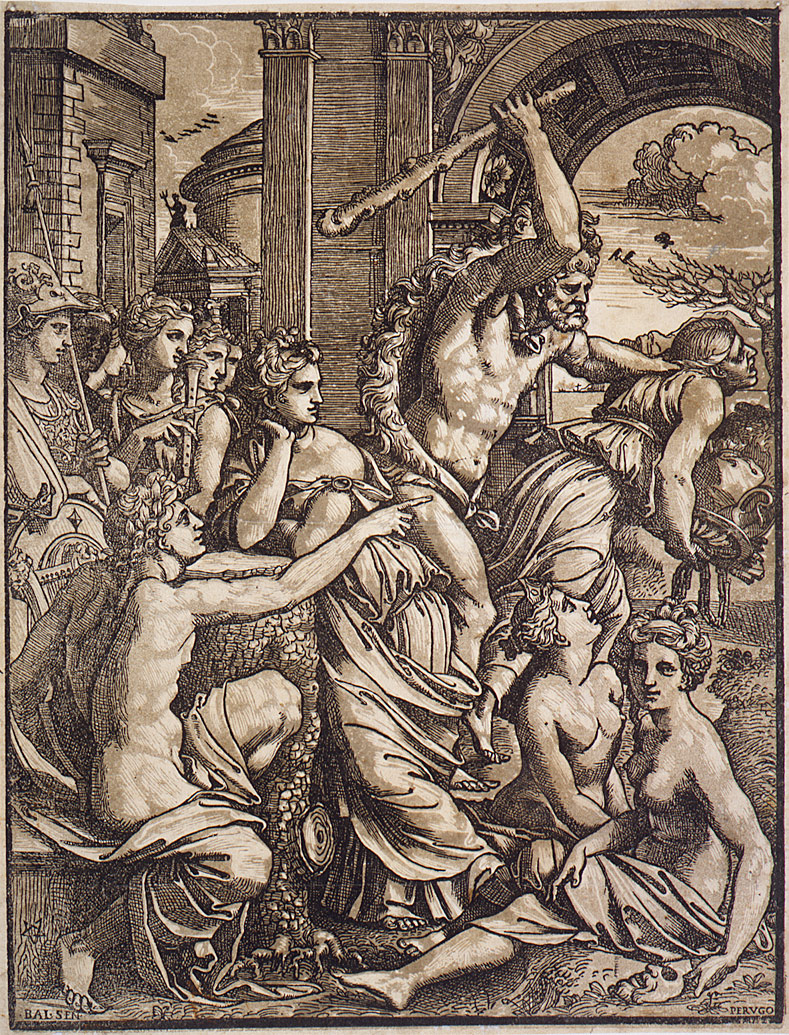
To learn more about this image, Hercules Chasing Avarice from the Temple of the Muses, go here.

The proximate causes of the current economic meltdown have to do with aggressive and malign mortgage lending practices which were used to generate mortgage bundles which were turned into securities and commoditized and leveraged as assets to borrow multiples of their amortized values to invest in who knows what else. Insurers insured and reinsurers reinsured these assets banking on the streams of income they promised. When the underlying assets began to lose value, that is to say when some of the mortgagees began to default, the whole teetering superstructure collapsed on itself. The 'stuckees' left holding the bag panicked and chaos ensued.

What does that mean? Let's put it in more concrete terms. Let's say you want to buy a house. You take out a 30-year mortgage from me (I'm a bank) for $300,000 at reasonable terms I think you can afford (assume my good faith for purposes of this example). Good. Now, I calculate the value of that mortgage over those 30 years—let's say it's $1 million, to keep it at round figures: that is, principle plus interest. Assume I have 1000 identical mortgages. According to my math, I now have $1 billion in assets—even though you and your fellows will only be paying me a few hundred dollars each each month. There is, of course, a lot of risk in this assumption, including people defaulting on their mortgage obligations to me, people paying down their mortgages early, etc. Ignore that for now.

Now, here's where the real magic comes in. I can do a number of things with $1 billion in these (sort-of) assets that you can't do with $1000 in real assets. I can sell them to a bundler for an agreed-upon price (it will be higher, in a rational world, for mortgages that have little risk of default and lower for riskier such assets). The bundler can slice them up into 'tranches' and sell security interests in the underlying payment streams. If the bundler (or purchaser of slices of mortgage bundles) is a hedge fund, it can borrow against them (up to an Enron-like 27-to-1 ratio) and invest the proceeds. The idea is that you can make greater returns on $27 billion than on $1 billion, especially if your return on assets is greater than the interest you're paying on the $27 billion. But remember, this is all leveraged on the back of only 1000 x $300,000 mortgages. Pretty soon, we're talking real money. And, even though they're supposed to be asset-backed, nobody can really tie any specific aspect of those $27 billion in investments to grandma's $300,000 condo in Fort Myers.

As in all things, Murphy's Law applies: Things can go wrong at any point in this process. Some examples: you lose a job, you are not qualified for a $300,000 mortgage, a mortgage broker falsifies/spins your qualifications, you repay early, you default, you take out a second mortgage on any equity you've accumulated (beginning a second line of leveraging), prices on real estate in your neighborhood/city/state/country/world tank because of foreclosures or souring economic times or whatever, you are otherwise "underwater" on your mortgage (i.e., your home is now worth less than the mortage(s) you've taken out on it), my investment returns don't exceed my interest rate, the hedge fund goes short on some investments and gets the equivalent of a 'margin call' on its leveraged debt, etc., etc.

This is a rough, general outline of the narrative of the origins of the current economic crisis. Some of the particulars may be off a bit; I'm not an economist. Top-heavy debt. Leverage. Uncertainty. These are real. And it doesn't take long before the whole thing comes crashing down, and not necessarily for rational reasons.

But to look no further than these let's call them 'symptoms' is to miss the underlying malaise, which is a philosophical if not spiritual one. Let me explain.

The incentives to borrow, to leverage are built in to the system. Capitalism, as practiced in the U.S. lo these many years, is aspirational. Its laissez-faire attitude toward the accumulation of wealth in the private sector is, of course, one of its hallmarks. As is its inbred antipathy toward the public-sector, in general.

Current laws and corporate practices tend to favor managers over shareholders, not to mention other interested parties. This has been a huge recent trend. Shareholders delegate/relinquish control of corporations to management: that's the definition of the corporate structure. It seems this is a fatal flaw.

In the current climate, it is the shareholders who are suffering as managers have driven their corporate assets into the ground—particularly in the financial sector which is the locus of the crisis we're in: banks are either going under or their share values are down over 90%. And, of course, the CEOs and other managers have been making out like bandits as they reap huge salaries and bonuses and share options whether or not they perform (i.e., create shareholder value). The difference between executive pay and average labor wages has increased radically over the last decade.

They have been managing their companies the way the Bush administration ran the country: their own interest in retaining power has taken precedence over the shareholders' interest in the well-being of their company. They didn't care whether they bankrupted the company/country, so long as they benefited in the short run.

There are a number of stakeholders in any given company: (a) the owners: shareholders; (b) the creditors: bondholders; (c) the managers: management; (d) the customers: purchasers (down chain); (e) the suppliers: vendors (up chain); (f) labor: the employees; as well as (g) any number of indirect beneficiaries: the local community of landowners, schools, churches, local governments, and suppliers of goods & services to local employees. There are more. To manage a company as if only the management's retention of its jobs and power is to neglect the interests of the rest of these stakeholders. This is a big problem.

As a political corollary, to manage a country as if the primary interest of the administration was to maintain its own power is to neglect a far-greater constituency of stakeholders in the country's well-being. I'll not enumerate them here, but it's pretty much everybody. And, though clearly analogous and key to any serious look at what has happened to our country over the past eight years, that is a political discussion for another day.

We have become less an "ownership society" than a "management society" where management means, essentially, to handle things. To supervise or run things. To control the situation, or at least appear to be in control. To achieve short-term profit, or the appearance thereof. To work around. To lurch from crisis to crisis or kick the can down the road. So much management today is simply PR, and that mostly self-serving. One even thinks of the locution of doctors "managing" an incurable disease: it only applies when they are incapable of curing it. The focus is all wrong for a viable company/country.

Management is not the same thing as problem solving. Problem solving means identifying problems, determining the underlying issues, and resolving them. This is not the same thing as controlling the situation, or the perception of the situation. True, one must have some form of control before solving something, but corporate America tends to reward more those who control the perception of things than those who actually roll up their sleeves and try to solve problems. PR triumphs.

Bush/Cheney/Rumsfeld et al. touted themselves as the CEO presidency. They were consummate managers. Bush had a solid track record of managing businesses (Arbusto Energy, Harken Energy) into the ground (that in itself should have alerted us to something), only to be bailed out at the last moment by rich friends of his father, including Osama bin Laden's brother. That they managed the country into the current situation should not be surprising, especially as they used their power to de-regulate and slacken enforcement of the laws and regulations put in place to protect stakeholders in the country's well-being other than the management/capitalist class. In fact, it was entirely predictable.

I wonder, too, if anyone's done a study of how many billions of dollars they spent on PR alone. We know they paid newspaper columnists and fiddled with the rules about on-shore military propagandizing and kept Hill & Knowlton-types on retainer. Not to mention Karl Rove. They set out to make the country in their own image. And it is now bankrupt.

It is my hope we've elected a problem solver as President. A true problem solver is unafraid of negotiation and input from others who share his interest (namely, solving the problems). In terms of company/country organizations, solutions from below are generally received as threats to the power of managers. It does not make them appear to be in control. For true problem solvers, the more input the better the available options.

Drat. I've veered off into politics again. And I didn't want to do that. But there is a philosophical point there. The Presidency inspires. If the president is a manager (as we've defined), then others will emulate. If the president is a problem solver, then, hopefully, problem solvers will rise.

This doesn't address the 'spiritual' crisis I mentioned. And by that I am not referring to any sort of religious notion. Stay with me here: Right after 9/11, President* Bush, in his initial response to the crisis, exhorted Americans to "go shopping." I remember at the time being stunned silly: 'WTF is he talking about?"

What that exhortation revealed was Bush's own true conception of the basis of American capitalism and, more to the point, his own deep-seated contempt for Americans. Americans are consumption machines. Buy, buy, buy. Acquire. Get. Spend, spend, spend. Have.

In Heidegger's terms, it was a case of having vs. being. Appearance vs. reality.

Over the ensuing years, everything the Bush administration did was geared to stoke this consumption engine. A supply-side economic philosophy requires mindless, infinite consumption for it to sustain. Lending and mortgage regulations were relaxed and interest rates kept low, and 'citizens' were encouraged to take on more or more debt for the purposes of consumption. Refinance so you can buy that car or take that vacation. Flip that house. The purpose of individual debt was not that of, say, the mortgage bundler or hedge fund, i.e., investment. No, the purpose of individual debt was consumption. And this is a spiritual malaise if it is the ground of your being. (see Paul Tillich—dang, there I go citing a theologian. I'll try to watch it.)

There's still a big economic problem. Here's a basic fact of life: assets depreciate, debt matures. Teach your children.

If you've ever done your own taxes or done bookkeeping for your business, you know this—whether it sank in or not. The stuff you buy loses its value. As soon as you sign the papers and drive that new car off the lot, it's resale values drops. But the money you borrowed to buy that car continues to grow as the interest matures. If you owe money, you pay interest until it is all paid down. The interest keeps growing, and sometimes it compounds.

Let me put it another way: very few of the things you buy increase in value. Almost all of them decrease. For example, several weeks ago I took my teenager to the local thrift shop. While she was looking around, I rummaged in the men's aisles and found a lovely, wool, tweed Brooks Brothers' sports jacket, unworn, with the tags still on it and the pockets uncut, for $20. The next time I was at the mall—my daughter is a product of her culture, sadly—I found the same jacket in BB new, on sale, for $300.

Asset values keep going down. And debt obligations keep going up. Diverging. Managers have seized control of the sources capital creation, and arrogated them to their own self-interest. Somewhere, somebody is holding a ship-load of IOUs and markers and is waiting to be paid. This is the big problem facing the country. Do I have a solution? Sadly, no.

Does Pres. Obama or Tim Geithner or Larry Summers? Who the heck knows.

But it seems to me the solution lies somewhere on the continuum of saving and investment, creativity and productivity (in problem solving), and public-spiritedness and not in the ethos of consumption, management, selfishness that have driven us into the hole/morass we find ourselves in now.

No wonder they call it the dismal science.