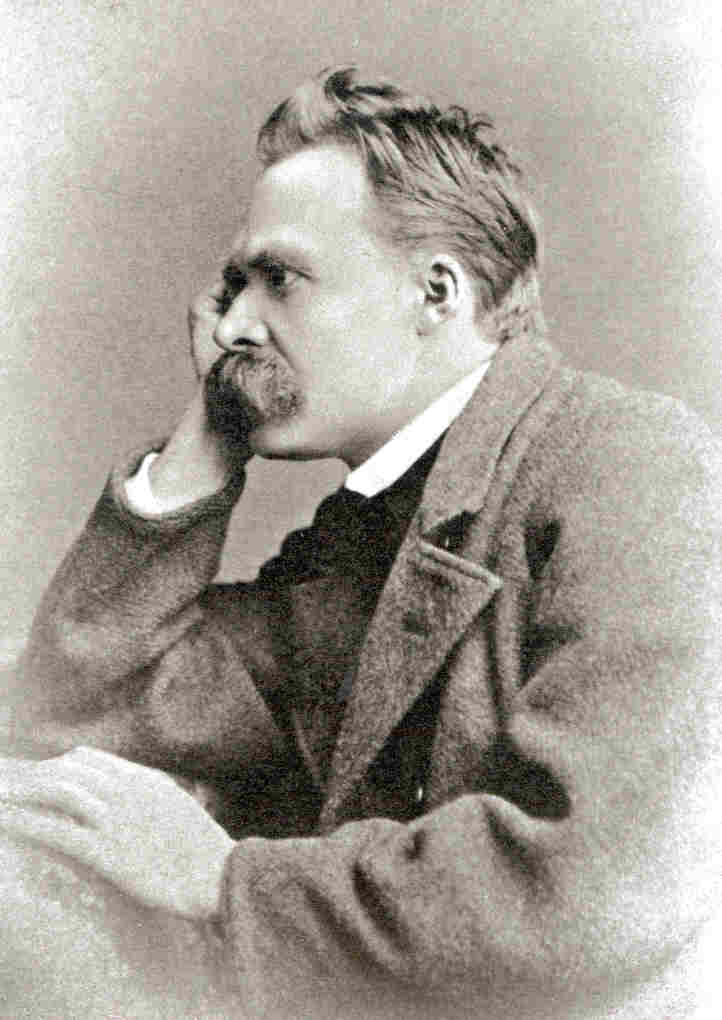
Friedrich Nietzsche was the first (at least to my knowledge) to philosophize about I want to call the "Post-Human" in his novel (if that's what you want to call it) Thus Spake Zarathustra.
Zarathustra was written and published between 1883 and 1885. Charles Darwin's The Origin of Species (1859) and Descent of Man (1871) were in wide currency in European intellectual circles prior to its conception. There is no conclusive evidence, however, as to whether Nietzsche read these revolutionary scientific treatises, but there should be little doubt he knew of their impact.
There is tremendous disagreement about how to translate Nietzsche's term Übermensch. Some translate it as Superman others as Overman or Uberman or Superhuman or Beyond-Man. And these translations have led many, including Nietzsche's sister, to misconceive the concept as something to be applied to Great Men or leaders or even comic book heroes.
It is clear from the Prologue to Zarathustra that Nietzsche had in mind an evolutionary concept. In §3 he has Zarathustra state: "Man is something that shall be overcome....Once you were apes, and even now, too, man is more ape than any ape." And then in §4: "Man is a rope, tied between beast and overman—a rope over an abyss." (Kaufman translation)
Humanity is a rung on an evolutionary ladder that leads from earlier branches on the simian limb of the tree of life to some unknown future form. Being is always Becoming. The foundation of existence is change. Nietzsche is asking us to think about where this change, this becoming, might lead. That is, what comes after humanity, i.e, the Post-Human. And this is the key to understanding the Nietzschean philosophy in Zarathustra.
Nietzsche's Zarathustra proclaims that God—as the traditional, central source of meaning, value, order, and morality in human life—is no longer a viable concept in the scientific age brought about by the Darwinian revolution. Humanity is thus doomed to nihilism—a meaningless, valueless, chaotic, amoral existence—absent an equally powerful new source of meaning. He finds this in the Post-Human.
All human life and activity should point to the Post-Human, should proclaim it, should make way for it, should strive to bring about this next evolutionary form of life—to the best of its limited knowledge and ability. That is the meaning of life for Zarathustra and thus for Nietzsche: Evolutionary Progress.
And though we cannot know what form this Post-Human, this New Being, might take, Nietzsche has Zarathustra speculate on some of the Post-Human's characteristics.
The Post-Human will bring its own meaning to life through an act of will. The Post-Human is the one who not only recognizes but joyfully accepts and even wills that his/her/its life should repeat itself just as it has unfurled/as it is/as it will happen over and over infinitely. This is the action of the self-aware, self-critical soul existing in an Eternal Present. It is Amor fati. It is an acceptance of the conditions of existence—the physical body and the real world, not a pining for some afterlife.
We might even say that it is the Post-Human willing itself into being that gives meaning and purpose to our own collective existence.
The Post-Human, Zarathustra speculates, will laugh in derision at the poor, pitiable state of our transitional humanity and will dance in a childlike celebration of his/her/its embrace of, nay, its creation of the fate that brought it into being.
Showing posts with label Nietzsche. Show all posts
Showing posts with label Nietzsche. Show all posts
08 June 2020


16 May 2008
The Swarm

[This is a continuation of the series of blogposts on Swarms. Of course, what prompted this sequence was the set of posts on recent natural disasters beginning here and the initial sense of a unified outpouring of sympathy.]
We've seen what it's like to be caught up in a disorienting swarm of other animals and wondered what force united these fish, insects, birds, bats, etc. We've speculated that, in human beings, it is akin to such primitive emotions as fear, hate, etc. Nathanael West has shown us what it's like to be a part of a swarm of our fellow humans: the helplessness of being caught up in something that is greater than ourselves, the vain struggle to extricate and differentiate one's self from the swirling chaos, the heedlessness of the crowd to the individual's pain, the amorality and disinhibition of those who are caught up in an anonymous herd, the grasping for comfort in memory and art to help explain what's happening to us. West even suggests some causes of this sort of swarm behavior, pulling in everything from movie star hype to moral outrage. It is too easy to lose one's self in the swarm, to let go the lonely struggle to set one's self apart—dare we say it, to transcend.
Others have observed and commented on this phenomenon in various contexts:
"there needs protection also against the tyranny of the prevailing opinion and feeling; against the tendency of society to impose, by other means than civil penalties, its own ideas and practices as rules of conduct on those who dissent from them; to fetter the development, and if possible, prevent the formation, of any individuality not in harmony with its ways, and compel all characters to fashion themselves upon the model of its own." J.S. Mill, On Liberty Ch. 1.
"Inasmuch as at all times, as long as there have been human beings, there have also been herds of men (clans, communites, tribes, peoples, states, churches) and always a great many people who obeyed, compared with the small number of those commanding—considering, then, that nothing has been exercised and cultivated better and longer among men so far than obedience—it may fairly be assumed that the need for it is now innate in the average man, as a kind of formal conscience that commands: 'thou shalt unconditionally do something, unconditionally not do something else,' in short, 'thou shalt.' ... In the last analysis, 'love of the neighbor' is always something secondary, partly conventional and arbitrary—illusory in relation to fear of the neighbor. ... The highest and strongest drives, when they break out passionately and drive the individual far above the average and the flats of the herd conscience, wreck the self-confidence of the community, its faith in itself, and it is as if its spine snapped. Hence just these drives are branded and slandered most. High and independent spirituality, the will to stand alone, even a powerful reason are experienced as dangers; everything that elevates an individual above the herd and intimidates the neighbor is henceforth called evil; and the fair, modest, submissive, conforming mentality, the mediocrity of desires attains moral designations and honors." F. Nietzsche, Beyond Good and Evil Secs. 199, 201.
"Differences only arise through individuation ... The unconscious consists, among other things, of remnants of the undifferentiated archaic psyche, including its animal stages. The reactions and products of the animal psyche have a uniformity and constancy of which we seem able to discover only sporadic traces in man. Man seems to us far more individual than the animals. This may perhaps be a delusion, since we have in us a convenient tendency to discern differences mainly in the things which interest us. ..." C.G. Jung, Symbols of Transformation p. 176.
"the facts of man's collective life easily rob the average individual of confidence in the human enterprise. The inevitable hypocrisy, which is associated with all of the collective activities of the human race, springs chiefly from this source: that individuals have a moral code which makes the actions of collective man an outrage to their conscience. They therefore invent romantic and moral interpretations of the real facts, preferring to obscure rather than reveal the true character of their collective behavior. Sometimes they are as anxious to offer moral justifications for the brutalities from which they suffer as for those which they commit. The fact that the hypocrisy of man's group behavior ... expresses itself not only in terms of self-justification but in terms of moral justification of human behavior in general, symbolises one of the tragedies of the human spirit: Its inability to conform its collective life to its individual ideals. As individuals, men believe that they ought to love and serve each other and establish justice between each other. As racial, economic and national groups they take for themselves, whatever their power can command." Reinhold Niebuhr, Moral Man and Immoral Society pp. 8-9.
"Freud tried to approach crowd phenomena from the point of view of the unconscious, but he did not see clearly, he did not see that the unconscious itself was fundamentally a crowd. ... Elias Canetti distinguished between two types of multiplicity that are sometimes opposed but at other times interpenetrate: mass ('crowd') multiplicities and pack multiplicities. Among the characteristics of a mass, in Canetti's sense, we should not large quantity, divisibility and equality ofthe members, concentration, sociability of the aggregate as a whole, one-way hierarchy, organization of territoriality or territorialization, and emission of signs. Among the characteristics of a pack are small or restricted numbers, dispersion, nondecomposable variable distances, qualitative metamorphoses, inequalities as remainders or crossings, impossibility of a fixed totalization or hierarchization, a Brownian variability in directions, lines of deterritorialization, and projection of particles. Doubtless, there is no more equality or any less hierarchy in packs than in masses, but they are of a different kind. The leader of the pack or the band plays move by move, must wager everything every hand, whereas the group or mass leader consolidates or capitalizes on past gains. The pack, even on its own turf, is constituted by a line of flight or of deterritorialization that is a component part of it, and to which it accredits a high positive value, whereas masses only integrate these lines in order to segment them, obstruct them, ascribe them a negative sign. Canetti notes that in a pack each member is alone even in the company of others (for example, wolves on the hunt; each takes care of himself at the same time as participating in the band). 'In the changing constellation of the pack, in its dances and expeditions, he will again and again find himself at its edge. He may be in the center, and then, immediately afterwards, at the edge again; at the edge and then back in the center. When the pack forms a ring around the fire, each man will have neighbors to the right and left, but no one behind him; his back is naked and exposed to the wilderness.'" Deleuze and Guattari, A Thousand Plateaus pp. 29, 33-34.
"Baudelaire had the true intuition of number as a tactile hand or nervous system for interrelating separate units, when he said that 'number is within the individual. Intoxication is a number.' That explains why 'the pleasure of being in a crowd is a mysterious expression of delight in the multiplication of number.' Number, that is to say, is not only auditory and resonant, like the spoken word, but originates in the sense of touch, of which it is an extension. The statistical aggregation or crowding of numbers yields the current cave-drawings or finger-paintings of the statisticians' charts. In every sense the amassing of numbers statistically gives man a new influx of primitive intuition and magically subconscious awareness, whether of public taste or feeling: 'You feel better satisfied when you use well-known brands.'" Marshall McLuhan, Understanding Media p. 107.[More to follow]
04 May 2008
Facets: Ways of looking at fiction

[D]iscursive language, say in novel writing, is artistically identified as description, which is what enables fiction to be convincing: we acquiesce in the fiction that we are being given facts. So that the difference between factual and fictive description is not that the former is true and the latter false—for something may after all be meant as factual and be false without thereby being elevated to the status of fiction, and fictional prose may in literal fact be true—but in the fact that the former is artistically identified as description and the latter literally identified as that. Arthur Danto, The Transfiguration of the Commonplace p. 127-----
...the drive is curiosity and the aim enlightenment. Use of symbols beyond immediate need is for the sake of understanding, not practice; what compels is the urge to konw, what delights is discovery, and communication is secondary to the apprehension and formulation of what is to be communicated....Symbolization, then, is to be judged fundamentally by how well it serves the cognitive purpose: by the delicacy of its discriminations and the aptness of its allusions; by the way it works in grasping, exploring, and informing the world; by how it analyzes, sorts, orders, and organizes; by how it participates in the making, manipulation, retention, and transformation of knowledge....Not only do we discover the world through our symbols but we understand and reappraise our symbols progressively in the light of our growing experience. ...-----
The difference between art and science is not that between feeling and fact, intuition and inference, delight and deliberation, synthesis and analysis, sensation and cerebration, concreteness and abstraction, passion and action, mediacy and immediacy, or truth and beauty, but rather a difference in domination of certain specific characteristics of symbols. Nelson Goodman, Languages of Art pp. 258, 260, 264
The language of fiction functions in two ways, therefore. In one, used appropriately, the sentences of a fiction "body forth" a particular imaginary world—producing Jehoshaphat [from Lagerkvist's, The Dwarf], who is referred to, as well as the dwarf, who makes reference to him; in another, the "voice" of the dwarf, collapsed into the "voice" of the fiction (since the story is told in the first person), is imagined to refer to Jehoshaphat. Hence, the referring use of language occurs in fiction only insofar as the world of the fiction is already assumed to exist; but it is then, precisely, that the distinction between fiction and reality is no longer critical. Joseph Margolis, Art & Philosophy-----
How then to posit the value of a text? How establish a basic typology of texts? The primary evaluation of all texts can come neither from science, for science does not evaluate, nor from ideology, for the ideological value of a text (moral, aesthetic, political, alethiological) is a value of representation, not of production (ideology "reflects," it does not do work). Our evaluation can be linked only to a practice, and this practice is that of writing....the goal of literary work (of literature as work) is to make the reader no longer a consumer, but a producer of the text. Roland Barthes, S/Z pp. 3-4-----
[T]he philosophical analysis of fiction has scarcely taken its first steps, Philosophers continue to interpret novels as if they were philosophies themselves, platforms to speak from, middens from which may be scratched important messages for mankind; they have predictably looked for content, not form; they have regarded fictions as ways of viewing reality and not as additions to it. There are many ways of refusing experience. This is one of them.-----
So little is known of the power of the gods in the worlds of fiction, or of the form of cause, or of the nature of soul, or of the influence of evil, or of the essence of good. No distinction is presently made between laws and rules of inference and conventions of embodiment, or their kinds. The role of chance or of assumption, the recreative power of the skillful reader, the mastery of the sense of internal life, the forms of space and time: how much is known of these? ... No search is made for first principles, none for rules, and infact all capacity for thought in the face of fiction is so regularly abandoned as to reduce it to another form of passive and mechanical amusement. The novelist has, by this ineptitude, been driven out of healthy contact with his audience, and the supreme values of fiction sentimentalized. William Gass, "Philosophy and the Form of Fiction," in Fiction and the Figures of Life, pp. 25-26
In the novel, the voice that speaks the first sentence, then the second, and so onward—call it the voice of the narrator—has, to begin with, no authority at all. Authority must be earned; on the novelist author lies the onus to build up, out of nothing, such authority. J.M. Coetzee, "On Authority in Fiction," Diary of a Bad Year p. 149-----
Literature is invention. Fiction is fiction. To call a story a true story is an insult to both art and truth. Every great writer is a great deceiver...There are three points of view from which a writer can be considered: he may be considered as a storyteller, as a teacher, and as an enchanter. A major writer combines these three—storyteller, teacher, enchanter—but it is the enchanter in him that predominates and makes him a major writer....-----
It seems to me that a good formula to test the quality of a novel is, in the long run, a merging of the precision of poetry and the intuition of science. In order to bask in that magic a wise reader reads the book of genius not with his heart, not so much with his brain, but with his spine. It is there that occurs the telltale tingle even though we must keep a little aloof, a little detached when reading. Then with a pleasure which is both sensual and intellectual we shall watch the artist build his castle of cards and watch the castle of cards become a castle of beautiful steel and glass. Vladimir Nabokov, "Good Readers and Good Writers," in Lectures on Literature pp. 5-6.
"Thinking, analyzing, inventing (he also wrote me) are not anomalous acts; they are the normal respiration of the intelligence. To glorify the occasional performance of that function, to hoard ancient and alien thoughts, to recall with incredulous stupor that the doctor universalis thought, is to confess our laziness or our barbarity. Every man should be capable of all ideas and I understand that in the future this will be the case." Jorge Luis Borges, "Pierre Menard, Author of the Quixote"-----
Of all that is written I love only what a man has written with his blood. Write with blood, and you will experience that blood is spirit. F. Nietzsche, Thus Spoke Zarathustra: First Part.
10 January 2008
Subscribe to:
Comments (Atom)