Nicholson Baker's first novel,
The Mezzanine, made quite a splash when it was published in 1986. I had neither the time nor the inclination to read it at the time, and the paperback edition has sat unread on my shelves for twenty years.
I'm not sure what my reaction to it would have been lo these many years ago, being at the time an office drone much like Howie, the POV character. My response to it now is mixed.
Let me preface this by saying that my problem with cultural references in the writing of my writer friends is usually one of dismay. Now, I'm a bit of factoid junkie and can identify an allusion or in-joke or cult reference with the best of them. Yet, cultural trivia tend to date novels. If we read that one character's favorite song is 'Girlfriend in a Coma' or that another goes home every night to tend to her pet rock, we get a sense of when those characters lived (late '80s and mid-'70s, respectively). The song and the trend are artifacts of their periods, just as broadswords and armor are of medieval crusades. If we do our cultural archaeology, we might even glean some bits of meaning or, importantly, characterization from the writer's use of these items (say, fey insouciance in the first instance and lonely, mindless trend-following in the second), if the writer is being 'intentional' (the very use of that word is itself a cultural reference to an intellectual fad, or trend, of the mid-'80s, as well).
Mezzanine is now nothing but an artifact. The mindless, chick-lit, prep-school and shopping and fashion novels of the early part of this century are, if anything, intentionally (there's that word again) 'artifactual': fashionable, brand-conscious, trend-setting, marketing tools to and for a hyper-consumerist, pre-teen through twenties-ish set of middle class girls (yes, girls and not young women). They practically come with a 'Use By' date stamped on them. Of course, they, too, will someday be relics to be studied by cultural anthropologists to try to understand something about the current American (and British) commodity capitalism culture. But, they are at least aware of their datedness.
Mezzanine, I feel, isn't. Still, in this respect, they are the heirs of Baker's novel.
Baker's book is dated. For example, there are, notwithstanding the writer's excruciating attention to detail, no desktop computers. Staplers and date-stamp machines are antiquated. There's even a cigarette vending machine by the bathroom.
More problematic is the overwhelming, absurd amount of detail Baker brings in. There is no selection, no judicious use of detail to color or characterize or advance the plot or set the scene. Baker describes things promiscuously and to obscene detail. It's as if he is trying to describe everything that happens and that goes through the narrator's mind in the span of the time it takes Howie to ride an escalator from the ground floor of his office building to the mezzanine where he works. That's not to say he doesn't describe things well. To the contrary, he is a marvelous writer of descriptive prose. Someday, an anthropologist or cultural archaeologist might pick up this book and actually get a sense of what went on in an average, urban white-collar worker's head one fine, summer day in the 1980s.
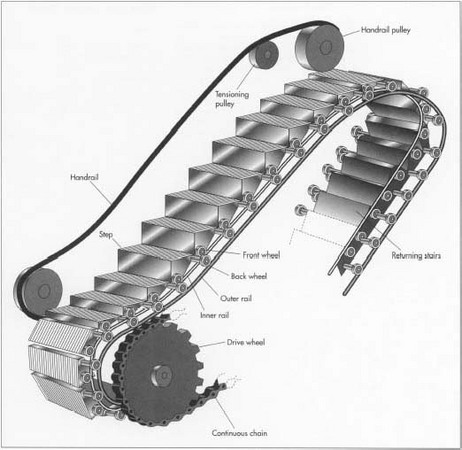
Here's the story, such as it is: Howie has broken a shoelace, his second in two days. This is wondrous, and pages and pages of verbiage are spent remarking this fact and attempting to theorize the forces at play in bringing about this coincidence. He sets out at lunch to go to the CVS and buy a new pair. In the meantime, he marvels over the workings of escalators, the polishing of the handrails thereof, staplers and date-stampers, paper towel dispensers in men's restrooms, the flushing of toilets, the modern drug store, the arrangements of bricks in a courtyard, the modern wonder that is perforated paper, and on and on. Words that come to mind: quotidian, jejune, even boring. Yawn.

The novel is essentially shapeless. As in a
Seinfeld episode (again, a cultural artifact), nothing happens. A faceless office worker goes out to a drug store at lunch to purchase a new pair of shoe laces and returns to his office on the mezzanine of a corporate office building up an
escalator, hoping to get to the top before anyone else jumps on either the up or down side. The character is smothered in the excessive details of a few brief moments—and, perhaps, that is the point; but that's a stretch, and I'm not feeling generous. There is no tension, no conflict, no real obstacles. Towards the end of the book, Howie, having finished his hot dog and his cookie and half his carton of milk (yes, he spent several pages describing it) and not read anything in the Penguin paperback of Marcus Aurelius's
Meditations he's been carrying around, synopsizes the book:
"'Manifestly,' I repeated, as if scolding myself, 'no condition of life could be so well adapted for the practice of philosophy as this in which chance finds you today!' Chance found me that day having worked for a living all morning, broken a shoelace, chatted with Tina, urinated successfully in a corporate setting, washed my face, eaten half of a bag of popcorn, bought a new set of shoelaces, eaten a hot dog and a cookie with some milk; and chance found me now sitting in the sun on a green bench, with a paperback on my lap. What, philosophically, was I supposed to do with that?" (p. 123)
Oh, and there're footnotes. Loads of 'em.
James Wood opens his first book,
The Broken Estate, as follows:
"The real is the atlas of fiction, over which all novelists thirst. The real is contour, aspiration, tyrant. The novel covers reality, runs away with it, and, as travelers yearn to escape, runs from it, too. It is impossible to discuss the power of the novel without discussing the reality that fiction so powerfully discloses, which is why realism, in one form or another and often under different names, has been the novel’s insistent preoccupation from the beginning of the form."
In my last post, I mentioned a type of 'the world is too much with us' realism, what Wood later calls "hysterical realism." If you like that sort of thing, this book is the mother lode. Perhaps an Ur-text.
Reading the book, I was put in mind of a passage from another book published some half-century earlier in another country. I had no idea at the time why the association leaped to mind, but I chased it down and re0read it. It goes like this:
"So I was in the park just now. The roots of the chestnut tree were sunk in the ground just under my bench. I couldn't remember it was a root any more. The words had vanished and with them the significance of things, their methods of use, and the feeble point of reference which men have traced on their surface. I was sitting, stooping forward, head bowed, alone in front of this black, knotty mass, entirely beastly, which frightened me. Then I had this vision.
It left me breathless. Never, until these last few days, had I understood the meaning of 'existence.' I was like the others, like the ones walking along the seashore, all dressed in their spring finery. I said, like them, 'The ocean is green; that white speck up there is a seagull,' but I didn't feel that it existed or that the seagull was an 'existing seagull'; usually existence hides itself. It is there, around us, in us, it is us, you can't say two words without mentioning it, but you can never touch it. When I believed I was thinking about it, I must believe that I was thinking nothing, my head was empty, or there was just one word in my head, the word 'to be.' Or else I was thinking ... how can I explain it? I was thinking of belonging, I was telling myself that the sea belonged to the class of green objects, or that the green was a part of the quality of the sea. Even when I looked at things, I was miles from dreaming that they existed: they looked like scenery to me. I picked them up in my hands, they served me as tools, I foresaw their resistance. But that all happened on the surface. If anyone had asked me what existence was, I would have answered, in good faith, that it was nothing, simply an empty form which was added to external things without changing anything in their nature. And then all of a sudden, there it was, clear as day: existence had suddenly unveiled itself. It had lost the harmless look of an abstract category: it was the very paste of things, this root was kneaded into existence. Or rather the root, the park gates, the bench, the sparse grass, all that had had vanished: the diversity of things, their individuality, were only an appearance, a veneer. This veneer had melted, leaving soft, monstrous masses, all in disorder—naked, in a frightful, obscene nakedness." [Sartre, J.-P., Nausea p. 126-27]
After I re-read this passage, I knew why it had presented itself unbidden to my mind: this is precisely the sort of thing the Baker novel lacks: insight. Roquentin is sufficiently self-aware to know he has what he calls Nausea. The press of things is overwhelming, revulsive. But he accepts it. Howie, on the other hand, just doesn't get it.
Howie is essentially passive, neutral toward all the things that impinge on his life and his consciousness. His attitude is one of subservience. He is held captive by reality, the press of things, and suffers from some cognate of
Stockholm Syndrome; he actually seems to like things the way they are. He certainly never questions things. Though, much to his credit, at one point, he actually wonders how long such a materialistic civilization can sustain itself.
Howie is locked inside a vapid subjectivity and cannot see the way out, the connection Roquentin makes. He himself is colorless, truly characterless. This book is the tale of the loneliness of a solitary consciousness. It represents an almost willful refusal of what I have called the
Ur-story: the coming to consciousness of one's own mortality and the subsequent sense of loss of the self amongst the things of the world. Howie is unself-conscious, adrift on a vast sea of materiality. Lost. And, perhaps, that is his true tragedy, though Baker isn't saying.

 This is not Jim H. sliding down a waterfall in Gorges State Park in Western N.C. this weekend.