Is there any such thing? Let's investigate—for good or ill. A blog about fiction and literature, philosophy and theology, politics and law, science and culture, the environment and economics, and ethics and language, and any thing else that strikes our fancy. (Apologies to Bertrand Russell)
Last year I indulged in a longish (15-part serial post), sustained personal essay about confronting my fear of heights by attempting to skydive with my daughter on her 18th birthday: Thyraphobia, or Purity of Heart is to Fear One Supposedly Fun Thing I'll Never Not Do Again. It was a self-discovery piece that ranged widely over a number of concerns, chiefly the power of the emotion of fear. Upon rereading it, it seemed to hang together fairly well, so I had been considering shortening/editing it and submitting it for publication. But there was a missing piece. Maybe this is the answer I was looking for all along: "How to Fall 35,000 Feet and Survive" in the current issue of Popular Mechanics.
"You're six miles up, alone and falling without a parachute. Though the odds are long, a small number of people have found themselves in similar situations—and lived to tell the tale. Here's PM's 120-mph, 35,000-ft, 3-minutes-to-impact survival guide."
It has happened—I had read about such things—but it's not something one can count on. Still, there's always hope. It's a human thing, don'tcha'know.
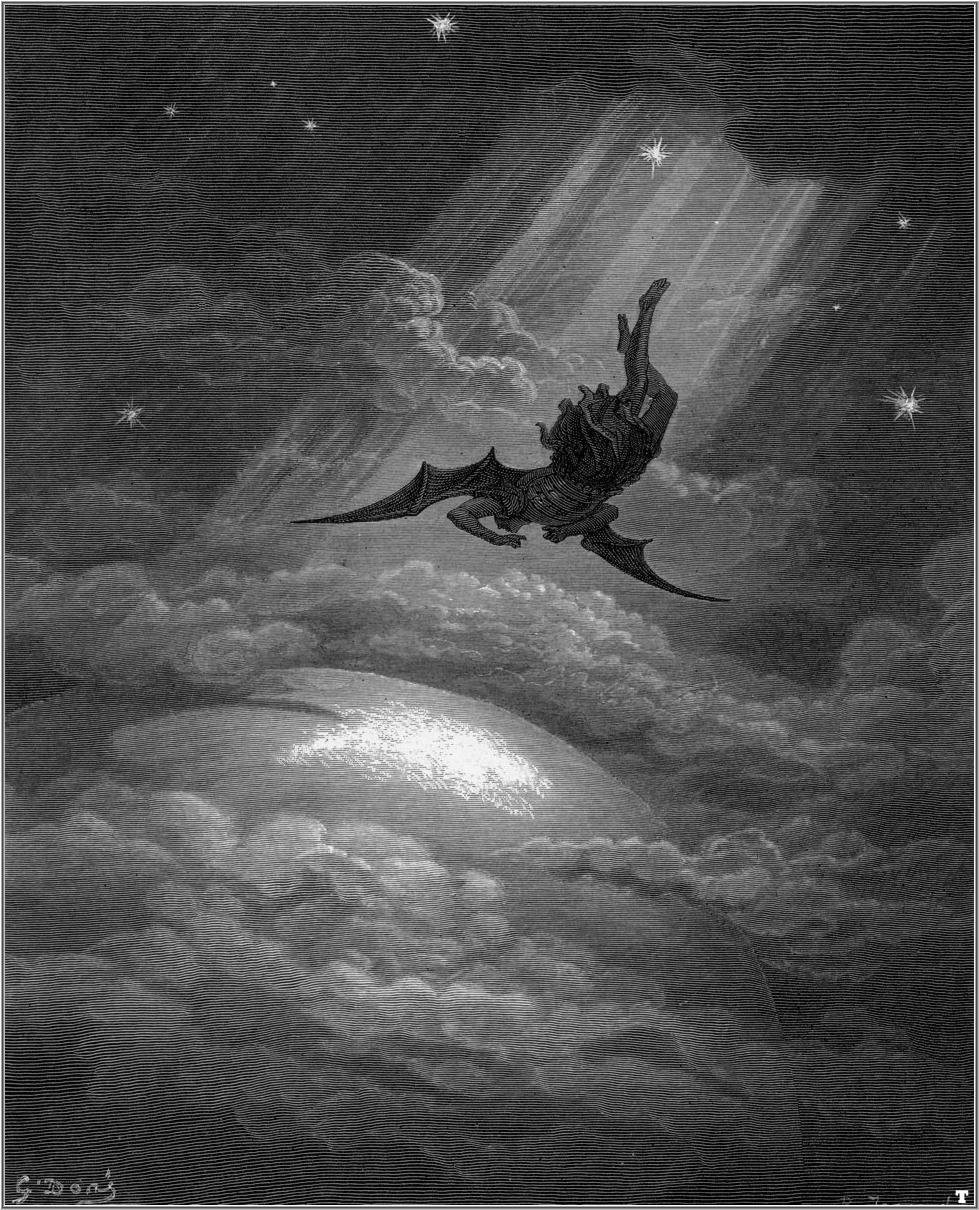
"'To be born again,' sang Gibreel Farishta tumbling from the heavens, 'first you have to die. Ho ji! Ho ji! To land upon the bosomy earth, first one needs to fly. Tat-taa! Taka-thun! How to ever smile again, if first you won't cry? How to win the darling's love, mister, without a sigh? Baba, if you want to get born again...' Just before dawn one winter's morning, New Year's Day or thereabouts, two real, full-grown, living men fell from a great height, twenty-nine thousand and two feet, towards the English Channel, without benefit of parachutes or wings, out of a clear sky.
'I tell you, you must die, I tell you, I tell you,' and thusly and so beneath a moon of alabaster until a loud cry crossed the night, 'To the devil with your tunes,' the words hanging crystalline in the iced white night, 'in the movies you only mimed to playback singers, so spare me these infernal noises now.'
Gibreel, the tuneless soloist, had been cavorting in moonlight as he sang his impromptu gazal, swimming in air, butterfly-stroke, breast-stroke, bunching himself into a ball, spreadeagling himself against the almost-infinity of the almost-dawn, adopting heraldic postures, rampant, couchant, pitting levity against gravity. Now he rolled happily towards the sardonic voice. 'Ohe, Salad baba, it's you, too good. What-ho, old Chumch.' At which the other, a fastidious shadow falling headfirst in a grey suit with all the jacket buttons done up, arms by his sides, taking for granted the improbability of the bowler hat on his head, pulled a nickname-hater's face. 'Hey, Spoono,' Gibreel yelled, eliciting a second inverted wince, 'Proper London, bhai! Here we come! Those bastards down there won't know what hit them. Meteor or lightning or vengeance of God. Out of thin air, baby. Dharrraaammm! Wham, na? What an entrance, yaar. I swear: splat." S. Rushdie, The Satanic Verses p.1
This serial post has gotten way out of hand. This is the fifteenth post under this title. Other matters have been put aside or shelved. My blog socializing has diminished while I've been drafting it. More to the point, my thoughts have been meandering seemingly aimlessly into matters far afield of my own experience that afternoon last summer when I failed to talk myself into jumping out of an airplane. It's time now to wrap things up.
Thanks to all who've had the patience to read over or through this seemingly endless series. And, especially, thanks to someone I don't know personally (hell, I don't even know his name), but whom I consider a blog-friend, BlckDgRd, who has faithfully linked, if I'm not mistaken, to every single one of these posts. Go read his blog. Go on, do it now. Then come back. I'm not going anywhere. But, yeah, read his blog every day (except maybe those days when he rants about DC United. Heh!)
This, then, will be my last post on this topic, under this title.
-----------------------
Resolved: I will never be a soldier, much less a good one. I knew this back when they threatened to draft me to fight in the police action in Southeast Asia where I knew I would surely die. The fear is too great in me. But, so is its flipside: my love of life and self.
One's life is the most important thing one has. It is, really, all one has: everything. A great and marvelous gift. Once it is gone, self, identity, and consciousness of the world vanish. Life is not something to be given up lightly or surrendered—especially under false or illusory pretenses.
Once you get beyond the ritual and dogma and supernatural claims, there is a great and wise truth at the base of Christianity, and it stems from the story of the life and death of Jesus. One verse (and I don't want to be taken for a proof-texting, verse-quoting preacher here) captures this thought: There is no greater love than that a man should give up his own life for the sake of his friends. That point is stated outright in the Gospel of John 15:13. Theological scholars, i.e., the Jesus Seminar, do not necessarily believe this was an actual saying of Jesus primarily because it comes in a passage in which Jesus calls for loyalty to himself. It has Jesus predicting what will happen to him after he and his unruly friends trash the main temple in Jerusalem during Passover: he will step up and take the rap for his gang of rowdies so they can live to fight another day in their quest to bring about the end of time. It may, in substance, have been a true teaching of Jesus, but, in all likelihood, the saying itself was a later ascription to him by the community of believers. Already, here, they are using Jesus as a symbol around which to cement the bonds of aggrieved community, to manipulate the loyalty of a small, committed cadre. This, I've said, we are to be wary of.
Still, it does state a fundamental, yet all-too-forgotten (or -ignored) truth of Christianity: we ought to love one another. Sacrifice to make others' lives better, to make a better world here and now. The argument is, of course, who are these others—one's friends in the biblical language—and what constitutes a better world? That is for each person to decide.
The sentiment is this: love is a great and powerful emotion, greater than fear or hatred or shame or anger—the complex of emotions I've been examining in this series. It is the cement of human community [see here]. Factionalism and eternalism alike have been used to pervert that love, to demean it, and turn it into its opposites. Fellow-feeling (to borrow Scheler's term, see here) can be manipulated by playing on people's insecurities, by telling them who their friends are and what their vision of a better world should be.
Concretely: if I am invested with some sort of political or spiritual authority and have dreams of warfare (either offensive or defensive), to get you to do my warlike bidding and enlist you in my cause, I must first convince you of our natural affinity (family, community, nation, race, religion, etc.) and our mutual grievances against a common threat, stressing the goodness and rightness and love of our cause and the evilness and hate of our foe. To get you to be willing to sacrifice your own life in the service of this cause, I must break down your natural emotional defenses (to wit: fear and self-preservation) by demeaning you and your life. I accomplish this by appealing to your own existential situation of misery (it is caused by the devious threats of our enemy) and your natural emotion of shame (you are a fallen creature, weak, flawed, and unworthy). My cause, I assert, will ennoble your own life and, in the process, make things better for those about whom you care. Then I must cement your loyalty by promising you and convincing you that your faithfulness will surely result in some form of reward—physical (loot, booty, spoils, heroic acclaim, etc.) or spiritual (eternal life and favor in paradise).
That is the formula. They all use it; they always have, and they always will.
In dreams, Carl Jung asserts, doors represent opportunities for change and transformation. One should never refuse the opportunity to enter them, to grow, to deepen one's understanding of one's self and one's world—in dreams. In an airplane at 14,000 ft. listing to one side with an open door, something I've been calling thyraphobia prevented me from taking that chance. But that was in reality. It was not a dream.
Yet, by not going through that open door, I gained the opportunity to understand something about myself and my own limitations. I learned that I am not afraid of fear itself. I was ok with it at the time, even though it overtook me completely, even though it rocked my world. And, upon reflection (some may call it rationalization or justification), I'm still ok with it: fear is a defense, an emotion tied to self-preservation and love of life. It is nothing to be ashamed of, not a thing to hate in oneself. It is, in effect, the reason I am skeptical of power and deeply anti-authoritarian. It is the reason I am, by and large and for the most part, a pacifist.
I was not destroyed by my fear and shame. I did not seek to lash out at some foe, real or imagined. I owned my thyraphobia, claimed it as mine. As part of who I am.
It was a rational fear—though somewhat hypertrophied. It had a real-world stimulus. No one told me I had to fear this thing. No one broke down my resistances. If anything, this fear was resistance itself. And it arose out of a deeply rooted sense of self-preservation, if not self-love. Not, I emphasize, vanity. But a love of life, a love of the world, a love of the experience of its awe and majesty, its miracle and, yes, its ugliness and evil, its fear and shame. It was a direct expression of my will to survive, of my desire to experience as much of the world as I possibly can within the four score years the Fates have putatively allotted me. And yes, it was an expression of who I am—who any of us is at heart.
But it was also a holy fear. To live is to be afraid: everything we have and do, every accomplishment and affinity, every battle we fight, is an effort to stave off this fundamental truth. We erect barriers and buffers between us and this primordial shock of recognition at how small and insignificant we truly are in the face of an at-best neutral universe.
Not to fear life and reality is not to respect it. Fear and the complex of concomitant emotions that flow from it are not to be dealt with lightly. They are to be nurtured—for they are life itself.
That day, in that airplane some two miles above the surface of the earth, when it came my time to jump, I met the fear—pure and crystalline—at the heart of my very being, at the heart of all being, and I've made peace with it in all its power. And, as I said, I will never not jump again.
Standing waiting for a man to show
Wide eyed one eye fixed on the door...
You know it makes sense, don't even think about it
Life and death are just things you do when you're bored.
Say fear is a man's best friend;
You add it up it brings you down.
How were the men who hijacked and commandeered four commercial jetliners on 9/11/2001 able to conquer what I can only assume was their innate, very human immediate fear of heights and death, disregarding whatever love of life they might have had and aim the planes they were flying into buildings on the ground and certain death?
One conventional, somewhat simplistic answer making the rounds after the attacks of 9/11/2001 was that "they hate America." That may have been the case. Hatred is a strong emotion. Hatred of the 'other' is a species of misanthropy which, as I noted earlier, is a symptom of a deeper malady: distrust, fear. The 'other' is out to get me. If you are not with me, you are against me. Me against my brother, my brother and me against my family, my family against the clan, my clan against my tribe, my tribe against my race, my race against my nation, my nation against the world. Or something to that effect. But, it is too facile to ascribe such a simplistic emotion to people who put together such an involved plot that included their own destruction. An entire plot was hatched, plotted in minute detail, funded, and executed. It was an act of war, futile in many respects, but war nonetheless. Embattlement seems insufficient.
Many have pointed to the alleged reward of the martyrs as the motivating factor behind the pilots and their accomplices: 72 full-breasted, black-eyed virgins and lots of wine and a place in paradise. The carrot to the stick. It supplies a spiritual motive, of sorts, to their actions. But this somewhat caricatured version ascribes base, sexual motives to the pilots' spirituality. There is some dispute as to the precise translation of the boons of the Islamic paradise of the martyrs. But it bears noting that imputing the motive of sexual and sensual pleasure to the terrorists' religiosity effectively serves to demean them in Puritanical, Protestant American eyes.
Translation issues aside, this view that suicide bombers and terrorists are motivated by dreams of some sort of paradise seems to have some grounding in fact. It is not unprecedented in the Western Christian tradition: consider the promises to the early Crusaders that death in the struggle to liberate the Holy Land from Saracens would bring remission of their sins and admittance to heaven.
Clearly, though, paradise is meant to be a better place. Better than what? we might ask. Better than this place. Better than this life.
They are led to disdain this world and the things of this world which, presumably, includes themselves. Ashamed of their lot in life, ashamed of themselves, blame must be laid. And America looms large as a convenient target for their hatred—and fear.
Overcoming this fallen world, overcoming the shameful self, is the first step to conquering the instinct of self-preservation. Why preserve what you have been convinced you should be ashamed of? Why fear the loss of this fallen, shame-laden life?
Death is a doorway to a better place, a more acceptable self. To stature. To pleasure. To love. To pride. Thyraphobia is a bad thing, a sign of weakness or cowardice in the warrior—spiritual and physical. The suicider need not fear this door. The terrorist is eternally welcome on the other side of this door. If he goes through this door, his abased life will not have been in vain.
Fear—the pure, raw, immediate feeling I felt as I stared down two miles to the drop zone—is thus thoroughly expunged by convincing the victim (yes let's call him a victim) that his life is shameful and miserable, and that he can escape that lowly misery by overcoming his fears of heights and dying. He is convinced that the source of all his misery is not only his enemy, but the enemy of his brother, his family, his clan, his tribe, his race, his nation, his civilization. He has a duty to screw his courage to the sticking place, overcome this paltry fear, and go through that doorway to the glories of martyrdom.
Anger, hatred, shame, and fear: every warlord—whether it is Osama bin Laden or Dick Cheney, Ho Chi Minh or LBJ, Adolf Hitler or Winston Churchill, Saladin or Richard the Lionhearted, Alexander the Great or Darius III, Xerxes the Great or Themistocles—must master the art of manipulating these emotions in the hearts of his warriors and his people. It is an ancient art and, thus, an effective one because these emotions are so profound, so deeply central to who we are as human beings.
It's important to be wary of imputing motives to others' actions: I know I, for one, despise it when some angry person—say, a drunk in a bar or a belligerent neighbor or a frustrated boss or an aggressive lawyer who knows he's losing his case or a political opponent or just about anyone with a borderline personality disorder—starts telling me what I'm thinking and why I did something and what I meant by whatever words I might have said.
It is not my intention here to do that, to project my own insecurities onto others, or to score political points against the previous administration. I'm trying to forge some sort of understanding of myself and, in effect, all of us, trying to operate at human baseline.
If—and I stress the hypothetical here—it is safe to say that Bush/Cheney/Rumsfeld (and especially Cheney) are heirs to what Richard Hostadter termed the "paranoid style" and that not only did they vicariously feel the terror (being, as predators, ever-sensitive to that weakness in others as well as under the civic duty of their offices) that we all felt on Sept. 11, 2001, but also, if they are at all human, that they experienced deep shame at their own failure to do what they loudly claimed their political enemies, the Democrats, were incapable of—to wit, keep us safe from terror—, that would seem to vindicate my own point that these negative emotions I've been examining demand careful handling—and especially so at the political level.
In response to these internal stimuli, compounded in effect by their access to true power (political and military), they instigated what I consider to be the greatest PR effort of recent memory: to wit that President Bush made us safe from terror. They sold us a war on fraudulent premises. But, more importantly for my purposes here, by pre-emptively "tak(-ing) Saddam out" they effectively managed to conceal their own shame and complicity (negligence).
[Aside: There is an argument to be made that their warring ways were strategically motivated. And I am not immune to that argument. That is to say, preserving U.S. might and world domination as the sole-surviving super power requires us occasionally to throw our weight around. To smack down some petty tyrant—i.e., Saddam Hussein—who threatens to disrupt our supply lines of a crucial resource—i.e., oil. To put the pincers on a troublesome thorn in our imperial paw since at least the time of President Carter's administration—i.e., Iran—by occupying countries on both its flanks and asserting controls over its access to key sea lanes. But that's another exercise, another theme blog series.]
But there's a flip side of that coin. I started off by acknowledging the healthiness of a certain kind and amount of fear: it demands you exercise caution out of a sense of self-preservation. Once this sort of fear is conquered, however—by, say, asserting that there is something more important and valuable than the individual self—then a different set of problems comes into play.
Individualism is an important Western Protestant Christian value. It is a cornerstone of the American way of life. Its concomitant, selfishness, is at the heart of many, if not most, of our economic and political policies. Understanding this is key to understanding America. We, as a rule, do not give up our allegiance to ourselves without a struggle. And we look suspiciously on those who do.
[There are exceptions, of course. These have to do, often, with our military and sports teams—though, even in those endeavors we reserve great affection for the heroes and stars who rise above their role in the unit or team and lead them to victory. Stanley Kubrick's Full Metal Jacket, particularly the first half, is instructive w/r/t the debasement and thus conquering of the self in the name of the greater unit good. Shame, because it so volatile, can be used as a profound motivator/manipulator.]
On 9/11/2001, there were four airplane 'pilots' (along with their co-conspirators), who, unlike me, willingly somehow and at some point overcame their own fears of falling from the sky and flew their planes (three of them did, anyway) into solid objects on the ground, obliterating themselves in the process. In this, I concede, they were far braver than I who couldn't bear to jump from a slow-flying plane with a professional skydiver and a parachute strapped to my back. What could motivate a person to take such a radical step? It's baffling to me.
I am comfortable enough with my own fears to know that I could never do such a thing. My own fear of heights is deeply rooted in my love of life, my sense of self-preservation. Did those pilots (I'll restrict my question to the pilots, because it's not at all clear that their accomplices knew precisely what was going to happen once they took over the planes) have no fear? Of course, they had fear; they're human beings. We all do.
But what allowed them to overcome it and so willingly sacrifice their own lives and futures? Were they somehow coerced or extorted or blackmailed? Was it ideological, as Bush/Cheney asserted? Did they hate us and our life-style (or at least some caricature version of it) so much they were willing to give up their own lives to inflict damage on certain symbols of our civilization? Did they believe they were at war with us? We with them? Did they believe that everything we did was specifically directed against them and what they prized (what Hostadter called the "paranoid style")? Did they not love their own lives? Were they insane? Did they do it out of a sense of religious or spiritual calling? Did they feel shame at their own lives and existence and somehow believe that America was a potent symbol of the root causes of that shame?
I am not sure there are certain answers to these questions, but I believe these are the right sorts of questions. And we have some clues that can, at least, give us some insight into what may have motivated these 'terrorists'.
Thanks for indulging my little digression re: paranoia. Now, where was I? Oh yes, I had alighted on something actually resembling a thesis: "terror, shame, hate, and anger together produce a complex, potentially toxic stew that must be handled with care and, perhaps, some degree of wisdom."
No one wants to feel these feelings. They make you feel bad, out of control. And it's only natural to fight the terror and try to conceal your shame in order to regain some semblance of control.
It's instructive in this regard that the previous American president decided to name the great adventure of his presidency the "Global War on Terror." He did not call it a war against terrorists (the specific evildoers and their ilk) or terrorism (which, at best, is a tactic of belligerents, often guerillas), or even a war against evil (as in "Axis of") or Islam or Arabs or oilfield competitors. It was, nominally, a war on an emotion—an extreme one, but an emotion nevertheless. Fight the fear.
Collectively, America, or I should say Americans, felt terror on Sept. 11, 2001: when the Twin Towers fell we did not know what had hit us; we were scared; we felt vulnerable. Terror struck. And our President decided to go to war against it.
"On September 20, 2001, during a televised address to a joint session of congress, President George W. Bush launched his war on terror when he said, 'Our war on terror begins with al Qaeda, but it does not end there. It will not end until every terrorist group of global reach has been found, stopped and defeated.'"
Unspoken was the claim: 'Only then will we feel safe again. That will salve our emotional scar. We will never be scared again.'
One could, I suppose, make the argument that Bush misspoke in calling it a war on "terror"—after all he was famous for mangling the English language—and the name stuck among his toadies and courtiers in the press and the government. That does not diminish the fact that the invasion of Afghanistan and pre-emptive invasion of Iraq continued to be grouped under this name until March of 2009.
One could, likewise, take issue with calling this adventure a 'war', as no such thing has been declared by Congress, which, under the U.S. Constitution, Art. 1, Sec. 8, is the only branch of government with the official capacity to do so, thus depriving Bush of his cherished "war president" moniker. But that would be splitting hairs.
The fact is, in response to an act of terrorism on U.S. soil, Bush lashed out at the entire world. He demanded every other nation take a side; they were either with us or against us. If they weren't helping us, we would treat them as hostile, in which case anything goes. His administration also used this GWOT meme as an excuse, i.e., cover, to consolidate executive power, to shred the Fourth Amendment to the U.S. Constitution, to reward cronies and private contractors, and to create a private armed force. Inter alia. (Maybe that little paranoia digression wasn't a wasted effort after all.)
Terror was also the nominal excuse for declaring that, contrary to international law and U.S. policy, the U.S. had the right to preemptively invade any country it deemed to even look like a threat. I now believe that was not the case.
It's clear to me now why my country declared a global war on terror, and went after Osama bin Laden and al Qaeda in Afghanistan soon thereafter. Nobody here wants to feel the way we felt that day again—except maybe Glenn Beck whose so-called "9-12 Project is designed to bring us all back to the place we were on September 12, 2001." (URL supplied only upon request) Fight the fear. And how best to protect ourselves from such a bad feeling than to root it out at the source?
But this was not Bush's only response. On September 17, 2002, one year after the attacks on the Twin Towers, he announced what has now been known as the Bush Doctrine:
"The security environment confronting the United States today is radically different from what we have faced before. Yet the first duty of the United States Government remains what it always has been: to protect the American people and American interests. It is an enduring American principle that this duty obligates the government to anticipate and counter threats, using all elements of national power, before the threats can do grave damage. The greater the threat, the greater is the risk of inaction – and the more compelling the case for taking anticipatory action to defend ourselves, even if uncertainty remains as to the time and place of the enemy’s attack. There are few greater threats than a terrorist attack with WMD.
To forestall or prevent such hostile acts by our adversaries, the United States will, if necessary, act preemptively in exercising our inherent right of self-defense. The United States will not resort to force in all cases to preempt emerging threats. Our preference is that nonmilitary actions succeed. And no country should ever use preemption as a pretext for aggression."
The U.S. declared it had the right to preemptively invade and attack any country it perceived as somehow threatening—anytime, anywhere. Breath-taking.
I now believe it was more than merely the feeling of terror that motivated this unprecedented belligerence. In my own experience of failing to jump out of the airplane, the feeling of terror was profound. I hated it and fought it with all my might. But worse than that, as I said, was the inner-directed feeling of shame. I submit that this over-reaction by the Bush administration might have had something to do with that.
Indeed, having determined that al Qaeda was responsible for the attacks of Sept. 11, it made rational sense that we would go after that avowed terrorist organization wherever they were holed up and protected—international law be damned. But to extend that to a doctrine seemingly perpetrated for the sole purpose of justifying a preemptive invasion of Iraq seemed irrational at the time, an almost hysterical overreaching.
I submit that it was an attempt to compensate for the shame President Bush and Vice President Cheney felt at failing to prevent the attacks of Sept. 11 on their watch.
the incoming Bush administration was briefed by outgoing members of the Clinton administration, including Richard Clarke and George Tenet, regarding the threats posed by al Qaeda and Osama bin Laden, but they dismissed these concerns;
multiple intelligence sources warned the Bush administration of the possibility of such attacks, including the infamous August 6, 2001, CIA Presidential Daily Briefing which declared in the very title that Bin Laden and al Qaeda were determined to attack on U.S. soil using hijacked airplanes; and
"On May 8, 2001, President Bush announced that Vice President Cheney would "oversee the development of a coordinated national effort so that we may do the very best possible job of protecting our people from catastrophic harm." (Statement by the President) The task force was to focus specifically, in Vice President Cheney's words, on the threat of "domestic terrorism...a terrorist organization overseas or even another state using weapons of mass destruction against the U.S., a hand-carried nuclear weapon or biological or chemical agents." (CNN, 5/8/01) Moreover, President Bush announced that he would "periodically chair a meeting of the National Security Council to review these efforts." (Statement by the President, 5/8/01) The Washington Post reports that, in the four months between the President's announcement and the September 11 attacks, "neither Cheney's review nor Bush's took place." (1/20/02). According to the 9-11 Commission, the Cheney Task Force "was just getting underway when the 9/11 attack occurred." (9-11 Commission, Staff Statement Number 8, "National Policy Coordination," p. 9)."
They dropped the ball. They got caught flat-footed. Cheney's task force on terrorist threats to the U.S. never met. America was attacked on their watch. They made the country even less safe than under the despised Clinton administration. As did we all, they experienced terror. And, if they are at all human, shame.
In other times and other countries and with other players, such a shameful lapse would require, at a minimum, Cheney's resignation or, conceivably, his seppuku. He had neither the integrity or honor to do either.
They—Bush, SecDef Donald Rumsfeld, and particularly Cheney—wanted to do everything they could to cover their shame, if not their culpability. If that meant carrying the GWOT to a country that was not involved in the 9/11 attacks to deflect blame, so be it. If that meant restricting domestic rights, so be it. What better way than to hide your shame and self-loathing than attacking someone you hate, however innocent he might be in the instant, and chiding others for being less than 100% patriotic.
Fight the terror, conceal the shame. These were precisely my own responses to my failure to jump, my admitted cowardice, my shame. I'm not unusual; I'm merely human. So is Bush. So is Cheney. Their failure to prevent those attacks—whether from mere negligence, arrogance, different priorities (high-ticket, big boy nuclear stuff), or whatever—was shameful. They, however, are constitutionally incapable of admitting shame. And their shamelessness led us into the foolish Iraqi quagmire from which we are only just now beginning to extricate ourselves. And this diversion of attention, resources, and focus from going after the real bad guys in their lair in Afghanistan has caused us to lose ground in that true front in the GWOT, a failure we are now beginning to reap the benefits of as that conflict escalates.
Certainly, there are Machiavellian reasons for a potentate to conceal his shame. But we are still paying the costs of Bush/Cheney's failure in American blood and treasure. Their ruinous, off-the-books adventure in Iraq is bankrupting this country. And their failure to finish the arguably justified assault on al Qaeda in Afghanistan has allowed the real terrorists to entrench and expand their capabilities.
They failed at combatting terror because of their preoccupation with their own shame. The threat of terror is as real today as it was when they took office in 2001. Cheney and Bush and Rumsfeld still bristle at any suggestion they were negligently naive to the threat of terror. To conceal their shame, they engineered a grandiose war on terror, arrogating, in the process, enormous extraordinary powers to themselves. Nothing they have done, however, has atoned for their shame.
As I said,"terror, shame, hate, and anger together produce a complex, potentially toxic stew that must be handled with care and, perhaps, some degree of wisdom." Something the previous administration failed utterly to do.
On further reflection, I'd like to add one further option to the above list for dealing with the welter of negative emotions I experienced when I failed to skydive, an option so obvious I'm kicking myself for having left it off the list:
I can allow the fear and self-loathing to continue to fester and metastasize within me and, eventually, succumb to paranoia (vide, e.g., H.S. Thompson & T. Pynchon & D.F. Wallace, inter alia et infra).
This option should, by rights, be grouped with the misanthropic, though, to my mind, it is more fundamental—misanthropy being more of an attitude and paranoia more of a root cause, if not a fundamental condition. In short, the two are by no means mutually exclusive, and the former is quite often a symptom, or indicator, of the presence of the latter.
Strictly for definitional purposes (again), I turn to the DSM-IV which characterizes what it terms 'paranoid personality disorder' as a pervasive distrust and suspicion of others such that their motives are interpreted as malevolent. (N.B.: The ascription of motive to others is key here. Questions of motivation are often, if not usually, irreducibly complex, and involve a high quotient of self-interest. To project and then reduce the motives of another person to a simplistic assault on the self is a supremely narcissistic gesture. But I digress (within this digression)). PPD is indicated by the presence of at least four of the following:
Suspects, without sufficient basis, that others are exploiting, harming, or deceiving him or her
Is preoccupied with unjustified doubts about the loyalty or trustworthiness of friends or associates
Is reluctant to confide in others because of unwarranted fear that the information will be used maliciously against him or her
Reads benign remarks or events as threatening or demeaning.
Persistently bears grudges, i.e., is unforgiving of insults, injuries, or slights
Perceives attacks on his or her character or reputation that are not apparent to others and is quick to react angrily or to counterattack
Has recurrent suspicions, without justification, regarding fidelity of spouse or sexual partner.
This, too, is a time-honored option. It is in the realm of paranoia (again, a soul-consuming transmogrification of basic fear; a mean basal fearfulness which, paradoxically, serves to mask a deep-seated, threatening sense of existential insignificance)—its projection of conspiratorial plots to confirm the paranoid in his feelings of oppression—that the transformation from the personal to the political occurs. There is a famous essay, "The Paranoid Style in American Politics," by Richard Hostadter from the November, 1964 Harper's Magazine. I quote liberally [editorial comments bracketed]:
"the modern right wing, as Daniel Bell has put it, feels dispossessed: America has been largely taken away from them and their kind, though they are determined to try to repossess it and to prevent the final destructive act of subversion. The old American virtues have already been eaten away by cosmopolitans and intellectuals; the old competitive capitalism has been gradually undermined by socialistic and communistic schemers; the old national security and independence have been destroyed by treasonous plots, having as their most powerful agents not merely outsiders and foreigners as of old but major statesmen who are at the very centers of American power. Their predecessors had discovered conspiracies; the modern radical right finds conspiracy to be betrayal from on high." [Tea Parties and Town Hall protestors?]
"The paranoid spokesman sees the fate of conspiracy in apocalyptic terms—he traffics in the birth and death of whole worlds, whole political orders, whole systems of human values. He is always manning the barricades of civilization. He constantly lives at a turning point. Like religious millenialists he expresses the anxiety of those who are living through the last days and he is sometimes disposed to set a date for the apocalypse." [Sean Hannity?]
"As a member of the avant-garde who is capable of perceiving the conspiracy before it is fully obvious to an as yet unaroused public, the paranoid is a militant leader. " [Glenn Beck?]
"The enemy is clearly delineated: he is a perfect model of malice, a kind of amoral superman—sinister, ubiquitous, powerful, cruel, sensual, luxury-loving. Unlike the rest of us, the enemy is not caught in the toils of the vast mechanism of history, himself a victim of his past, his desires, his limitations. He wills, indeed he manufactures, the mechanism of history, or tries to deflect the normal course of history in an evil way. He makes crises, starts runs on banks, causes depressions, manufactures disasters, and then enjoys and profits from the misery he has produced. The paranoid’s interpretation of history is distinctly personal: decisive events are not taken as part of the stream of history, but as the consequences of someone’s will. Very often the enemy is held to possess some especially effective source of power: he controls the press; he has unlimited funds; he has a new secret for influencing the mind (brainwashing); he has a special technique for seduction (the Catholic confessional)." [Who's the anti-Christ?]
"It is hard to resist the conclusion that this enemy is on many counts the projection of the self; both the ideal and the unacceptable aspects of the self are attributed to him. The enemy may be the cosmopolitan intellectual, but the paranoid will outdo him in the apparatus of scholarship, even of pedantry. Secret organizations set up to combat secret organizations give the same flattery. The Ku Klux Klan imitated Catholicism to the point of donning priestly vestments, developing an elaborate ritual and an equally elaborate hierarchy. The John Birch Society emulates Communist cells and quasi-secret operation through “front” groups, and preaches a ruthless prosecution of the ideological war along lines very similar to those it finds in the Communist enemy.* Spokesmen of the various fundamentalist anti-Communist “crusades” openly express their admiration for the dedication and discipline the Communist cause calls forth." [FoxNews vs. the so-called 'liberal media'?]
"On the other hand, the sexual freedom often attributed to the enemy, his lack of moral inhibition, his possession of especially effective techniques for fulfilling his desires, give exponents of the paranoid style an opportunity to project and express unacknowledgeable aspects of their own psychological concerns. Catholics and Mormons—later, Negroes and Jews—have lent themselves to a preoccupation with illicit sex. Very often the fantasies of true believers reveal strong sadomasochistic outlets, vividly expressed, for example, in the delight of anti-Masons with the cruelty of Masonic punishments." [Rush Limbaugh?]
"...the paranoid mind is far more coherent than the real world." [Dick Cheney & the neo-cons?]
"We are all sufferers from history, but the paranoid is a double sufferer, since he is afflicted not only by the real world, with the rest of us, but by his fantasies as well." [Sarah Palin?]
Plus ça change, plus c'est la même chose.
When you are entrenched in your own self-affirming fortress of fear and terror, indeed the world and everyone and everything in it feels like it is out to get you.
By way of fun and further penance for neglecting such an obvious option, I'll end this little [who am I kidding] digression with some literary quotes on the topic (this being, of course, the reason I feel so stupid for leaving it off the list from the previous post):
Thomas Pynchon's "Proverbs for Paranoids" (references are from Gravity's Rainbow)
"You may never get to touch the Master, but you can tickle his creatures." 237
"The innocence of the creatures is in inverse proportion to the immorality of the Master." 241
"If they can get you asking the wrong questions, they don't have to worry about answers." 251
"You hide, they seek." 262
"Paranoids are not paranoids (Proverb 5) because they're paranoid, but because they keep putting themselves, fucking idiots, deliberately into paranoid situations." 292
"We are turning into a nation of whimpering slaves to Fear—fear of war, fear of poverty, fear of random terrorism, fear of getting down-sized or fired because of the plunging economy, fear of getting evicted for bad debts or suddenly getting locked up in a military detention camp on vague charges of being a Terrorist sympathizer."—Hunter S.Thompson, "Extreme Behavior in Aspen," February 3, 2003
"There are times, however, and this is one of them, when even being right feels wrong. What do you say, for instance, about a generation that has been taught that rain is poison and sex is death? If making love might be fatal and if a cool spring breeze on any summer afternoon can turn a crystal blue lake into a puddle of black poison right in front of your eyes, there is not much left except TV and relentless masturbation. It's a strange world. Some people get rich and others eat shit and die."—H.S. T., Gonzo Papers, Vol. 2:Generation of Swine: Tales of Shame and Degradation in the '80s, 1988 [did he leave the commas out of that last sentence?]
"People who claim to know jackrabbits will tell you they are primarily motivated by Fear, Stupidity, and Craziness. But I have spent enough time in jackrabbit country to know that most of them lead pretty dull lives; they are bored with their daily routines: eat, fuck, sleep, hop around a bush now and then... No wonder some of them drift over the line into cheap thrills once in a while; there has to be a powerful adrenalin rush in crouching by the side of a road, waiting for the next set of headlights to come along, then streaking out of the bushes with split-second timing and making it across to the other side just inches in front of the speeding front tires." -- H.S.T., Fear and Loathing on the Campaign Trail '72
"It would be easy to say that we owe it all to the Bush family from Texas, but that would be too simplistic. They are only errand boys for the vengeful, bloodthirsty cartel of raving Jesus-freaks and super-rich money mongers who have ruled for at least the last 20 years, and arguably the last 200 years. They take orders well, and they don't ask too many questions. The real power in America is held by a fast-emerging new Oligarchy of pimps and preachers who see no need for Democracy or fairness or even trees, except maybe the ones in their own yards, and they don't mind admitting it. They worship money and power and death. Their ideal solution to all the nation's problems would be another 100 Year War. Coming of age in a fascist police state will not be a barrel of fun for anybody, much less for people like me, who are not inclined to suffer Nazis gladly and feel only contempt for the cowardly flag-suckers who would gladly give up their outdated freedom to live for the mess of pottage they have been conned into believing will be freedom from fear. Ho ho ho. Let's not get carried away here. Freedom was yesterday in this country. Its value has been discontinued. The only freedom we truely crave today is freedom from Dumbness. Nothing else matters." HST "Memo from the Sports Desk" intro to Kingdom of Fear.
"Never turn your back on Fear. It should always be in front of you, like a thing that might have to be killed." HST, Kingdom of Fear, "There Is No Such Thing As Paranoia."
And last, but not least:
"Nothing brings you together like a common enemy" David Foster Wallace, Infinite Jest 113;
"the people to be most frightened of are the people who are most frightened" DFW, IJ 204
"Yes, I'm paranoid--but am I paranoid enough?" DFW, IJ fn.211/1035?
Maybe that last statement was a little extreme. If I ever managed to conquer my fear of jumping out of an airplane—which b/t/w I have absolutely no inclination to do—, I would no longer be ashamed of myself. I would have something to be proud of. Fine: eliminate the emotional stimulus (i.e., the terror) by conquering it and, thus, eliminate the shame and self-loathing. But that is not what happened. Denial gets me nowhere, though it does throw up a certain challenge. And, as indicated by the David Foster Wallacean subtitle to this series of posts, I intend never to not jump again.
Still, it lingers.
By not going through the door of that perfectly functional airplane at a height of 14,000ft., I got to know some of my limitations (thanks again Jeff and Harry), one of which is this basic flaw in my make-up: a paralyzing terror of precarious heights. I felt ashamed of this fault in my nature. I was angry at myself and I hated this feeling of humiliation.
So that was my situation, and such is my condition.
There are, I suppose, any number of possible models for dealing with such stark negative emotions that are inescapable in the human condition:
I can internalize the self-loathing and become depressed and despair at this human-all-too-human infliction (Kierkegaard's profound analysis of modernity in The Sickness Unto Death);
I can somehow get rid of myself, or at least the particular aspect of myself that caused all these bad feelings (i.e., somewhere on a scale from suicide (a time-honored response to shame and loss of face) to fundamental change a la conversion (the Christian response) or analysis (the Freudian));
I can become recklessly adventurous and engage in self-destructive behaviors (a subset of the previous option) (again, time honored);
I can get up the gumption to try to skydive again, determined to actually succeed this time—maybe this time using Xanax or some other pharmaceutical/technological therapeutic fix to get me through it (ditto);
I can try to forget about it or deny its significance (until, if Freud is to be believed, this repressed reasserts itself in another, inconvenient context);
I can try to hide the fact of my own weakness and ridicule or attack others in whom I recognize a similar fallibility or whom I perceive to be even weaker, becoming misanthropic;
I can accept my limitations for what they are (the stoic, Jeffian/Callahan view) and try to draw life lessons from them (i.e., be philosophic) and perhaps even make art out them (the fiction writer's response);
I can just go on (Beckett's solution).
I can forgive myself (similar to, but distinct from, the two options above and, IMHO, much more difficult);
Or some combination of any or all of the above.
The bottom line: the negative emotions terror, shame, hate, and anger together produce a complex, potentially toxic stew that must be handled with care and, perhaps, some degree of wisdom.
Let me elaborate on that last statement a bit. I ended the last post by saying: "And as bad a feeling as terror is, shame is even worse." Why is that?
Fear, generally, is an emotional response to something external—often something in nature. When proportional to the stimulus, or cautionary, it is understandable. It is situational. Concrete. It can be explained evolutionarily, instinctually. It is part of our animal nature as human beings.
My own experience was more profound, even neurotic. What I experienced was more powerful than my conscious, rational mind. It overcame, overwhelmed me. It paralyzed me. I had no control over it. I couldn't conquer it. It was such a bad feeling I knew I never wanted to experience it again. Yet, paradoxically, this did not provide me sufficient motivation to overcome it and simply push through the door.
There's nothing controversial there. Warriors know this and seek to induce terror in their enemies: if you cause your adversary to panic and flee the field of battle, you prevail.
But, again, however exaggerated, my own feeling of terror was a fear of something: I was terrified of falling from a great height—parachute and parachute-buddy or no.
The subsequent embarrassment I felt is a different story altogether. Where fear is outward directed, shame is self-directed. Shame is a more general emotion. Its dynamic includes such feelings as self-loathing, image-consciousness, disgust at one's vulnerabilities, perhaps even grief over one's limitations.
In my case, though set off situationally—namely by my own cowardice—it was much more existential. It was a negative emotional response to the negative emotional reaction of fear. (And in this case, two negatives don't make a positive; they double down.) I was ashamed of being afraid; and since it was I who had experienced terror, it was I of whom I was ashamed.
The situational fear would soon be allayed: the stimulus would be removed: the airplane door would be closed, and I would be once again on solid ground. I, however, the person who had experienced this profound sense of terror and could not conquer it, could not so easily be removed; I had to live with myself. And my shame.
[Without getting too analytic here, it bears remarking that perhaps I couldn't overcome my own panic simply because I didn't want to; I liked the let's call it 'ecstatic' feeling of being out of control; I failed to conquer my fear because I like the feeling of failure; I succumbed to the terror because I wanted to wallow in my own shame. Any or all of the above may or may not be the case, but that's a discussion between me and my analyst—or at least something to work out dramatically through the characters in my fiction—which, by the way, is pretty much the psychoanalytic crux of the protagonist's situation in my still-unagented and, thus, still-unpublished novel, EULOGY. Sorry for the "shameless" plug. That being said, as the subtitle to this series of posts indicates, I'll never not parachute again: I will either go up and jump no matter what, or I'll not go up.]
So, what is the learning here? What the wisdom? The take away, as they say? With regard to fear, once you remove the stimulus, you extinguish the emotion. Not so much with respect to shame; it is deeper-rooted, self-referential: to extinguish it, you must first somehow remove yourself.
And that is what I meant. Shame is a worse—more lingering, more dreadful—emotion even than terror.
Without getting all meta on you, you can see from the dates that it took me a full week to draft the last couple of posts in this series. There are many reasons for that and not a few excuses. Bottom line: these were hard posts to draft. The facts themselves were memorable and easily recalled, but it was the embarrassment, the memory of being unable to conquer my own fear, admit it to myself, and attempt to understand it that held me back from committing it to writing and publishing it on the internet.
But no, bottom line: I did not jump. I was scared. And I couldn't get past it.
There it is. I've admitted my cowardice in writing. To my shame, I've confronted my own lack of courage publicly.
Why was it so hard?
Fear is a bad feeling—not the evolutionarily healthy sort of 'be wary of danger' fear that causes us humans to be alert to our circumstances and cautions us to take care what we're doing or where we're stepping in response to real stimuli. Fact is, I should've felt a certain amount of fear there at that door. The pros told me they did, every time. That's the good type of fear, a positive feeling—the intrusion of consciousness. The fear I'm talking about is the wild, neurotic panic I felt as I stared out that open door looking straight down two miles to the ground, even with a parachutist strapped to my back. It was a paralyzing terror that welled up from some place deep in my unconscious and took over my rational self. That's what made it so scary: I had no control over my own feelings. It was too intense for my body. And I did not want to experience that feeling again.
No one likes to confront bad feelings, much less dwell on them by writing about them.
But, believe it or not, there was more: an even worse feeling, if you can imagine.
After the other brave souls had jumped, I sat next to Andy on the floor behind the pilot's seat. The only thing I could say, at first, was "I'm sorry. I'm sorry." I repeated it over and over, my forehead resting on my my hand. I don't know whom I was apologizing to—maybe myself. Was I sorry he didn't get the chance to jump? Was I sorry for taking up space on the plane and blocking the door? Was I sorry I couldn't get a grip on my own terror? Probably some of all three.
He told me to hold on and be prepared to equalize the pressure in my sinuses just as the plane banked and dove back toward the airport. I felt the pressure building up and felt nauseated. I pinched my nose and blew out (a scuba diving skill, by the way) and the feeling immediately subsided.
Andy and I talked on the way down about his wife, who is a commercial pilot and a writer, and his day job as a lawyer.
When we landed, I think the people who were camped in the mouth of the hangar were surprised to see someone get off the plane—or maybe that's why they came in the first place: that same sort of prurience that brings people to NASCAR racing. One man, the guy who first mentioned the fear of the door, came over and told me that he 'chickened out' his first time, too, and that now skydiving is his favorite thing to do. "You just have to force yourself through that door."
"You think you'll want to try it again?" he said.
"I doubt it."
Then I saw Jeff, the blond Jeff who, in our conversation, managed to repeat his Dirty Harry bromide: "Man's got to know his limitations."
"Then I guess I've learned one of mine," I said.
All this—the kind gestures, the sympathizing words (prurient or not)—was meant, I assume, to make me feel better about myself. The folks I spoke to were genuinely nice, including the instructors. But it didn't work. I specifically did not feel better about myself. I felt shame. I had let myself down. I paraded my humiliation through the crowd of onlookers who I know must've been talking about how I'd just come out of the plane.
And as bad a feeling as terror is, shame is even worse.
Besides the pilot, there were thirteen of us squatting on the bare floor of the twin-engine's fuselage—five tandems and two solo jumpers and the jackass videographer who sat on a bench at the back of the plane (like the guy with the red helmet in the picture accompanying the first post). The stupid thing, though I didn't quite realize it at the time, was my getting in last. That meant I was sitting right next to the door. The Door. He Thyra. (I was sitting on the floor right where the guy the back of whose head you can see in the same photo is.)
I was reasonably calm as the engine revved, the plane taxied, and took off. I've flown hundreds of times in all sorts of aircraft. I watched out the side door as we left the ground and climbed sharply. So far, so good. I was going to make it, despite the rattling of the plane as it took off. I was going to do this.
The thing about these smaller jump planes is they attain altitude very quickly; the jump company advertises 14,000 feet in seven minutes. Out the Plexiglas door I could see the airport receding quickly into the distance. Then we banked—to the door side. I found myself leaning against the hull of the plane as we spiraled upward. Then, then, the video guy, for whatever reason, decided to roll the door up. All of a sudden there was nothing between me and ground. I felt like I was going to be sucked right out of the plane. It was an irrational feeling but very real. I was looking straight down—about a mile at this point—at the tiny airstrip.
My body tensed up. I braced my foot against the thin door frame and pushed back. I reached for something to grab onto but could find nothing. I reached up and put my hand against the bare wall. It was small comfort.
"You okay?" Andy said.
"No."
"You're hooked in," he whispered.
I looked down at the floor but couldn't see a seat belt or where any part of my harness was connected to the floor of the plane. Nary a clip or carabiner in sight. I pushed away from the door. Given the angle of our climb and the steepness of our bank, the only thing I could think of was being sucked out of that open door. And yet I knew I wasn't going to be: that was the frustrating part.
After some apparently covert motions behind me by Andy, the videographer slid the door closed.
"Hey, why'd you do that?" someone shouted sounding suspiciously like Wisdommy. "It's hot in here."
The video guy just shook his head in what looked like disgust.
I ignored him and closed my eyes, took several deep slow breaths, tried to slow my racing heart rate, and relax. After a moment I had regained what I felt was control and I opened my eyes. I convinced myself I had conquered this thing now and was going to do this thing.
"Okay, I'm hooking my harness to you," Andy said. "One, two, three, four. Four places. This is going to be fun."
I heard the clips click into place. I could see how comforting that sound is and how important it was for the instructor to verbalize what he was doing. "Great," I said, but I did not mean it entirely.
We reached our jump altitude: 14,000 feet. The plane, obviously, was not pressurized. Fourteen thousand feet is the highest you're allowed to fly in an unpressurized cabin without oxygen. Now, I've been at 11,000 feet before, on the lip of Nyiragongo Volcano in what is now the Congo, without oxygen, and I had a touch of altitude sickness: weakness in the gut and legs, difficulty breathing, difficulty walking, lightheadedness, that sort of thing. It was possible I was feeling a bit of that in the plane I told myself. And still had every intention of exiting the plane through the door at altitude.
"It's time! Everybody ready?" the videographer said as he rolled the door up again. Laughing heartily, he swung out the opening so he could perch just outside the door and film everyone leaving the doorway.
And again, despite my best efforts, the panic struck. I was paralyzed. My body stiffened up again; every muscle seized up tight. It was almost like I had been working out and overdone it; I ached all over. Terror had taken me over and would not let me go.
"I can't do this," I said to Andy.
"Sure you can. I've done this over a thousand times and have never had an incident. It'll be great. Look, let's just get up and go to the door, and then you can make up your mind." He knew what he was doing. We would get there, I would be shamed into not backing out, the muscle memory of the mechanics we had practiced in the hangar would kick in, he would add just a few foot-pounds of energy, there would be some awkward leaning, some pain in my hamstrings, and out we would plunge.
"No," I said. "I can't."
"Are you sure? It's perfectly safe."
"Yeah, I know. But I just can't do it. Send everybody else around us."
"You can't get your money back," he said as he motioned for the others to go on. "You paid for the trip up. How you get down is your choice."
I knew that. I didn't care.
There was some grumbling because the others had to crabwalk around us hooked in tandem, and we were quickly leaving the drop zone. As soon as Andy unhitched me, I went to the back of the plane and sat on the videographer's bench to get out of everyone else's way.
I watched first as Wisdommy then Wisdaughter and lastly Wisdoc got to the door and leapt, shrieking out attached, of course, to their tandem buddies. I had no worries for their safety. I knew in my mind every reasonable precaution had been taken. Lots of people did this every single day. I firmly believed they would enjoy their two minutes of freefall and their eight or ten minutes of floating and would land softly at the airstrip. Elated. A new experience under their belts to brag about to their friends (and put up on Facebook). But I also knew I couldn't do it.
We heard the plane's engine chug to life. Then came the announcement that it was our turn to board. Our instructors/tandem buddies found us on the sofas and escorted us out toward the plane. I squirmed uncomfortably in my jumpsuit and too-snug harness. One older guy who was sitting with the crowd of observers must've seen me struggling with my "junk". He stopped me as we walked by and told me not to worry, it would feel better once I got out of the plane.
"Great," I said tugging at my crotch. "Thanks."
"And besides," he said, "the pinching'll help take your mind off the door."
I had no idea what he was talking about, and it probably showed in my face.
"Oh, some of the guys have a name for it: they call it fear of the door," he said. "It happens to some people. They see the door and just can't go through it. It's a real thing."
"Puh," I snorted, impatient and annoyed at the same time, the suggestion having been firmly planted. Was this guy reading my mind?
"Don't worry," Andy (my tandem partner) said, cutting the man (who'd apparently had a couple of bloody Mary's already that morning) off and taking my elbow and pushing me on toward the waiting plane, "in all the time I've been here, we've only had one or two people who couldn't jump."
Couldn't. Good to know.
Just then I saw Jeff (of the long, Lynyrd Skynyrd-esque, blond hair) and his group returning from the drop zone. They were clearly jazzed. Jeff had loved it and swore he was going to do it again. Of course, he said, it was a little scary at first. His wife (whose dyed blond hair was nowhere near as beautiful as his), beaming, echoed his sentiment. "I was really scared, but it was so much fun," she said. She didn't regret it in the least. "Good luck," Jeff said. "Just do it." Guy had a thing for cliches.
It being her birthday, we'd engaged a videographer to record Wisdaughter's jump. [And yes it's up on Facebook with some awful Southern rock music in the background, but no I'm not going to tell you where you can find it, thank you very much.] He was a big, enthusiastic old boy, cracking wise as he filmed us climbing the three steps up into the plane's fuselage. Thumbs up and all that. After all the interruptions on the way to the plane, Andy and I were the last tandem to get into the plane. As I entered, last but for the camera guy, I pretended to bang my head on the low top of the door. The Door. "Ouch," I winced, rubbing my forehead and mugging for the camera. Giggles and moans and grins all around. "Stop clowning around, Dad. Let's go." My kids're so onto me.
I told myself that bit of slapstick would take their minds off what was about to happen. Who was I kidding? I was working hard to suppress what I knew was coming—the fears of a clown.
We suited up and stepped into our harnesses. The harnesses loop tightly around your upper thighs then fasten around your waist and shoulders to keep you from falling forward and out of them.
I spoke with Wisdaughter's dive-buddy, let's call him 'Joey' (he might be a grad student at GIT), and asked about jumping accidents they'd had at the facility. He told me the very harnesses we were just then strapping on were of recent design and had been implemented when the aforementioned paraplegic had somehow passed out on a tandem dive and flipped down and, due to a lack of lower body muscle control, out of his harness. The new design, which loops tightly around your thighs, purportedly keeps you from doing just that. I credited Joey for his forthrightness, explaining that I had researched the very topic of accidents at the dive facility and was wondering just how someone, -plegic or not, could conceivably have fallen out of a tandem harness. He then went through an elaborate pantomime of the incident, taking care to demonstrate how it simply couldn't happen again. Safety and all that.
My dive-buddy, let's call him 'Andy', is a lawyer in Atlanta. He gets his jollies, and supplements his income, by jumping on the weekends. He was very reassuring. He'd done over 1500 jumps without anything anywhere near an incident, he told me. I told him I didn't want to swing around or go up and over the canopy once we'd deployed our chute. I wanted to hang straight underneath it for the spiral down. He looked a bit disappointed (or that's how I interpreted his look) but agreed. That's the best I could do, I felt the need to explain.
Perhaps sensing my trepidation—the terror in my eyes? the quaver in my voice?—he asked me to practice the specific mechanics of the door—The Door!—exit there on the carpet in the dressing room several times. This, I suspect (principally because none of the others in my group was requested to go through the same motions), was his attempt to have me achieve, behaviorally and physically, what, unbeknownst to him, Wisdoc had managed to achieve, inwardly and psychically, in her own door dream—namely, to give me an outward mechanism, i.e., a set of specific set of uncomfortable tasks, to focus on that would distract me and make me forget about whatever inner turmoil it was he intuited I might have been experiencing.
Fortunately or un-, as the case may be, I do have an inner life, and quite an exquisite one from all indications. That is to say, one not so easily lulled or gulled.
As we were rehearsing our exits, tatooed, spiky-haired instructor Jeff came over and announced that there was some sort of glitch with the plane, and they had to shut off its engines. That meant we would have to wait half-an-hour before they would be able to restart it. So we plopped on one of the shabby sofas in front of a big-screen television and watched jump DVDs of members of the groups that had already completed their jumps. There was lots of screaming and joking around and bad, loud rock music in the background. The participants enjoyed watching themselves on the television. One of them, a woman "of a certain age" with bottle-blond hair, bee-stung lips, Botoxed cheeks, too much expensive jewelry, and long, shiny nails, told us how this was going up on her Facebook page so her step-daughter who lived in Colorado could see it and be proud of her. She told us how this was her first time and how scared she'd been at the door, but how she'd been with her husband whose hobby skydiving is and just gone ahead and jumped anyway and Voila! there she was doing it on the big screen.
I had trouble hearing what she was saying; the music on the video was blaring through huge speakers, my jumpsuit was hot, and my harness was pinching my balls. Yet there was no escaping the inevitable inference: if she could do it, anybody could.
I'll be the first to admit I've always had a bit of acrophobia—but only at certain kinds of heights. Walking across a swinging suspension bridge, for example, or being stuck atop a stopped, rickety ferris wheel, or riding up that clanking climb on the first hill of a roller coaster: those sorts of things make me a bit panicky. Not flying in a jet plane, though, nor being inside a tall building, nor going up in the Arch in St. Louis.
[Sidebar: Oddly, I used to get a little queasy standing on the observation deck atop the old World Trade Center when we would entertain out-of-town guests in NYC—which was the only time we ever did those sorts of touristy things—but never up on the Empire State Building. The WTC felt like it was swaying with the wind, which, of course, it was as was the Citicorp Center where I used to work on like the 60th floor which itself would visibly sway in a strong wind. Sometimes at night the swaying would cause doors in empty offices to slam shut because of the counterweighted movement—and yeah, it was kind of spooky say at about 3 a.m. late on a Sunday night when I had a Monday a.m. deadline and nobody was even in the whole building much less on my floor and I was just a little delirious in the first place from a weekend's sleep deprivation. On a further side note, I also used to wonder what would happen if one of the Twin Towers toppled over whenever I would walk under them which was every day for several years while I was in law school (but that's a post for another day. They just seemed so precarious. Naturally, I just chalked it up to projecting my own acrophobia onto those inanimate duoliths [Note to self: Good research topic for causes/motivations of 9/11 masterminds having chosen the WTC's as target? Did they experience the same sort of emotional reaction at some point in the past and have a destructive rather than a phobic projective urge? Gives one pause.]).]
Anyway. The point is I'm exquisitely aware of my acrophobic tendencies, and I take active steps to allay my fear. (1) Whenever possible, I avoid. I would never, for instance, attempt to walk a tightrope or take a job walking iron. I don't rockclimb—though I'll hitch up and go to one of those fake climbing walls and shinny right on up to the top and ring the bell (though I have to admit the first time I tried I got halfway up and froze and had to come down just to test how well I was belayed). And (2) I cope. I close my eyes and use yoga breathing and relaxation techniques I learned in drama class and during college. Sometimes I even try to visualize, you know, a happy place sort of thing, too. And usually it works.
Fact is prior to my attempt at skydiving, as I said, I'd been fairly successful at overcoming my acrophobia (that is conquering my panics), primarily because my panicked responses had been proportional to the stimuli—and the stimuli had been relatively mild. I don't freak out on roller coasters or ferris wheels or well-built suspension bridges. I grab on to something—a rope, a rail—, I suck it up, and go on, often even enjoying the experience.
But it's more than a feeling we're talking about here or a mild fright; a panic attack is an overpowering physical sensation. Hell, George Orwell devised an entire system of societal control based solely on the inducement of it: Room 101. And David Chase created six award-winning seasons of premium American pay-TV based on one character's inability to deal with his own unmotivated experience of it. It's disorienting. Discombobulating.
Just so we know what we're talking about here, the DSM IV lists the diagnostic criteria for a panic attack as follows:
A discrete period of intense fear or discomfort, in which four (or more) of the following symptoms developed abruptly and reached a peak within 10 minutes:
palpitations, pounding heart, or accelerated heart rate
sweating
trembling or shaking
sensations of shortness of breath or smothering
feeling of choking
chest pain or discomfort
nausea or abdominal distress
feeling dizzy, unsteady, lightheaded, or faint
derealization (feelings of unreality) or depersonalization (being detached from oneself)
fear of losing control or going crazy
fear of dying
paresthesias (numbness or tingling sensations)
chills or hot flushes
And, knowing all this, I decided I was man enough to challenge my own phobia and the debilitating panic it induced in me, amp up the stimuli to the extreme, and attempt to skydive.
I didn't. I did not march my two beloved children out the door and forbid them from jumping out of a perfectly functional airplane. I was, I suppose, afraid I'd incur their noisy resentment (and louder resistance) and look like an idiot—especially since I'd already agreed to it and PREPAID (sneaky thing that!). At some primitive level I was torn between the urge to protect my cubs—which, by the way, is a very powerful instinct, right up there with self-preservation—and my normal rational self. I knew that thousands of people skydive safely every day, and we were going to jump in tandem with experienced professionals. That thought—and the promise I'd made to my kids—carried the day.
One other thing: that morning, Wisdoc had awoken and said she'd been dreaming about jumping, and, after declaring she had no desire to do it, had changed her mind, and that she, too, wanted to jump. She said she simply saw herself in her dream going through the door over and over and eventually falling safely to the ground. So she was on board to jump now as well. Talk about the power of the unconscious.
We filled out our forms and went through a brief orientation session with "Jeff". Jeff had wild, spiky hair and piercings and tatoos up and down his legs and arms and something like 5,000 jumps under his belt. He was not an adrenaline junky, he swore. He was clean and sober too, he said through bleary eyes—all the instructors there were, even though it was Sunday morning. He said it was perfectly normal to be afraid of jumping. In fact, it would be abnormal not to be a little apprehensive. Everybody, even the instructors who did multiple jumps every day, was. "Fear makes you careful," he said. "Believe me," he said, "none of us are (sic) suicidal."
On the carpet there in the waiting room, we practiced the motions we would need to do to exit the door of the plane and the jutting belly and arched back posture we would need to maintain during freefall. And we met the people who would be clipped to our backs for the ride down and pull the chutes at the appropriate time. So far, so good.
After orientation we had about an hour to mingle with other jumpers. I struck up a conversation with guy in a scuba diving tee shirt. He looked to be about sixty, but he had the truest, smoothest blond hair I've ever seen—even his mustache and goatee and eyebrows. His hair cascaded in gentle locks down below his shoulders. His skin was smooth and hairless and as tanned red as the laces on a baseball. He looked like he could've been a member of Lynyrd Skynyrd. He said he walked iron, which I interpreted to mean he worked construction on skyscrapers—not a job I could ever do, though I did work construction on a twelve-story hospital the year I dropped out of college. I think his name was Jeff, too.
This Jeff and I talked about our favorite places to scuba dive and then about our fears of skydiving. He told me he'd never done it before, but his wife and daughter (who were there with him) had given him a certificate to do so for his birthday. Eventually I asked the question that had been preying on me: "What do you do if you get to the door and decide you just can't jump?" He thought about it a moment and pulled his hair back into a temporary pony tail with both hands and said something so ridiculously cliched I nearly sputtered. He said, quoting "Dirty Harry" and, I suppose, the wisdom of his colleagues who walked the iron-framed skyscraper shells: "Man's got to know his limitations."
But I didn't laugh. I looked him in his crystal-clear blue eyes and saw how sincere he was. I nodded to his experience. It sounded like a statement he'd earned somehow—though I didn't ask. "I guess that's what it is," I said turning my head to look out the mouth of the hangar at the latest group of returning jumpers. Just at that moment a voice on the loudspeaker called his group to suit up. They were the jumpers immediately ahead of us. "See you when you get down," I said. "Good luck."
It was a July Sunday morning, hot but not too hot. We arrived at the small airstrip at the appointed hour, a carful of eager. We found the metal Quonset hangar and parked behind a small RV sitting up on cinderblocks. It had grimy windows covered over with anti-Obama and heavy metal rock band stickers. From somewhere underneath it, I could hear a cat mewing.
About thirty or so people were sitting in folding soccer chairs on the hangar's apron facing the runway, chatting, smoking cigarettes, and occasionally glancing up into the sky. As we walked toward them, I naturally looked up. Large white cumulus clouds let in patches of sky blue sky. Just at that moment, I saw something about the size of a deer tick on a Lipizzaner's rump . It was the figure of a man falling in a puff through one of the clouds directly overhead. Whoa!
I craned to see him. He grew larger and larger as he plummeted directly toward me. Soon, others came into view. Then, after what seemed like a really long time, the first man opened his chute. A black and grey canopy with some sort of military insignia unfurled above him. Right behind him the other black figures opened identical chutes, probably a jump group from the local army base. I watched them sail down, spiraling round and round toward the drop zone about a hundred yards from where I was standing, swooping in one-by-one between two lines of colorful banners fluttering in the breeze, tugging on their controls and pulling up, stopping in mid-air about two feet off the ground, and setting down gently and precisely on a marker in the grass between the runways just as the plane that had, apparently, taken them up landed. Wow!
No one there, the regulars apparently, seemed particularly moved by this incredible feat. No applause. We, on the other hand, watched the men, who were all dressed in black coveralls, land, gather their parachutes, and stride back to the hangar, our mouths agape, staring back and forth at each other in disbelief. "OMG, we're gonna' do that," Wisdaughter said, clapping her hands.
"We better go in to register," I said. My neck ached. The others in my group, Wisdoc, Wisdommy, and Wisdaughter, could hardly contain their excitement. They chattered as we stepped into a dark room, the blinds on its windows pulled tight to keep out the glare of the sun. Its walls were lined with sofas and vending machines. A young woman at a plexiglas window confirmed our appointment and handed us out some forms—kind of like at the dentist's office.
This seems like a good place to explain how we got there in the first place. Wisdaughter had just turned eighteen and had declared that the one thing she could legally do on her birthday that she couldn't have done the day before was to skydive. So, she said, that is what she would like for us all to do—as a party and her present, our last family outing (ex our long-awaited scuba diving trip) before she had to head off to college. Wisdommy, who's a tad older was gung-ho and couldn't believe he hadn't thought of the same thing on his birthday last year. Wisdoc said she didn't want to jump, but was supportive and would cheer them on from the ground. I had said, "Okay, here's what I'll do: You guys go ahead. I'll suit up, strap into the gear, go up in the plane with you, and make a decision at the door whether to jump. I can't promise anything." If nothing else, I am sufficiently self-aware to at least suspect I might seize up at the last second.
Now, before you are allowed to skydive, you have to fill out a number of CYA forms absolving anybody and everybody in the known, civilized world of any and every kind of legal liability, real or imagined, whatsoever henceforth and forevermore, including, but not limited to the airport, the owner of the land under the airstrip, the air traffic controllers, the airplane manufacturer, the parachute and parachute paraphernalia manufacturers, the skydive company (its employees, owners, subsidiaries, heirs, and assigns), the pilots, the people jumping with you, the chute packers, the owners of the Quonset hangar, etc., etc. Understandably. The skydive company, itself a limited liability corporation, by my reading, was hidden in a maze of like sixteen other limited liability corporations each with different places of doing business from like Michigan to Florida; they weren't going to make it easy if you decided to go back on your entirely voluntary agreement not to sue: it would take thousands of dollars of discovery just to figure out whom to sue and where to locate their assets.
But I'm a lawyer. I'm used to that stuff, though, admittedly, I'd never seen quite such a defensive shell game. And, from my preliminary research, in all the thirty-plus years the skydive company had been in business, they'd only had two serious accidents: one when a paraplegic flipped over and fell through his tandem harness and the other when a just-married couple's chutes had gotten tangled on the way down.
What struck me like a ball peen hammer to the temple, though, on the first page of the stack of papers we received, in something like 36-point bold font, was a centered statement reading something like: "Skydiving is an extremely high-risk activity. You could seriously injure yourself or lose your life even if everything goes right." In a slightly smaller font, but no less attention-getting, it identified the company sponsoring this high-risk company as "The Uninsured [...] Company." This got my Spidey-sense all tingly. What in the hell was I getting not just myself, but my family, into?
I wanted to get up, grab the papers from their hands, and march them out the door that very second.
I lead a fairly boring life. No real highs, no real lows. Moderate in most things except, of course, moderation. Emotionally, I'm reasonably even-keeled: no raging, no binging, no cowering, no wallowing, no violence, no dark moods, no self-pity, no spite. Pretty dull stuff, objectively speaking.
Recently, however, I experienced an intensity of emotion that shattered my usual calm, wrung me out like a cheap ShamWow!. Unlike anything else I have ever felt in my entire life, this was as naked and raw an emotion as I can imagine ever having—and living to tell the tale.
It was fear. Sheer unalloyed terror. Petrifying panic. An irrational,* (*I'll qualify this later) existential** (**ditto) dread that made me want to rip off my skin and leap out of myself. And what's more, I brought it on myself.
Let me back up. I've done many things in my life that many people would be afraid of doing: I've played organized American football and disorganized rugby, I've caught a H.S. kid with an 86 mph fastball, I've climbed a 12,000 foot volcano and stared down its sheer inner cliff walls into its vast smoldering caldera, I've bushwhacked through trackless jungle and spent three hours sitting on the side of an African mountain with a troop of gorillas, I've talked my way out of what could've been a dicey situation when a Congolese guerilla leveled his AK-47 at me and demanded to see what my U.S. money looked like, I've played with large (non-poisonous) snakes, on vacation this month I had a tarantula fall out of a tree onto my hand, I've scuba dived with 6-10 ft. long black-tipped reef sharks and snorkeled straight into a school of barracudas, I've swum through a coral cave at a depth of 90ft., I've sat out on the beach on a starless night and watched a heavy lightning and thunder storm, I've been in a plane struck by lightning, I've piloted a glider plane, I've spoken and even sung in front of crowds ranging from a handful to over a thousand, I've acted and starred in stage plays, I've disagreed with and even corrected a federal judge in open court (gulp), I've demanded a raise and a promotion and said if I didn't get it I'd quit, I've quit a job, I've been in the operating theater during open heart surgery and held a living human heart in my hand, I've eaten sushi, I've made a life commitment to my spouse, I've sired children.
All that is by way of saying I'm not a fearful person generally. Have I ever been afraid in my life? Of course; I'm human. Have I been able to get a handle on this fear, contain it, and act in the face of it? Yes (see above). In fact, one motif in my (still unagented and thus unpublished) novel, EULOGY, deals with the protagonist's confrontation of roughly six or seven of the commonly-cited ten most common fears. And what are these fears? According to this site, they are as follows:
Fear of public speaking (Glossophobia)
Fear of death (Necrophobia)
Fear of spiders (Arachnophobia)
Fear of darkness (Achluophobia, Scotophobia or Myctophobia)
Fear of heights (Acrophobia)
Fear of people or social situations (Sociophobia)
Fear of flying (Aerophobia)
Fear of open spaces(Agoraphobia)
Fear of thunder and lightning(Brontophobia)
Fear of confined spaces(Claustrophobia)
(N.B. It's hard to credit that people are more afraid of public speaking than death, unless you're a public speaker by trade trying to pump yourself up.)
But this—the fear I experienced—this was way beyond anything I'd ever felt before. It was an animal terror so pure it consumed me entirely; it took over my body—which, of course, means it took over my mind—and refused to let me go.
And what was the cause of this siege? A doorway. θύρα in the the Greek (transliterated thura- or thyra-), thus thuraphobia or thyraphobia: fear of doors. A doorway about three feet wide and five feet tall. Curved, with a rolling plexiglas door. I was invited to go through the door, encouraged, nearly forced. But I couldn't—not wouldn't, mind you. Could not. My body, at some pre-cortical, reptilian-brained level, simply rebelled. "I"—the rational, conscious self of me that intended, indeed wanted to go through that door—was unable to move.
Why? Because on the other side of this door was a drop of about 14,000 feet. Some two and a half miles straight down.