I apologize for not posting regularly. I've been distracted by clamorous U.S. politics, the glimmer at the end of the tunnel of my second novel, Twitter, October baseball, inter alia. However, our home planet's most precious resource is still in peril and should lay claim to our attention.
Plastic pollution, virtually indestructible, is choking oceanic ecosystems and threatening coastal economies.
The presence of trillions of pieces of plastic garbage in Earth's oceans is a chief component of evidence for the argument by scientists that the planet has entered a new epoch, the Antropocene, defined by human meddling and spoilage. The Smithsonian looks at the global water shortages to identify truly stressed areas in the Anthropocene.
Tropical fish collectors in the Indian and Pacific Oceans are killing the coral reefs with cyanide and bleach used to stun the colorful aquarium dwellers.
High salt and arsenic concentrations are threatening one of the world's largest freshwater aquifers in South Asia which supplies some three-quarters of a billion people.
Unified Native American and First Nations tribal groups continue to protest a Dakota Access Pipeline on reservation land near Standing Rock, North Dakota, that will endanger freshwater sources. Keep up with the news here.
Flint, Michigan's drinking water crisis continues. News here.
Water has become a luxury for the people of the Indian state of Punjab, much of it shipped in from elsewhere as the drought there continues.
A large sinkhole sent contaminated water and fertilizer plant waste into Florida's main drinking-water aquifer.
An unknown but substantial amount of coal ash was discharged from Duke Energy storage ponds into the Neuse River as a result of flooding from Hurricane Matthew in Eastern North Carolina.
The largest recorded earthquake in East Texas was triggered by hydrofracking, the high-volume injection of wastewater from oil and gas activities deep underground.
The world is unprepared for the "truly staggering" effects of a warming ocean.
Iran's salty Lake Urmia turned from a deep green to blood red due to algae and bacteria blooms caused by drought, heat, and demand for irrigation water.
Greenland's ice is melting even faster than scientists previously calculated.
The island nation of Kiribati is doomed by rising seas and will soon be completely underwater.
Migrants seeking refuge in Europe continue to die in unprecedented numbers in shipwrecks in the Mediterranean Sea.
The Hubble Space Telescope has spotted evidence of water vapor plumes on Europa, one of Jupiter's moon. Meanwhile, NASA's Cassini space probe has found evidence of a global ocean beneath the icy crust of Enceladus, one of Saturn's moons.
Showing posts with label This Week in Water. Show all posts
Showing posts with label This Week in Water. Show all posts
21 October 2016


22 September 2016
This Week in Water
Lots to report on this week. It's easy to focus on the depredations of flood, drought, overheating and rising seas, pollution, &c, with respect to our world's most precious resource. However, as promised last time, this post will focus on some positive and interesting aspects on this always timely subject.
Spending time in, on, around, and under the ocean reduces the stress hormone cortisol and increases the feel-good hormones—serotonin, oxytocin, and dopamine—in humans. [And you wonder why scuba diving is one of my favorite things in the world!]
President Obama has quadrupled the size of the world's largest natural marine sanctuary, the Papahānaumokuākea Marine National Monument in Hawaii.
Wondering what we can do to preserve our oceans and other international bodies of water? Here's one look at the subject.
Dolphins use complex language and sentences to chat with each other much the same way humans do. We have yet to crack their code or effectively translate.
Deep water desalination from Monterey Bay may resolve environmental problems posed by seawater intakes from shallower, closer in sources.
One of the driest countries on Earth, Israel, now makes more freshwater than it needs.
Scientists are improving desalination technologies throughout the Middle East, reducing both (a) excess carbon dioxide in the atmosphere from the region's oil and natural gas extrusion industries and (b) excess briny salt waste from desalination.
Engineers from Georgia Tech and Nanjing University have developed a new solar desalination process based on self-assembling nanoparticle membranes using low-cost, abundant, stable materials.
After raising some 1.5 billion Euros, a 21-year old whom we've reported on before is set to test his technological solution for ridding the ocean of plastic.
Harvard scientists have created an artificial photosynthesis system—a bionic leaf—that uses solar energy to split water molecules and hydrogen-eating bacteria to produce liquid fuels—which may obviate someday the need for drilling for fossil fuels.
Nanotechnology may save the Cascajo wetlands an endangered and contaminated lake near Lima, Peru.
NASA plans to map coral reefs from the air to further demonstrate the impact of climate change and ocean warming.
NASA's Dawn space probe has found signs of water on dwarf planet Ceres, the largest body in the asteroid belt between Mars and Jupiter.
NASA's Mars Reconnaissance Orbiter discovered evidence of volcanoes erupting under ice sheets on the Red Planet billions of years ago.
NASA's New Horizons Spacecraft discovered a distinct water-ice signature on the surface of Pluto's outermost moon, Hydra.
NOAA scientists discovered a new form of jellyfish that lights up like a children's toy.
Physicists at Oak Ridge National Laboratory have discovered a new state of water molecule—beyond gas, liquid, and solid.
Good stuff!
Spending time in, on, around, and under the ocean reduces the stress hormone cortisol and increases the feel-good hormones—serotonin, oxytocin, and dopamine—in humans. [And you wonder why scuba diving is one of my favorite things in the world!]
President Obama has quadrupled the size of the world's largest natural marine sanctuary, the Papahānaumokuākea Marine National Monument in Hawaii.
Wondering what we can do to preserve our oceans and other international bodies of water? Here's one look at the subject.
Dolphins use complex language and sentences to chat with each other much the same way humans do. We have yet to crack their code or effectively translate.
Deep water desalination from Monterey Bay may resolve environmental problems posed by seawater intakes from shallower, closer in sources.
One of the driest countries on Earth, Israel, now makes more freshwater than it needs.
Scientists are improving desalination technologies throughout the Middle East, reducing both (a) excess carbon dioxide in the atmosphere from the region's oil and natural gas extrusion industries and (b) excess briny salt waste from desalination.
Engineers from Georgia Tech and Nanjing University have developed a new solar desalination process based on self-assembling nanoparticle membranes using low-cost, abundant, stable materials.
After raising some 1.5 billion Euros, a 21-year old whom we've reported on before is set to test his technological solution for ridding the ocean of plastic.
Harvard scientists have created an artificial photosynthesis system—a bionic leaf—that uses solar energy to split water molecules and hydrogen-eating bacteria to produce liquid fuels—which may obviate someday the need for drilling for fossil fuels.
Nanotechnology may save the Cascajo wetlands an endangered and contaminated lake near Lima, Peru.
NASA plans to map coral reefs from the air to further demonstrate the impact of climate change and ocean warming.
NASA's Dawn space probe has found signs of water on dwarf planet Ceres, the largest body in the asteroid belt between Mars and Jupiter.
NASA's Mars Reconnaissance Orbiter discovered evidence of volcanoes erupting under ice sheets on the Red Planet billions of years ago.
NASA's New Horizons Spacecraft discovered a distinct water-ice signature on the surface of Pluto's outermost moon, Hydra.
NOAA scientists discovered a new form of jellyfish that lights up like a children's toy.
Physicists at Oak Ridge National Laboratory have discovered a new state of water molecule—beyond gas, liquid, and solid.
Good stuff!
26 August 2016
This Week in Water
Still playing a bit of catch-up here. Lots to report, so let's dig in:
In the U.S., the state of Louisiana experienced unprecedented rainfall and widespread destructive flooding.
The historic drought in Southern California has caused a spate of catastrophic fires in and around the Los Angeles area.
Algae blooms in U.S. bodies of water are becoming all too common.
Farm fertilizer runoff is creating a dead zone in the Gulf of Mexico the size of the state of Connecticut.
Permafrost below shallow Arctic lakes is thawing as a result of increasingly warmer winters.
Arctic sea ice may be reaching its lowest-ever levels and could become ice-free for the first time in 100,000 years.
In Syria, amid the on-going civil war and devastation, the embattled city of Aleppo has no running water.
In Iran, Lake Urmia has turned from a deep green to blood red due to algae and bacteria blooms.
In Africa, Lake Tanganyika fisheries are declining from overfishing and the effects of global warming.
Historic flooding in Paris threatened artworks in the Louvre and Orsay museums.
Let's leave it off here. Next time we'll look at some positive developments in the world of our planet's most precious resource.
In the U.S., the state of Louisiana experienced unprecedented rainfall and widespread destructive flooding.
The historic drought in Southern California has caused a spate of catastrophic fires in and around the Los Angeles area.
Algae blooms in U.S. bodies of water are becoming all too common.
Farm fertilizer runoff is creating a dead zone in the Gulf of Mexico the size of the state of Connecticut.
Permafrost below shallow Arctic lakes is thawing as a result of increasingly warmer winters.
Arctic sea ice may be reaching its lowest-ever levels and could become ice-free for the first time in 100,000 years.
In Syria, amid the on-going civil war and devastation, the embattled city of Aleppo has no running water.
In Iran, Lake Urmia has turned from a deep green to blood red due to algae and bacteria blooms.
In Africa, Lake Tanganyika fisheries are declining from overfishing and the effects of global warming.
Historic flooding in Paris threatened artworks in the Louvre and Orsay museums.
Let's leave it off here. Next time we'll look at some positive developments in the world of our planet's most precious resource.
29 July 2016
This Week in Water
I apologize for the break in #ThisWeekInWater posting. I've dived in the Pacific and swam miles in the Atlantic, splashed through Appalachian mountain creeks and run through Georgia torrents in the interim—all the while trying to keep hydrated in the heat. Also, we married off a son at a beach wedding who is, even as I write this, on a honeymoon boat to the Faroe Islands and Iceland. Meanwhile, the world's water issues have not resolved themselves. So for the next few posts we'll be playing a bit of catch-up (if that's even possible).
Climate change—that is to say, global heating—is causing oxygen loss in vast areas of the Pacific, and some fear all life in the ocean may suffocate in the coming decades. This is a real thing.
"A key paper about the threats of climate change to World Heritage sites intentionally left off any mention of the Great Barrier Reef after the Australian government raised an objection..." to UNESCO
Sea level rise has already swallowed five islands in the Pacific's Solomon Islands. Scientists link the destructive rise to human-caused global warming.
Melting permafrost is further exacerbating global heating.
Unsustainable fishing is threatening to cause the extinction of some of the Philippines' largest fish.
Nearly a million gallons of molasses from a sugarcane processing plant spilled into a river in El Salvador, threatening wildlife and humans downstream as well.
Water levels in Lake Mead reached record lows, and despite a relatively wet winter, drought conditions in much of Southern California remain unimproved.
Malaysia's dams and reservoirs have been drying up causing severe shortages.
The World Bank reports that water scarcity, exacerbated by climate change, could cost some regions of the world upwards of 6% of their GDP by 2050, spurring migration and sparking conflict: "High and Dry: Climate Change, Water and the Economy."

Climate change—that is to say, global heating—is causing oxygen loss in vast areas of the Pacific, and some fear all life in the ocean may suffocate in the coming decades. This is a real thing.
"A key paper about the threats of climate change to World Heritage sites intentionally left off any mention of the Great Barrier Reef after the Australian government raised an objection..." to UNESCO
Sea level rise has already swallowed five islands in the Pacific's Solomon Islands. Scientists link the destructive rise to human-caused global warming.
Melting permafrost is further exacerbating global heating.
Unsustainable fishing is threatening to cause the extinction of some of the Philippines' largest fish.
Nearly a million gallons of molasses from a sugarcane processing plant spilled into a river in El Salvador, threatening wildlife and humans downstream as well.
Water levels in Lake Mead reached record lows, and despite a relatively wet winter, drought conditions in much of Southern California remain unimproved.
Malaysia's dams and reservoirs have been drying up causing severe shortages.
The World Bank reports that water scarcity, exacerbated by climate change, could cost some regions of the world upwards of 6% of their GDP by 2050, spurring migration and sparking conflict: "High and Dry: Climate Change, Water and the Economy."

That should be enough to keep you busy (if not paralyzed with depression) for now.
22 April 2016
This Week in Water
Earth Day, 2016. Greetings! Let's see what's happening these days with our planet's most precious resource.
As much as 93% of Australia's Great Barrier Reef, the largest living structure on Earth, is experiencing coral bleaching—the worst on record—due to increased ocean temperatures.
Experts in the field are predicting that if earth's temperatures continue to increase, unprecedented rising sea levels and devastating superstorms from melting ice in Antarctica and Greenland will have destabilizing effects on climate and civilization. Current models appear to be far too conservative.
Arctic sea ice levels are lower than they've ever been after a historically warm winter.
Melting ice sheets are causing the position of Earth's axis to shift—which could magnify the effects of climate change as global temperatures get hotter, weather events become more extreme, and sea levels rise.
Some are suggesting to pump seawater to the surface of Antarctica to increase the size of the ice sheets and, theoretically, slow or even halt rising sea levels—at a tremendous cost.
One of the strongest typhoons on record, Fantala, struck the Indian Ocean.
More than 80% of the water in rural China is unfit for drinking due to contamination from industry and farming.
Are whale sharks dying out?
Pacific bluefin tuna population has dropped 97% from historic levels due primarily to overfishing.
Nearly 40% of the population of Somalia is suffering from an extreme drought that is fast becoming a humanitarian crisis. Ethiopians are feeling its effects as well.
Criminal charges—purportedly the first of many—have been filed in the ongoing Flint, Michigan, drinking water crisis, though remediation has yet to happen.
An Italian team has arrived to help repair the Mosul Dam in Iraq which threatens to collapse, potentially killing millions.
Is the most important river in the Western U.S., the Colorado River, dying a slow man-made death?
The level of Northern India's groundwater is dropping approximately one foot per year due to overuse.
The White House held a summit meeting on March, 22, 2016, to raise awareness of water issues and potential solutions in the U.S., including crumbling water infrastructure.
Can a biodegradable, algae-based bottle help end the world's plastic addiction?
And finally, the U.K. science minister "torpedoed" 'Boaty McBoatface' as the name of its new $300 million Arctic research vessel much to the chagrin of the thousands of people who voted for the name in a much-ballyhoed internet poll.
As much as 93% of Australia's Great Barrier Reef, the largest living structure on Earth, is experiencing coral bleaching—the worst on record—due to increased ocean temperatures.
Experts in the field are predicting that if earth's temperatures continue to increase, unprecedented rising sea levels and devastating superstorms from melting ice in Antarctica and Greenland will have destabilizing effects on climate and civilization. Current models appear to be far too conservative.
Arctic sea ice levels are lower than they've ever been after a historically warm winter.
Melting ice sheets are causing the position of Earth's axis to shift—which could magnify the effects of climate change as global temperatures get hotter, weather events become more extreme, and sea levels rise.
Some are suggesting to pump seawater to the surface of Antarctica to increase the size of the ice sheets and, theoretically, slow or even halt rising sea levels—at a tremendous cost.
One of the strongest typhoons on record, Fantala, struck the Indian Ocean.
More than 80% of the water in rural China is unfit for drinking due to contamination from industry and farming.
Are whale sharks dying out?
Pacific bluefin tuna population has dropped 97% from historic levels due primarily to overfishing.
Nearly 40% of the population of Somalia is suffering from an extreme drought that is fast becoming a humanitarian crisis. Ethiopians are feeling its effects as well.
Criminal charges—purportedly the first of many—have been filed in the ongoing Flint, Michigan, drinking water crisis, though remediation has yet to happen.
An Italian team has arrived to help repair the Mosul Dam in Iraq which threatens to collapse, potentially killing millions.
Is the most important river in the Western U.S., the Colorado River, dying a slow man-made death?
The level of Northern India's groundwater is dropping approximately one foot per year due to overuse.
The White House held a summit meeting on March, 22, 2016, to raise awareness of water issues and potential solutions in the U.S., including crumbling water infrastructure.
Can a biodegradable, algae-based bottle help end the world's plastic addiction?
And finally, the U.K. science minister "torpedoed" 'Boaty McBoatface' as the name of its new $300 million Arctic research vessel much to the chagrin of the thousands of people who voted for the name in a much-ballyhoed internet poll.
28 March 2016
Mono Lake (This Week in Water, Kinda' Sorta) Pt. 4
This is the last batch of Mono Lake photos I'll post. I may post some others from my trip way out west, but I took them with my iPhone camera and the resolution is not as crisp. Enjoy.
As always, click pic to embiggen slide show or right click to open an enlargeable, downloadable pic in a separate window.
Oh, and you might not be surprised to learn that the artwork of at least one Yes album (from the '70s, yo!) and one Pink Floyd album were inspired by the scenes at Mono Lake. Mountains come out of the sky, and they stand there


As always, click pic to embiggen slide show or right click to open an enlargeable, downloadable pic in a separate window.
Oh, and you might not be surprised to learn that the artwork of at least one Yes album (from the '70s, yo!) and one Pink Floyd album were inspired by the scenes at Mono Lake. Mountains come out of the sky, and they stand there


25 March 2016
Mono Lake (This Week in Water, Kinda' Sorta') Pt. 3
More photographs from my visit to that picturesque, high desert oasis by the Inyo National Forest called Mono Lake for you to enjoy. There is just so much happening in each shot, and the character and color of the water seems to change by the moment.
But first, true story: the other night I was scrolling through the movie channels on my electric teevee machine, and my eye alighted on the opening of Clint Eastwood's 'High Plains Drifter', and I was like "Wha?" And sure shootin', it was filmed almost entirely at Mono Lake. Fortuity? Serendipity? Who knows. Naturally, I couldn't NOT watch.
(as always click pic to embiggen slide show, or right click to open expandable, downloadable, desktop quality photo)


But first, true story: the other night I was scrolling through the movie channels on my electric teevee machine, and my eye alighted on the opening of Clint Eastwood's 'High Plains Drifter', and I was like "Wha?" And sure shootin', it was filmed almost entirely at Mono Lake. Fortuity? Serendipity? Who knows. Naturally, I couldn't NOT watch.
(as always click pic to embiggen slide show, or right click to open expandable, downloadable, desktop quality photo)


23 March 2016
Mono Lake (This Week in Water, Kinda' Sorta') Pt. 2
As promised, more photos from my shoot at Mono Lake (as always, click to embiggen slideshow, right click for expandable, downloadable page):


I apologize if some seem repetitious, but lighting, line, color, shape, texture, form, or pattern seemed to change almost by the moment. Enjoy!
FYI: I have new lockscreens on my iPhone and a new desktop on my iMac now!
21 March 2016
Mono Lake (This Week in Water, kinda' sorta') Pt. 1
This is not really a new #ThisWeekInWater, but it sorta' is.
Sometimes you get lucky. We all know people who are photogenic. They may look undistinguished in real life, but when you see them in a photograph they look amazing. There are also places that are photogenic, and I stumbled on one of them last week.
A little backstory: A couple weeks back, Wisdoc & I went with our neighbors, Chris & Ginger, to the Booth Western Art Museum in Cartersville, GA, to see a terrific photography exhibition entitled "Ansel Adams: Before & After." There, I saw some striking photographs of a place I'd never heard of called Mono Lake (Wikipedia article here) and wondered where it was.
The next weekend, Wisdoc & I flew out to the Left Coast to take Wisdaughter skiing for Spring Break at Mammoth Lakes, California. As long-time readers may recall, last year, while skiing at Deer Valley, Utah, I fell, hit my head, and nearly wrecked my shoulder. This year I decided to treat the time as a writer's retreat. (And yes, if you're interested, I managed to get some good work done.) But when I began studying the map of the Eastern Sierras and Yosemite and the Owens Valley, I discovered that Mono Lake was only about a half-hour drive from Mammoth. So I borrowed Wisdoc's pretty good digital camera and decided to make a day of it.
The result? Several posts worth of photographs. The thing is, when reviewing them, there was hardly a bad shot in the hundreds I took. And, for the most part, it had nothing to do with my own skills at framing and shooting. This place just happens to be one of the most photogenic places on earth. I mean it! If you love to take pictures, grab yourself a decent camera and go to Mono Lake. (Heck, some of my faves I took with my paltry iPhone camera). You'll start thinking you're not a rank amateur shutterbug.
Prepare to be wowed! (or not). Here's the first batch.
And, as always, click pics to embiggen slide show or right click thumbnail for expandable pic.
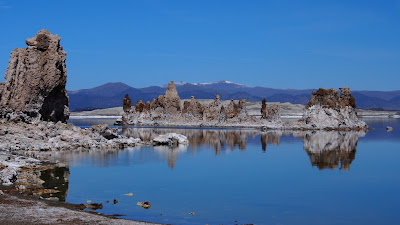


More to follow.
Sometimes you get lucky. We all know people who are photogenic. They may look undistinguished in real life, but when you see them in a photograph they look amazing. There are also places that are photogenic, and I stumbled on one of them last week.
A little backstory: A couple weeks back, Wisdoc & I went with our neighbors, Chris & Ginger, to the Booth Western Art Museum in Cartersville, GA, to see a terrific photography exhibition entitled "Ansel Adams: Before & After." There, I saw some striking photographs of a place I'd never heard of called Mono Lake (Wikipedia article here) and wondered where it was.
The next weekend, Wisdoc & I flew out to the Left Coast to take Wisdaughter skiing for Spring Break at Mammoth Lakes, California. As long-time readers may recall, last year, while skiing at Deer Valley, Utah, I fell, hit my head, and nearly wrecked my shoulder. This year I decided to treat the time as a writer's retreat. (And yes, if you're interested, I managed to get some good work done.) But when I began studying the map of the Eastern Sierras and Yosemite and the Owens Valley, I discovered that Mono Lake was only about a half-hour drive from Mammoth. So I borrowed Wisdoc's pretty good digital camera and decided to make a day of it.
The result? Several posts worth of photographs. The thing is, when reviewing them, there was hardly a bad shot in the hundreds I took. And, for the most part, it had nothing to do with my own skills at framing and shooting. This place just happens to be one of the most photogenic places on earth. I mean it! If you love to take pictures, grab yourself a decent camera and go to Mono Lake. (Heck, some of my faves I took with my paltry iPhone camera). You'll start thinking you're not a rank amateur shutterbug.
Prepare to be wowed! (or not). Here's the first batch.
And, as always, click pics to embiggen slide show or right click thumbnail for expandable pic.

 |
| Algae near the shore |


More to follow.
10 March 2016
This Week in Water
Oh, Jim H., what further and on-going depredations of our planet's most precious resource will you aggregate (much to our general annoyance) this week?
Flint, Michigan news. Still no remediation. Still no accountability.
Seas have been rising faster the last century than at any time in the past 2800 years, much of it due to global warming.
Locally, tidal flooding closed Tybee Island, GA.
Cyclone Winston, the worst storm ever recorded in the southern hemisphere, left tens of thousands homeless in Fiji.
El Niño storms have brought billions of gallons of water into California's parched reservoirs. Snowfall in the Sierras is way above average.
Coral reef islands provide hospitable habitats for phytoplankton production and thus for healthy ecosystems in otherwise barren oceans. Some fear coral may not survive into the next century. Excess acidity in the oceans is warping the skeletons and bleaching young coral, a result of carbon dioxide emissions.
They had to truck in snow for the ceremonial start of this year's Iditarod sled-dog race in Alaska.
Radiation from Japanese nuclear reactor Fukushima has now contaminated as much as one-third of the world's oceans.
Indian Point, New York City's nuclear power plant, is leaking 'uncontrollable radioactive flow' in the Hudson River.
After Flint, water testing methods are coming under increasing scrutiny.
Delhi, India is experiencing a severe water crisis. More here.
U.S. tech leaders are calling for a comprehensive innovative strategy to map a secure water future for the country and the world.
Iraq's largest dam is at risk of bursting, threatening millions of people around Mosul downstream.
Is China building a powerful radar on a disputed island in the South China Sea?
@FloridaMan: A scuba diver survived after apparently being sucked into a nuclear power plant intake pipe in South Florida.
Giant, and I do mean GIANT, waves shut down a 12-mile stretch of the Kamehameha Highway on the North Shore of Oahu. Who would want to go there, you might well ask? Well, Eddie Would Go! And, indeed, Eddie Aikau went. And so did his 66 year old brother Clyde. [Full Disclosure: That's one of my favorite beaches in the world. In summer, the water is as calm as a lake. You can stand in the water up to your neck and never get any up your nose. Oh, and the water's so clear you can count your toes 5' below the surface. Babies play in the gently lapping waves. Not winter!]
Flint, Michigan news. Still no remediation. Still no accountability.
Seas have been rising faster the last century than at any time in the past 2800 years, much of it due to global warming.
Locally, tidal flooding closed Tybee Island, GA.
Cyclone Winston, the worst storm ever recorded in the southern hemisphere, left tens of thousands homeless in Fiji.
El Niño storms have brought billions of gallons of water into California's parched reservoirs. Snowfall in the Sierras is way above average.
Coral reef islands provide hospitable habitats for phytoplankton production and thus for healthy ecosystems in otherwise barren oceans. Some fear coral may not survive into the next century. Excess acidity in the oceans is warping the skeletons and bleaching young coral, a result of carbon dioxide emissions.
They had to truck in snow for the ceremonial start of this year's Iditarod sled-dog race in Alaska.
Radiation from Japanese nuclear reactor Fukushima has now contaminated as much as one-third of the world's oceans.
Indian Point, New York City's nuclear power plant, is leaking 'uncontrollable radioactive flow' in the Hudson River.
After Flint, water testing methods are coming under increasing scrutiny.
Delhi, India is experiencing a severe water crisis. More here.
U.S. tech leaders are calling for a comprehensive innovative strategy to map a secure water future for the country and the world.
Iraq's largest dam is at risk of bursting, threatening millions of people around Mosul downstream.
Is China building a powerful radar on a disputed island in the South China Sea?
@FloridaMan: A scuba diver survived after apparently being sucked into a nuclear power plant intake pipe in South Florida.
Giant, and I do mean GIANT, waves shut down a 12-mile stretch of the Kamehameha Highway on the North Shore of Oahu. Who would want to go there, you might well ask? Well, Eddie Would Go! And, indeed, Eddie Aikau went. And so did his 66 year old brother Clyde. [Full Disclosure: That's one of my favorite beaches in the world. In summer, the water is as calm as a lake. You can stand in the water up to your neck and never get any up your nose. Oh, and the water's so clear you can count your toes 5' below the surface. Babies play in the gently lapping waves. Not winter!]
18 February 2016
This Week in Water
Yes, it's that time again. Let's get to it, shall we?
The on-going crisis in Flint, MI, is...well...on going. Follow it here.
Members of the Isle de Jean Charles Band of Biloxi-Chitimacha-Choctaw Native Americans have become the first community of official climate refugees in the U.S.
Greenland's melting ice sheets, besides adding huge amounts of water to the world's oceans, may be releasing 400,000 metric tons of phosphorous every year.
Microsoft co-founder Paul Allen's yacht destroyed 80% of a protected coral reef in the Cayman Islands.
The growing risk of worldwide water shortages may be worse than scientists originally estimated, affecting upwards of 4 billion people for at least one month of the year.
Hedge fund managers are not simply investing in water assets but are buying up water rights in the Western U.S. Is Wall Street the answer to the water crisis in the West? (Gives a new meaning to the term 'liquid assets', no?)
New Jersey Governor and failed U.S. GOP Presidential Candidate Chris Christie has privatized his state's water supply.
Better water management techniques could halve the world's food gap by 2050 and buffer some of the harmful effects of global warming on crop yields.
It looks like this year's El Niño, one of the most potent on record, may be winding down.
A giant iceberg stranded and killed up to 150,000 Adélie penguins in Antarctica.
The Atlantic Ocean is absorbing 50% more carbon than it was a decade ago.
Microscopic, mixotrophic organisms may have an impact larger than previously known on the ocean's food web and the global carbon cycle.
After six years of planning, NOAA has had to scrap its proposal to expand the size and focus of Hawaii's Humpback Whale National Marine Sanctuary.
How much water is there on Planet Earth? It's shockingly less than you might imagine. Here's a visualization.
Scientists have discovered a legendary boiling river in the Peruvian Amazon.
There's a massive underworld of lava tube caves with permanent ice inside 14,000ft. Mauna Loa, one of the Big Island of Hawaii's volcanos.
New Horizons Spacecraft discovers even more water ice on Pluto than previously thought.
The on-going crisis in Flint, MI, is...well...on going. Follow it here.
Members of the Isle de Jean Charles Band of Biloxi-Chitimacha-Choctaw Native Americans have become the first community of official climate refugees in the U.S.
Greenland's melting ice sheets, besides adding huge amounts of water to the world's oceans, may be releasing 400,000 metric tons of phosphorous every year.
Microsoft co-founder Paul Allen's yacht destroyed 80% of a protected coral reef in the Cayman Islands.
The growing risk of worldwide water shortages may be worse than scientists originally estimated, affecting upwards of 4 billion people for at least one month of the year.
Hedge fund managers are not simply investing in water assets but are buying up water rights in the Western U.S. Is Wall Street the answer to the water crisis in the West? (Gives a new meaning to the term 'liquid assets', no?)
New Jersey Governor and failed U.S. GOP Presidential Candidate Chris Christie has privatized his state's water supply.
Better water management techniques could halve the world's food gap by 2050 and buffer some of the harmful effects of global warming on crop yields.
It looks like this year's El Niño, one of the most potent on record, may be winding down.
A giant iceberg stranded and killed up to 150,000 Adélie penguins in Antarctica.
The Atlantic Ocean is absorbing 50% more carbon than it was a decade ago.
Microscopic, mixotrophic organisms may have an impact larger than previously known on the ocean's food web and the global carbon cycle.
After six years of planning, NOAA has had to scrap its proposal to expand the size and focus of Hawaii's Humpback Whale National Marine Sanctuary.
How much water is there on Planet Earth? It's shockingly less than you might imagine. Here's a visualization.
Scientists have discovered a legendary boiling river in the Peruvian Amazon.
There's a massive underworld of lava tube caves with permanent ice inside 14,000ft. Mauna Loa, one of the Big Island of Hawaii's volcanos.
25 January 2016
This Week in Water
I'm sure no one on the U.S. East Coast needs to be told what's happening this week in water, but here goes:
A massive, historic winter storm (named 'Jonas') smacked the U.S. Atlantic Seaboard with snowfalls over 30 inches and blizzard winds up to 60 mph and coastal flooding affecting nearly 80 million people and leaving at least 27 dead. You might have heard about it.
In other news:
Hurricane Pali, an extremely rare winter hurricane, swept through the Pacific. Meanwhile, Hurricane Alex, the first January hurricane since 1958, formed in the Atlantic Ocean. More here.
The amount of man-made heat energy absorbed by the world's oceans has doubled since 1997.
Canada's ice roads are melting, resulting in food and water shortages to many of that country's remote northern First Nation communities.
Warming trends are affecting Greenland's ability to store excess water and, thus, more melting ice may be running off into the ocean than previously believed.
Research suggests that farmlands in more developed countries that rely on climate stability for high yield agriculture may be more vulnerable to changing conditions—such as increased drought—affected by climate change.
Drought conditions and water shortages are now a threat to what was once the world's wettest place—Cherrapunji in northeastern India.
Though El Niño storms are replenishing many California lakes and aquifers, some scientists fear the state may never fully recover from its historic drought.
Continuing winter flooding along the lower Mississippi River may prove to be among the costliest in history.
The toxic water crisis in Flint, Michigan, continues. Criminal investigations are being initiated and the National Guard has been summoned, yet people still do not have sufficient lead-free water to bathe and cook and drink. The ramifications of this colossal political miscalculation by Gov. Rick Snyder may continue for generations.
President Obama rejected an attempt by congressional Republicans to gut the Clean Water Act and overturn landmark federal regulation seeking to ensure that water used for drinking, bathing, recreation, and energy development is protected.
Some fear that by 2050 there will be more discarded plastic in the ocean than fish.
Restoration of coastal wetlands may play a crucial role in slowing climate change. Saltwater ecosystems of seagrass and marshes and mangrove promote healthy fisheries, sequester carbon in their soils, stave off erosion, and provide defenses to powerful storm surges.
Chile is attempting to harness seawater and solar power in the Atacama Desert, one of the driest places on earth.
Scientists still don't fully understand why water is such a unique liquid, e.g., why ice floats or how it absorbs and releases a large amount of heat without undergoing huge changes in temperature.
Is there water ice on Pluto?
A massive, historic winter storm (named 'Jonas') smacked the U.S. Atlantic Seaboard with snowfalls over 30 inches and blizzard winds up to 60 mph and coastal flooding affecting nearly 80 million people and leaving at least 27 dead. You might have heard about it.
In other news:
Hurricane Pali, an extremely rare winter hurricane, swept through the Pacific. Meanwhile, Hurricane Alex, the first January hurricane since 1958, formed in the Atlantic Ocean. More here.
The amount of man-made heat energy absorbed by the world's oceans has doubled since 1997.
Canada's ice roads are melting, resulting in food and water shortages to many of that country's remote northern First Nation communities.
Warming trends are affecting Greenland's ability to store excess water and, thus, more melting ice may be running off into the ocean than previously believed.
Research suggests that farmlands in more developed countries that rely on climate stability for high yield agriculture may be more vulnerable to changing conditions—such as increased drought—affected by climate change.
Drought conditions and water shortages are now a threat to what was once the world's wettest place—Cherrapunji in northeastern India.
Though El Niño storms are replenishing many California lakes and aquifers, some scientists fear the state may never fully recover from its historic drought.
Continuing winter flooding along the lower Mississippi River may prove to be among the costliest in history.
The toxic water crisis in Flint, Michigan, continues. Criminal investigations are being initiated and the National Guard has been summoned, yet people still do not have sufficient lead-free water to bathe and cook and drink. The ramifications of this colossal political miscalculation by Gov. Rick Snyder may continue for generations.
President Obama rejected an attempt by congressional Republicans to gut the Clean Water Act and overturn landmark federal regulation seeking to ensure that water used for drinking, bathing, recreation, and energy development is protected.
Some fear that by 2050 there will be more discarded plastic in the ocean than fish.
Restoration of coastal wetlands may play a crucial role in slowing climate change. Saltwater ecosystems of seagrass and marshes and mangrove promote healthy fisheries, sequester carbon in their soils, stave off erosion, and provide defenses to powerful storm surges.
Chile is attempting to harness seawater and solar power in the Atacama Desert, one of the driest places on earth.
Scientists still don't fully understand why water is such a unique liquid, e.g., why ice floats or how it absorbs and releases a large amount of heat without undergoing huge changes in temperature.
Is there water ice on Pluto?
07 January 2016
This Week in Water
Busy holiday and end-of-year 'real life' issues now past, it's time to kick off the new year, 2016, with another installment of #TWIW.
The full effects of the current powerful El Niño have yet to be felt.
Winter temperatures in the Arctic rose above the freezing point in December as a result of storms originating from El Niño, the same storms that brought historic rains to the southern U.S. and Great Britain.
The U.S. midwest experienced historic flooding of the Mississippi River over the holidays. As did parts of northern England.
For the first time in ten years, California's snowpack is above normal.
Flooding from Typhoon Melor in the Philippines resulted in the evacuation of 725,000 people.
The Florida Keys are experiencing increasingly regular street flooding during high tides, and as temperatures continue to climb so will sea levels around Miami.
Melting Arctic sea ice is associated not only with increased heat absorption but also with increased precipitation in the Arctic.
The North American Great Lakes are warming twice as fast the planet's oceans. So is Israel's Lake Kinneret and many others worldwide.
The most critical ecosystem of Europe's oldest lake, Lake Ohrid in Macedonia, one of the most biodiverse lakes in the world, is being paved over to accommodate increased tourism.
Bolivia's second largest lake, Lake Poopo in the Andes, has dried up.
Scientists have been significantly underestimating humanity's global water footprint by as much as 20%, and some believe we are fast approaching unsustainable levels.
Flint, Michigan has been declared a state of emergency after the state government changed up its water supply and toxic levels of lead and other toxic substances began showing up in the drinking water. You can (and should) follow the news here.
The chemicals in the fluids used in hydraulic fracturing, aka fracking, are known to be associated with developmental and reproductive toxicity. The extent of their concentrations in groundwater supplies affected by fracking requires urgent further study.
The Australian government has given final approval to a giant coal terminal at Abbot Point in northern Queensland, just 12 miles from the Great Barrier Reef.
President Obama signed a new law banning the use of exfoliating plastic microbeads in soaps and shampoos and toothpaste beginning in 2017. These have been making their way into our waterways and water supplies for years.
Orange peels may be able to absorb excess mercury contamination in the water and soil.
Researchers at the University of Hawaii at Manoa and NOAA are crowd-sourcing tsunami sensors on cargo ships and other seafaring vessels to provide more accurate real-time data than current warning systems.
Scientists at Cornell University have developed a reusable polymer that can remove pollutants from flowing water within seconds.
Industry views on the state of water in 2015 here.
Dry ice rather than water could have sculpted those mysterious gulleys on Mars.
The full effects of the current powerful El Niño have yet to be felt.
Winter temperatures in the Arctic rose above the freezing point in December as a result of storms originating from El Niño, the same storms that brought historic rains to the southern U.S. and Great Britain.
The U.S. midwest experienced historic flooding of the Mississippi River over the holidays. As did parts of northern England.
For the first time in ten years, California's snowpack is above normal.
Flooding from Typhoon Melor in the Philippines resulted in the evacuation of 725,000 people.
The Florida Keys are experiencing increasingly regular street flooding during high tides, and as temperatures continue to climb so will sea levels around Miami.
Melting Arctic sea ice is associated not only with increased heat absorption but also with increased precipitation in the Arctic.
The North American Great Lakes are warming twice as fast the planet's oceans. So is Israel's Lake Kinneret and many others worldwide.
The most critical ecosystem of Europe's oldest lake, Lake Ohrid in Macedonia, one of the most biodiverse lakes in the world, is being paved over to accommodate increased tourism.
Bolivia's second largest lake, Lake Poopo in the Andes, has dried up.
Scientists have been significantly underestimating humanity's global water footprint by as much as 20%, and some believe we are fast approaching unsustainable levels.
Flint, Michigan has been declared a state of emergency after the state government changed up its water supply and toxic levels of lead and other toxic substances began showing up in the drinking water. You can (and should) follow the news here.
The chemicals in the fluids used in hydraulic fracturing, aka fracking, are known to be associated with developmental and reproductive toxicity. The extent of their concentrations in groundwater supplies affected by fracking requires urgent further study.
The Australian government has given final approval to a giant coal terminal at Abbot Point in northern Queensland, just 12 miles from the Great Barrier Reef.
President Obama signed a new law banning the use of exfoliating plastic microbeads in soaps and shampoos and toothpaste beginning in 2017. These have been making their way into our waterways and water supplies for years.
Orange peels may be able to absorb excess mercury contamination in the water and soil.
Researchers at the University of Hawaii at Manoa and NOAA are crowd-sourcing tsunami sensors on cargo ships and other seafaring vessels to provide more accurate real-time data than current warning systems.
Scientists at Cornell University have developed a reusable polymer that can remove pollutants from flowing water within seconds.
Industry views on the state of water in 2015 here.
Dry ice rather than water could have sculpted those mysterious gulleys on Mars.
14 December 2015
This Week in Water
As we've been anticipating, nearly 200 nations signed an agreement to work to reduce the man-made sources of global warming. Details here. Many felt it did not go far enough because it specifies no specific actions and provides no mandatory sanctions, but it represents a step in the right direction and, by setting frameworks, goals, and intentions going forward, is far better than no agreement at all.
Meanwhile, in the real world:
Scientists are piecing together the data respecting ocean temperatures over the last 5 million years and their correlation with global climate.
Falling oxygen levels caused by warming oceans may prove to be a greater threat to the survival of life on Earth than flooding from rising seas. About two-thirds of the Earth's oxygen is produced by the process of photosynthesis in ocean phytoplankton, and this process is disrupted by warming seas. Scientists elsewhere, however, are at a loss to explain an unprecedented rise in the number of phytoplankton in the Northern Atlantic but believe it may result from increased acidification due to high levels of carbon dioxide in the atmosphere. Stay tuned.
View a remarkable set of photographs documenting rapid coral bleaching caused by warming oceans here.
Rising oceans are threatening the Marshall Islands (among others) threatening a way of life. (Some brilliant photography from the The New York Times!)
Abnormally high tides in the Florida Keys have been flooding low-lying areas for months, threatening property values.
Southern India has been hit by floods caused by the heaviest rainfall in more than a century.
China's largest glacier is now retreating at a record pace.
Hundreds of thousands of people were evacuated as Typhoon Melor struck the Eastern Philippines.
As a record-breaking Pacific cyclone season wraps up, Hawaii proved remarkably lucky in dodging no less than 15 major storms.
Scientists discovered a 100+ million year old underground ocean under the Chesapeake Bay.
Scientists have developed a new class of superhydrophobic nanomaterials to protect surfaces from water.
Meanwhile, in the real world:
Scientists are piecing together the data respecting ocean temperatures over the last 5 million years and their correlation with global climate.
Falling oxygen levels caused by warming oceans may prove to be a greater threat to the survival of life on Earth than flooding from rising seas. About two-thirds of the Earth's oxygen is produced by the process of photosynthesis in ocean phytoplankton, and this process is disrupted by warming seas. Scientists elsewhere, however, are at a loss to explain an unprecedented rise in the number of phytoplankton in the Northern Atlantic but believe it may result from increased acidification due to high levels of carbon dioxide in the atmosphere. Stay tuned.
View a remarkable set of photographs documenting rapid coral bleaching caused by warming oceans here.
Rising oceans are threatening the Marshall Islands (among others) threatening a way of life. (Some brilliant photography from the The New York Times!)
Abnormally high tides in the Florida Keys have been flooding low-lying areas for months, threatening property values.
Southern India has been hit by floods caused by the heaviest rainfall in more than a century.
China's largest glacier is now retreating at a record pace.
Hundreds of thousands of people were evacuated as Typhoon Melor struck the Eastern Philippines.
As a record-breaking Pacific cyclone season wraps up, Hawaii proved remarkably lucky in dodging no less than 15 major storms.
Scientists discovered a 100+ million year old underground ocean under the Chesapeake Bay.
Scientists have developed a new class of superhydrophobic nanomaterials to protect surfaces from water.
23 November 2015
This Week in Water
As noted, with the Paris Climate Conference aka COP21 coming up, it's been a very busy week in water. Let's get to the links:
Pingos, or huge mounds, off Siberia may presage a huge release of the dangerous super-greenhouse gas methane into the atmosphere.
Some worry civilization may not survive upcoming water wars caused by climate change. Many are attributing the Syrian civil war and refugee crisis to unprecedented drought conditions from 2006-2010 that forced many rural subsistence farmers into overcrowded cities. At a minimum, water policy analysis is going to be a growth industry in the coming years and decades.
Nearly two billion people in the northern hemisphere rely on declining melting snowpack as a crucial source of water.
Sea level rise is attributed in part to runoff from human over-depletion of aquifers. Some are experimenting with flooding the farmland above aquifers in wintertime to see if they can replenish the aquifers without damaging crops or affecting drinking water. Though groundwater is not as renewable as people once thought.
Egypt's Nile River Delta, once the breadbasket of the Mediterranean, is sinking into the sea.
Surprisingly, global sea levels actually fell in 2011 when ocean waters flooded Australia and couldn't find their way out.
Over 800 trillion microbeads of plastic enter U.S. wastewater daily. The city of Oakland, CA, is suing Monsanto for damages to help in mitigating PCBs, chemical pollutants, in storm drain runoff to San Francisco Bay. Researchers have developed a way to break down pharmaceuticals into harmless compounds so they don't contaminate drinking water.
Scientists have designed an artificial photosynthesis process that allows underwater solar cells to turn captured greenhouse gases into fuel.
Scientists are continually refining the processes for generating clean, inexpensive fuel from water. Some are focused on so-called "dragon water", super-heated water from beneath the earth's surface. There are six quintillion gallons of water hiding in the Earth's crust.
In case you didn't know, bottled water is extremely wasteful.
New desalination systems are constantly being developed and refined. MIT engineers used an electrolytic shockwave to get the salt out of saltwater that is efficient and inexpensive. Others are using nanoparticles and ultraviolet light to extract man-made pollutants from soil and water. Drinkwell is an organization that supplies inexpensive filtration systems to poor communities.
Saudi Arabia insists that its nuclear power is primarily for the purpose of developing desalination processes.
As many as 139 countries may have the ability to get all their power from renewable resources by 2050.
Here's a picture of tidal channels flowing between small island cays in the Bahamas taken by an astronaut aboard the International Space Station. Full disclosure: Several years ago on a scuba diving trip to Exuma, we dove one of these channels. The boat let us out on the upstream side of the channel and we swam with (or were carried by) the brisk currents through the cut where the boat gathered us up and took us back to the start. We did this about 6 or 7 times. It was like an exciting amusement park ride—but with sharks and rays and dolphins!

Pingos, or huge mounds, off Siberia may presage a huge release of the dangerous super-greenhouse gas methane into the atmosphere.
Some worry civilization may not survive upcoming water wars caused by climate change. Many are attributing the Syrian civil war and refugee crisis to unprecedented drought conditions from 2006-2010 that forced many rural subsistence farmers into overcrowded cities. At a minimum, water policy analysis is going to be a growth industry in the coming years and decades.
Nearly two billion people in the northern hemisphere rely on declining melting snowpack as a crucial source of water.
Sea level rise is attributed in part to runoff from human over-depletion of aquifers. Some are experimenting with flooding the farmland above aquifers in wintertime to see if they can replenish the aquifers without damaging crops or affecting drinking water. Though groundwater is not as renewable as people once thought.
Egypt's Nile River Delta, once the breadbasket of the Mediterranean, is sinking into the sea.
Surprisingly, global sea levels actually fell in 2011 when ocean waters flooded Australia and couldn't find their way out.
Over 800 trillion microbeads of plastic enter U.S. wastewater daily. The city of Oakland, CA, is suing Monsanto for damages to help in mitigating PCBs, chemical pollutants, in storm drain runoff to San Francisco Bay. Researchers have developed a way to break down pharmaceuticals into harmless compounds so they don't contaminate drinking water.
Scientists have designed an artificial photosynthesis process that allows underwater solar cells to turn captured greenhouse gases into fuel.
Scientists are continually refining the processes for generating clean, inexpensive fuel from water. Some are focused on so-called "dragon water", super-heated water from beneath the earth's surface. There are six quintillion gallons of water hiding in the Earth's crust.
In case you didn't know, bottled water is extremely wasteful.
New desalination systems are constantly being developed and refined. MIT engineers used an electrolytic shockwave to get the salt out of saltwater that is efficient and inexpensive. Others are using nanoparticles and ultraviolet light to extract man-made pollutants from soil and water. Drinkwell is an organization that supplies inexpensive filtration systems to poor communities.
Saudi Arabia insists that its nuclear power is primarily for the purpose of developing desalination processes.
As many as 139 countries may have the ability to get all their power from renewable resources by 2050.
Here's a picture of tidal channels flowing between small island cays in the Bahamas taken by an astronaut aboard the International Space Station. Full disclosure: Several years ago on a scuba diving trip to Exuma, we dove one of these channels. The boat let us out on the upstream side of the channel and we swam with (or were carried by) the brisk currents through the cut where the boat gathered us up and took us back to the start. We did this about 6 or 7 times. It was like an exciting amusement park ride—but with sharks and rays and dolphins!

18 November 2015
This Week in Water
Lots of pre-Paris Conference on Climate Change activity—which is still happening despite the attacks of 11/13. So let's dive right in. Vive Generation Bataclan!
Many are dead and many more missing, and a quarter million Brazilians are without safe drinking water after two dams collapsed at an iron ore mine in Minas Gerais state.
Thousands of Wisconsinites are losing access to safe drinking water due to lax enforcement of industrial pollutant regulations.
To no one's great surprise (certainly not readers of TWIW here on WoW), damage to gulf coral from the massive 2010 BP oil spill in the Gulf of Mexico has turned out to be more extensive than previously thought.
A massive Greenland glacier which has sufficient mass to raise sea levels by nearly two feet is on the verge of collapse.
Scientists have solved a 40-year-old problem about how to measure sea ice volume and thickness.
Smith Island is sinking into the Chesapeake Bay thanks to climate change.
Charleston, SC's flooding "king tides" are getting progressively higher, propelled even further due to this years super strong El Niño.
While some areas of Antarctica are losing record amounts of glaciated ice, other areas are gaining.
For the first time in recorded history, two major hurricanes in the Arabian Sea were observed.
Four Republican U.S. Senators formed a Senate Energy and Environment Working Group to focus on environmental issues caused by climate change. They deserve mention: Kelly Ayotte (R-NH), Lamar Alexander (R-TN), Mark Kirk (R-IL), and Lindsey Graham (R-SC).
Another fossil fuel extraction company, Norway's state-owned oil and gas company Statoil, has announced it is pulling operations out of the Alaskan Arctic.
The Buckminster Fuller Institute has awarded a $100,000 prize to a commercial fisherman for a sustainable ocean farming plan designed to address overfishing, mitigate climate change, restore marine ecosystems, and provide jobs for fisherman.
Even more evidence of a watery past on Mars found.
Many are dead and many more missing, and a quarter million Brazilians are without safe drinking water after two dams collapsed at an iron ore mine in Minas Gerais state.
Thousands of Wisconsinites are losing access to safe drinking water due to lax enforcement of industrial pollutant regulations.
To no one's great surprise (certainly not readers of TWIW here on WoW), damage to gulf coral from the massive 2010 BP oil spill in the Gulf of Mexico has turned out to be more extensive than previously thought.
A massive Greenland glacier which has sufficient mass to raise sea levels by nearly two feet is on the verge of collapse.
Scientists have solved a 40-year-old problem about how to measure sea ice volume and thickness.
Smith Island is sinking into the Chesapeake Bay thanks to climate change.
Charleston, SC's flooding "king tides" are getting progressively higher, propelled even further due to this years super strong El Niño.
While some areas of Antarctica are losing record amounts of glaciated ice, other areas are gaining.
For the first time in recorded history, two major hurricanes in the Arabian Sea were observed.
Four Republican U.S. Senators formed a Senate Energy and Environment Working Group to focus on environmental issues caused by climate change. They deserve mention: Kelly Ayotte (R-NH), Lamar Alexander (R-TN), Mark Kirk (R-IL), and Lindsey Graham (R-SC).
Another fossil fuel extraction company, Norway's state-owned oil and gas company Statoil, has announced it is pulling operations out of the Alaskan Arctic.
The Buckminster Fuller Institute has awarded a $100,000 prize to a commercial fisherman for a sustainable ocean farming plan designed to address overfishing, mitigate climate change, restore marine ecosystems, and provide jobs for fisherman.
Even more evidence of a watery past on Mars found.
28 October 2015
This Week in Water
After last week's change in format in which we laid out what may be two of the BIGGEST news items in human history (no joke: [1] an extinction event that may include us + [2] evidence of possible extraterrestrial life) plus one of the greatest frauds ever perpetrated on the world, we return to aggregating links about our planet's most precious resource—and there are plenty!
Scientists are finding further evidence of how Greenland is melting. [The Times link has amazing drone video and remarkable graphics.] Why does this matter? Greenland's ice sheets sit on land, so when they melt they cause the oceans to rise—unlike, say, a melting iceberg which is the example climate change denialists always cite, claiming that melting ice is like an ice cube in a glass of water and does not contribute to rising sea levels.
Permafrost warming in Alaska is 'accelerating', threatening to release dangerous levels of the greenhouse gas methane into the environment. Researchers worry that this could cost the world's economies trillions of dollars more in damages.
This year's snowpack in the High Sierras was the worst in the past 500 years, and the snow's water content was only 5% of its historical average over the same period.
Hurricane Patricia, the most powerful cyclone ever recorded in the Western Hemisphere, struck land on the west coast of Mexico bringing torrential rainfall and flooding as far north as Michigan.
The recent flooding in South Carolina is the result of at least the 6th 1-in-a-1000-year rain event in the U.S. since 2010.
This year's 'dead zone' in the Gulf of Mexico, a result of excess rainfall and nutrient runoff from the Mississippi River, is larger than average and much larger than expected.
Iran's Lake Urmia, once the planet's sixth largest salt lake (larger than Utah's Great Salt Lake) has dried up to a mere 10% of its size, similar to what happened to the Aral Sea in Central Asia, exposing a vast salt desert.
The Obama administration has created two new marine sanctuaries in the U.S., the first such in 15 years, one in a portion of Lake Michigan and the other in the Potomac River.
In a 2-1 ruling, a panel of the Sixth Circuit Court of Appeals has blocked U.S. efforts to keep its streams and wetlands clean.
U.S. Representative Lamar Smith (R-TX), chairman of the House Science Committee, has launched a wide-ranging, open-ended inquisition into climate scientists' recent findings that global warming is not in some sort of pause or hiatus, subpoenaing email records and other communications of internal deliberations from NOAA and the National Centers for Environmental Information. There are currently no allegations of corruption or wrongdoing.
Oxybenzone, an ingredient in most sunscreen brands, is killing coral, causing DNA damage in both adults and larval stage animals. This only adds to the effects of warmer water temperatures on delicate coral marine life, i.e., "coral bleaching" that is happening world wide.
No one is quite sure how to solve the world's water problems, but there is much work to be done.
A Dutch company called Elemental Water Makers is working to use 100% renewable energy to desalinate seawater with a pilot project in the British Virgin Islands—the type of solution this blog has been advocating for years.
Scientists are finding further evidence of how Greenland is melting. [The Times link has amazing drone video and remarkable graphics.] Why does this matter? Greenland's ice sheets sit on land, so when they melt they cause the oceans to rise—unlike, say, a melting iceberg which is the example climate change denialists always cite, claiming that melting ice is like an ice cube in a glass of water and does not contribute to rising sea levels.
Permafrost warming in Alaska is 'accelerating', threatening to release dangerous levels of the greenhouse gas methane into the environment. Researchers worry that this could cost the world's economies trillions of dollars more in damages.
This year's snowpack in the High Sierras was the worst in the past 500 years, and the snow's water content was only 5% of its historical average over the same period.
Hurricane Patricia, the most powerful cyclone ever recorded in the Western Hemisphere, struck land on the west coast of Mexico bringing torrential rainfall and flooding as far north as Michigan.
The recent flooding in South Carolina is the result of at least the 6th 1-in-a-1000-year rain event in the U.S. since 2010.
This year's 'dead zone' in the Gulf of Mexico, a result of excess rainfall and nutrient runoff from the Mississippi River, is larger than average and much larger than expected.
Iran's Lake Urmia, once the planet's sixth largest salt lake (larger than Utah's Great Salt Lake) has dried up to a mere 10% of its size, similar to what happened to the Aral Sea in Central Asia, exposing a vast salt desert.
The Obama administration has created two new marine sanctuaries in the U.S., the first such in 15 years, one in a portion of Lake Michigan and the other in the Potomac River.
In a 2-1 ruling, a panel of the Sixth Circuit Court of Appeals has blocked U.S. efforts to keep its streams and wetlands clean.
U.S. Representative Lamar Smith (R-TX), chairman of the House Science Committee, has launched a wide-ranging, open-ended inquisition into climate scientists' recent findings that global warming is not in some sort of pause or hiatus, subpoenaing email records and other communications of internal deliberations from NOAA and the National Centers for Environmental Information. There are currently no allegations of corruption or wrongdoing.
Oxybenzone, an ingredient in most sunscreen brands, is killing coral, causing DNA damage in both adults and larval stage animals. This only adds to the effects of warmer water temperatures on delicate coral marine life, i.e., "coral bleaching" that is happening world wide.
No one is quite sure how to solve the world's water problems, but there is much work to be done.
A Dutch company called Elemental Water Makers is working to use 100% renewable energy to desalinate seawater with a pilot project in the British Virgin Islands—the type of solution this blog has been advocating for years.
19 October 2015
This Week in Water
As the UN Climate Change Conference in Paris approaches, I want to change the format for this week's TWIW post and interject an argument and some editorial opinion. Normally, TWIW is a news aggregator replete with interesting links to issues and news about our planet's most important resource. If you want to take a look at past posts, simply click on the "This Week in Water" link in the "Labels" below.
Sometimes there is so much news that it becomes difficult to see the forest for the trees—or the ocean for the waves as the case may be. As with the last post about the discovery of evidence of flowing water on Mars, this week brings us three VERY BIG items and, in this instance, they deserve some discussion and thought.
Item #1—Exxon Evidence. Evidence has come to light that Exxon has had specific internal knowledge about the drastic, deleterious effects of man-made global warming since the 1980s—to wit, melting glaciers and polar ice and rising sea levels. Yet, internal documents show that the company used its vast marketing and political power not only to conceal this fact from the world but has been actively lying about it to its shareholders, the public, and regulators. In the meantime, it has used this knowledge to figure out how to improve its extraction of even more damaging fossil fuels from the earth. "Genocidal Behavior" and "Sociopathic Greed" hardly begin to describe this concerted series of potentially planet-murdering actions. In a truly free market with valid 'price discovery mechanisms', these costs would/should necessarily have to be borne by the company and figured into its balance sheet; yet Exxon-Mobil (and other fossil fuel extraction-based companies and their suppliers and supporters) continues to receive billions of dollars in U.S. tax breaks and subsidies and to profit from its criminally insane behavior while ignoring the public costs of their business. Questions about the viability of possible legal and/or political remedies are, hopefully, arising globally, though the damage may be irreparable. And the fact is there may be no specific laws to punish and remediate these companies' actions.
Item #2—Extinction Event. The planet is currently facing what scientists are calling its Sixth Great Extinction Event, and some are asking whether humans can survive this catastrophe. This results partially from a collapse of the food chain originating in our ocean ecosystems due to rising levels of atmospheric carbon dioxide and warming global climate.
Item #3—Extra-terrestrials? Back in 2010 I posted a piece about so-called Kardashev civilizations. [Go on, read it; it's pretty cool. It'll open in a new window. Besides, this post isn't going anywhere.] Now, astronomers have discovered an anomalous star in our galaxy some 1500 light years away that shows some signs that might be indicative of an alien civilization approaching a Type II Kardashev civilization, namely one which is able to harness the energy of a star to fuel its development. (By contrast, earth's civilization is ~0.7 on the Kardashev scale because we are barely beginning to capture solar, wind, hydro, and tidal power) One explanation for the behavior of light from this star is that there are advanced life forms constructing a Dyson Sphere around their sun. Of course, there are plenty of other hypotheses to be eliminated before anyone can claim this for certain. Still, it's potentially HUGE news—I mean, the biggest news in human history. (How does this relate to water, you might ask? If there is such a civilization, they must certainly have some form of watery world resources. Okay, it's tenuous, but it's such a huge piece of news I couldn't resist.)
One fairly straightforward conclusion to draw from these Items is that our planet's continued reliance on fossil fuels (due, mostly, to the economic and political power of the extraction industries) is killing us, and if we want to advance and perhaps even to survive as a civilization and possibly a species we need to change our behavior radically, moving to sustainable energy practices before it's too late. How this can seem even remotely controversial continues to baffle me.
Sometimes there is so much news that it becomes difficult to see the forest for the trees—or the ocean for the waves as the case may be. As with the last post about the discovery of evidence of flowing water on Mars, this week brings us three VERY BIG items and, in this instance, they deserve some discussion and thought.
Item #1—Exxon Evidence. Evidence has come to light that Exxon has had specific internal knowledge about the drastic, deleterious effects of man-made global warming since the 1980s—to wit, melting glaciers and polar ice and rising sea levels. Yet, internal documents show that the company used its vast marketing and political power not only to conceal this fact from the world but has been actively lying about it to its shareholders, the public, and regulators. In the meantime, it has used this knowledge to figure out how to improve its extraction of even more damaging fossil fuels from the earth. "Genocidal Behavior" and "Sociopathic Greed" hardly begin to describe this concerted series of potentially planet-murdering actions. In a truly free market with valid 'price discovery mechanisms', these costs would/should necessarily have to be borne by the company and figured into its balance sheet; yet Exxon-Mobil (and other fossil fuel extraction-based companies and their suppliers and supporters) continues to receive billions of dollars in U.S. tax breaks and subsidies and to profit from its criminally insane behavior while ignoring the public costs of their business. Questions about the viability of possible legal and/or political remedies are, hopefully, arising globally, though the damage may be irreparable. And the fact is there may be no specific laws to punish and remediate these companies' actions.
Item #2—Extinction Event. The planet is currently facing what scientists are calling its Sixth Great Extinction Event, and some are asking whether humans can survive this catastrophe. This results partially from a collapse of the food chain originating in our ocean ecosystems due to rising levels of atmospheric carbon dioxide and warming global climate.
Item #3—Extra-terrestrials? Back in 2010 I posted a piece about so-called Kardashev civilizations. [Go on, read it; it's pretty cool. It'll open in a new window. Besides, this post isn't going anywhere.] Now, astronomers have discovered an anomalous star in our galaxy some 1500 light years away that shows some signs that might be indicative of an alien civilization approaching a Type II Kardashev civilization, namely one which is able to harness the energy of a star to fuel its development. (By contrast, earth's civilization is ~0.7 on the Kardashev scale because we are barely beginning to capture solar, wind, hydro, and tidal power) One explanation for the behavior of light from this star is that there are advanced life forms constructing a Dyson Sphere around their sun. Of course, there are plenty of other hypotheses to be eliminated before anyone can claim this for certain. Still, it's potentially HUGE news—I mean, the biggest news in human history. (How does this relate to water, you might ask? If there is such a civilization, they must certainly have some form of watery world resources. Okay, it's tenuous, but it's such a huge piece of news I couldn't resist.)
One fairly straightforward conclusion to draw from these Items is that our planet's continued reliance on fossil fuels (due, mostly, to the economic and political power of the extraction industries) is killing us, and if we want to advance and perhaps even to survive as a civilization and possibly a species we need to change our behavior radically, moving to sustainable energy practices before it's too late. How this can seem even remotely controversial continues to baffle me.
29 September 2015
This Week in Water
Really, there is only one piece of water news this week:
NASA has discovered evidence of flowing salt water on Mars.
That is to say: NASA HAS DISCOVERED EVIDENCE OF FLOWING SALT WATER ON MARS!!!!!!!
NASA has discovered evidence of flowing salt water on Mars.
 |
| Dark lines indicate where water flows on Mars |
That is to say: NASA HAS DISCOVERED EVIDENCE OF FLOWING SALT WATER ON MARS!!!!!!!
22 September 2015
This Week in Water
I've been away and been distracted; apologies. A lot has happened in our watery world in my absence so let's get to it, focusing this week on the threats to our oceans.
Scientists are claiming the upcoming Paris climate talks are paying insufficient heed to the dangers posed by global warming to the world's oceans.
Scripps oceanographers have found the fourth lowest Arctic sea-ice minimum ever recorded this year and surprising turbulence under the surface.
As reported here many times over the years, rising seas threaten U.S. coastal cities such as San Francisco in the near- to mid-term future.
Long-term warming trends coupled with this year's super strong El Niño are causing unprecedented bleaching and death of Hawaii's coral, and the outlook is not good.
This year's dead zone in the Gulf of Mexico, at approximately 6,474 square miles, is significantly above average and larger than forecast even in June.
The impact of the 1989 Exxon Valdez oil spill in Alaska's Prince William Sound has been far greater than anyone thought, including heart defects in salmon and herring due to exposure to crude oil toxins in the seawater.
A newly discovered underwater volcano in the Pacific Ocean is spewing carbon dioxide, thereby further acidifying the ocean and turning vibrant coral gardens to carpets of algae.
A pristine underwater ecosystem of ocean life has been discovered off the south coast of Australia at unexpected depths.
The U.S. Navy has agreed to reduce underwater explosive testing and mid-range sonar training off the coasts of California and Hawaii that have killed a number of whales, dolphins, seals, and sea lions and adversely affected the hearing abilities of many others.
The Everglades Foundation of Palmetto Bay has announced a $10 million prize to entrepreneurs who come up with a solution to the world's growing algae populations. The algaefication of the oceans and freshwater ways (including so-called dead zones) is caused by phosphorus and nitrogen and other chemical runoff from fertilizers and from sewage treatment.
The University of Hawaii at Manoa's Hawaii Undersea Research Laboratory (aka HURL) has been exploring the deep seas since the 1980s. [Great article from the NY Times about HURL's important work.]
Scientists are claiming the upcoming Paris climate talks are paying insufficient heed to the dangers posed by global warming to the world's oceans.
Scripps oceanographers have found the fourth lowest Arctic sea-ice minimum ever recorded this year and surprising turbulence under the surface.
As reported here many times over the years, rising seas threaten U.S. coastal cities such as San Francisco in the near- to mid-term future.
Long-term warming trends coupled with this year's super strong El Niño are causing unprecedented bleaching and death of Hawaii's coral, and the outlook is not good.
This year's dead zone in the Gulf of Mexico, at approximately 6,474 square miles, is significantly above average and larger than forecast even in June.
The impact of the 1989 Exxon Valdez oil spill in Alaska's Prince William Sound has been far greater than anyone thought, including heart defects in salmon and herring due to exposure to crude oil toxins in the seawater.
A newly discovered underwater volcano in the Pacific Ocean is spewing carbon dioxide, thereby further acidifying the ocean and turning vibrant coral gardens to carpets of algae.
A pristine underwater ecosystem of ocean life has been discovered off the south coast of Australia at unexpected depths.
The U.S. Navy has agreed to reduce underwater explosive testing and mid-range sonar training off the coasts of California and Hawaii that have killed a number of whales, dolphins, seals, and sea lions and adversely affected the hearing abilities of many others.
The Everglades Foundation of Palmetto Bay has announced a $10 million prize to entrepreneurs who come up with a solution to the world's growing algae populations. The algaefication of the oceans and freshwater ways (including so-called dead zones) is caused by phosphorus and nitrogen and other chemical runoff from fertilizers and from sewage treatment.
The University of Hawaii at Manoa's Hawaii Undersea Research Laboratory (aka HURL) has been exploring the deep seas since the 1980s. [Great article from the NY Times about HURL's important work.]
Subscribe to:
Posts (Atom)