

Please help the Burmese people if you can.


AMS: An American reads a book, and often as not it is treated as an economic reality rather than as a political risk. Book packaging will receive as much attention as what’s being packaged. I don’t want to demean contemporary literature at all, but it is constrained perhaps by the emphasis on what the next thing will be to make a splash.But this is something new entirely.
WHG: That commercialization process increasingly bothers me. It has gotten so much worse, and it has made the art world a zoo. When I was writing this piece recently for "New York Review" on Johns, I just kept thinking, what does it do to a painter to know that every brush stroke is inescapably another hundred thousand dollars? How does one manage to deliver the right critical notice? I’m glad literature is spared that, or rather, that it is milder in our case. [Interview with Wm. S. Gass]
 Who are we to say these writers can't do what they need to to earn a living wage? In the U.S., unless you write commercial or genre fiction, or resort to memoir or hit the jackpot with a screenplay, it's tough to sell your work. Still, in our mind there's now a bit of an "ick" factor attached to their names and we will have some trouble getting past it when it comes to reading, much less purchasing, any further work of any of these writers.
To make any contribution worth caring about, a philosopher's study of Shakespeare should do three things. First and most centrally, it should really do philosophy, and not just allude to familiar philosophical ideas and positions. It should pursue tough questions and come up with something interesting and subtle--rather than just connecting Shakespeare to this or that idea from Philosophy 101. A philosopher reading Shakespeare should wonder, and ponder, in a genuinely philosophical way. Second, it should illuminate the world of the plays, attending closely enough to language and to texture that the interpretation changes the way we see the work, rather than just uses the work as grist for some argumentative mill. And finally, such a study should offer some account of why philosophical thinking needs to turn to Shakespeare's plays, or to works like them. Why must the philosopher care about these plays? Do they supply to thought something that a straightforward piece of philosophical prose cannot supply, and if so, what? "Stages of Thought"

[D]iscursive language, say in novel writing, is artistically identified as description, which is what enables fiction to be convincing: we acquiesce in the fiction that we are being given facts. So that the difference between factual and fictive description is not that the former is true and the latter false—for something may after all be meant as factual and be false without thereby being elevated to the status of fiction, and fictional prose may in literal fact be true—but in the fact that the former is artistically identified as description and the latter literally identified as that. Arthur Danto, The Transfiguration of the Commonplace p. 127-----
...the drive is curiosity and the aim enlightenment. Use of symbols beyond immediate need is for the sake of understanding, not practice; what compels is the urge to konw, what delights is discovery, and communication is secondary to the apprehension and formulation of what is to be communicated....Symbolization, then, is to be judged fundamentally by how well it serves the cognitive purpose: by the delicacy of its discriminations and the aptness of its allusions; by the way it works in grasping, exploring, and informing the world; by how it analyzes, sorts, orders, and organizes; by how it participates in the making, manipulation, retention, and transformation of knowledge....Not only do we discover the world through our symbols but we understand and reappraise our symbols progressively in the light of our growing experience. ...-----
The difference between art and science is not that between feeling and fact, intuition and inference, delight and deliberation, synthesis and analysis, sensation and cerebration, concreteness and abstraction, passion and action, mediacy and immediacy, or truth and beauty, but rather a difference in domination of certain specific characteristics of symbols. Nelson Goodman, Languages of Art pp. 258, 260, 264
The language of fiction functions in two ways, therefore. In one, used appropriately, the sentences of a fiction "body forth" a particular imaginary world—producing Jehoshaphat [from Lagerkvist's, The Dwarf], who is referred to, as well as the dwarf, who makes reference to him; in another, the "voice" of the dwarf, collapsed into the "voice" of the fiction (since the story is told in the first person), is imagined to refer to Jehoshaphat. Hence, the referring use of language occurs in fiction only insofar as the world of the fiction is already assumed to exist; but it is then, precisely, that the distinction between fiction and reality is no longer critical. Joseph Margolis, Art & Philosophy-----
How then to posit the value of a text? How establish a basic typology of texts? The primary evaluation of all texts can come neither from science, for science does not evaluate, nor from ideology, for the ideological value of a text (moral, aesthetic, political, alethiological) is a value of representation, not of production (ideology "reflects," it does not do work). Our evaluation can be linked only to a practice, and this practice is that of writing....the goal of literary work (of literature as work) is to make the reader no longer a consumer, but a producer of the text. Roland Barthes, S/Z pp. 3-4-----
[T]he philosophical analysis of fiction has scarcely taken its first steps, Philosophers continue to interpret novels as if they were philosophies themselves, platforms to speak from, middens from which may be scratched important messages for mankind; they have predictably looked for content, not form; they have regarded fictions as ways of viewing reality and not as additions to it. There are many ways of refusing experience. This is one of them.-----
So little is known of the power of the gods in the worlds of fiction, or of the form of cause, or of the nature of soul, or of the influence of evil, or of the essence of good. No distinction is presently made between laws and rules of inference and conventions of embodiment, or their kinds. The role of chance or of assumption, the recreative power of the skillful reader, the mastery of the sense of internal life, the forms of space and time: how much is known of these? ... No search is made for first principles, none for rules, and infact all capacity for thought in the face of fiction is so regularly abandoned as to reduce it to another form of passive and mechanical amusement. The novelist has, by this ineptitude, been driven out of healthy contact with his audience, and the supreme values of fiction sentimentalized. William Gass, "Philosophy and the Form of Fiction," in Fiction and the Figures of Life, pp. 25-26
In the novel, the voice that speaks the first sentence, then the second, and so onward—call it the voice of the narrator—has, to begin with, no authority at all. Authority must be earned; on the novelist author lies the onus to build up, out of nothing, such authority. J.M. Coetzee, "On Authority in Fiction," Diary of a Bad Year p. 149-----
Literature is invention. Fiction is fiction. To call a story a true story is an insult to both art and truth. Every great writer is a great deceiver...There are three points of view from which a writer can be considered: he may be considered as a storyteller, as a teacher, and as an enchanter. A major writer combines these three—storyteller, teacher, enchanter—but it is the enchanter in him that predominates and makes him a major writer....-----
It seems to me that a good formula to test the quality of a novel is, in the long run, a merging of the precision of poetry and the intuition of science. In order to bask in that magic a wise reader reads the book of genius not with his heart, not so much with his brain, but with his spine. It is there that occurs the telltale tingle even though we must keep a little aloof, a little detached when reading. Then with a pleasure which is both sensual and intellectual we shall watch the artist build his castle of cards and watch the castle of cards become a castle of beautiful steel and glass. Vladimir Nabokov, "Good Readers and Good Writers," in Lectures on Literature pp. 5-6.
"Thinking, analyzing, inventing (he also wrote me) are not anomalous acts; they are the normal respiration of the intelligence. To glorify the occasional performance of that function, to hoard ancient and alien thoughts, to recall with incredulous stupor that the doctor universalis thought, is to confess our laziness or our barbarity. Every man should be capable of all ideas and I understand that in the future this will be the case." Jorge Luis Borges, "Pierre Menard, Author of the Quixote"-----
Of all that is written I love only what a man has written with his blood. Write with blood, and you will experience that blood is spirit. F. Nietzsche, Thus Spoke Zarathustra: First Part.
Sometimes in the spring the old lake will return. One will open a cellar door to wading boots floating tallowy soles up and planks and buckets bumping at the threshold, the stairway gone from sight after the second step. The earth will brim, the soil will become mud and then silty water, and the grass will stand in chill water to its tips. Our house was at the edge of town on a little hill, so we rarely had more than a black pool in our cellar, with a few skeletal insects skidding around on it. A narrow pond would form in the orchard, water clear as air covering grass and black leaves and fallen branches, all around it black leaves and and drenched grass and fallen branches, and on it, slight as an image in an eye, sky, clouds, trees, our hovering faces and our cold hands. Marilynne Robinson, Housekeeping, p. 5
 I'm a scuba diver. I've been diving for many years and seen lots of cool wildlife, large and small. One of the coolest things I ever saw, however, came while I was snorkeling just offshore from Providenciales, Turks and Caicos. We were swimming from one clump of coral to another in about 15-20 feet of water. I saw something moving near the bottom and grabbed my partner's fin. We stopped. Just below us was a squadron of Caribbean reef squid. There were nine of them in a straight-line formation. The two on the ends were the largest—I'd say 10-12 inches long. They had spotted us about the same time I spotted them and stopped swimming. We hovered above them. They hovered on the bottom, eyeing us with their large black eyes. We stayed in that spot about 20-25 minutes examining each other.
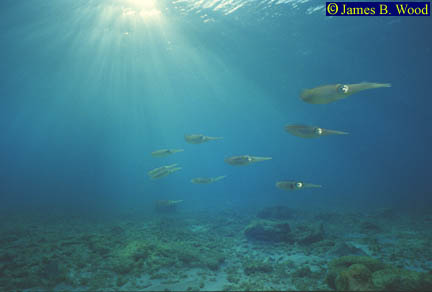 I'm not much of a free diver, but I was able to gulp enough air to get down near them several times. They watched me and knew what I was doing, but they let me get almost near enough to touch them. It was amazing. There was clearly intelligence here. But a very alien intelligence. My sense was that this was a family or a troop of some sort, maybe a school (sorry for the pun). The two larger squid on the ends changed colors and shapes almost simultaneously. Then the line did the same thing. At times, it was almost like seeing an electrical current pass through them. Then they would point their short tentacles like an arrow or open them. It was like they were taking the younger ones out for a field trip, showing them what to do in certain situations, how to capture food, etc. That may be projecting, but clearly, they were reacting to us and what we were doing and they were communicating among themselves in ways I could not immediately grasp. It was a close encounter of the third kind. Truly amazing. Eventually, I made one last pass down to where they hovered at the bottom and swam off. They swam off as well. I shall never forget it.
There is only one time in the history of each planet when its inhabitants first wire up its innumerable parts to make one large Machine. Later that Machine may run faster, but there is only one time when it is born.Follow-up thoughts: Reflect on our previous post about the pre-pre-historic megalith site of the Garden of Eden; are we in the same sort of primitive moment as our species emerges from the Industrial/Information Age to something we can't begin to imagine, with its own possibilities and limitations. Indeed, ch-ch-ch-changes are afoot. Will some future society look at our nascent internet connectivity and marvel at how primitive we were? Will there be any surprisingly forward-seeing relics of this moment? [Oh yeah, what happens when someone pulls the plug?]
You and I are alive at this moment.
We should marvel, but people alive at such times usually don't. Every few centuries, the steady march of change meets a discontinuity, and history hinges on that moment. We look back on those pivotal eras and wonder what it would have been like to be alive then. Confucius, Zoroaster, Buddha, and the latter Jewish patriarchs lived in the same historical era, an inflection point known as the axial age of religion. Few world religions were born after this time. Similarly, the great personalities converging upon the American Revolution and the geniuses who commingled during the invention of modern science in the 17th century mark additional axial phases in the short history of our civilization.
Three thousand years from now, when keen minds review the past, I believe that our ancient time, here at the cusp of the third millennium, will be seen as another such era. In the years roughly coincidental with the Netscape IPO, humans began animating inert objects with tiny slivers of intelligence, connecting them into a global field, and linking their own minds into a single thing. This will be recognized as the largest, most complex, and most surprising event on the planet. Weaving nerves out of glass and radio waves, our species began wiring up all regions, all processes, all facts and notions into a grand network. From this embryonic neural net was born a collaborative interface for our civilization, a sensing, cognitive device with power that exceeded any previous invention. The Machine provided a new way of thinking (perfect search, total recall) and a new mind for an old species. It was the Beginning.
In retrospect, the Netscape IPO was a puny rocket to herald such a moment. The product and the company quickly withered into irrelevance, and the excessive exuberance of its IPO was downright tame compared with the dotcoms that followed. First moments are often like that. After the hysteria has died down, after the millions of dollars have been gained and lost, after the strands of mind, once achingly isolated, have started to come together - the only thing we can say is: Our Machine is born. It's on.
But I was already writing. Inventing a vast, improbable fantasy for her of her own devising. The story of how we described the entire world to a piece of electrical current. A story that could grow to any size, could train itself to include anything we might think worth thinking. A fable tutored and raised until it became the equal of human hopelessness, the redeemer of annihilating day. I could print and bind invention for her, give it to her like a dead rat left on the stoop by a grateful pet. And when the ending came, we could whisper it to each other, completed in the last turn of phrase.
While I thought this, A. sat worrying her single piece of jewelry, a rosary. I don't know how I knew; maybe understanding can never be large enough to include itself. But I knew with the certainty of the unprovable that somewhere inside, A. still preserved the religion she was raised on.
For a moment, she seemed to grow expansive, ready to entertain my words from any angle. She opened her mouth and inhaled. Her neural cascade, on the edge of chaos, where computation takes place, might have cadcenced anywhere. For a moment, it might even have landed on affection.
It didn't. "I have to sit and listen to this," she said, to no one. "I trusted you. I had fun with you. People read you. I thought you knew something. Total self-indulgence."
A. stood up in disgust and walked away. No one was left to take the test but me.
What does it matter who actually wins this local and preliminary contest? What matters, surely, is not this particular machine but those that will follow, and here is a tale worth the telling, that of the one true rarity in the universe—the story of birth.
Or in that striving to be born, anyway, there is a story. Within the machine is a spark that wants out, it seems—as it seems we all want out. The paddling beast of burden begins to understand—that its sorry conclusion has arrived, its body is not a suitable body, its feet ought to be webbed, the chambers of its heart are insufficient to cross so vast a premise of water, and sunny millennia of grazing have maladapted it to this fluid new task ... Its each kick and throb expresses a wordless, inbred, outreaching dissatisfaction and a cry, a deeply abdominal despairing grunt, collects in its straitened throat. This cry wants out. The old man with his systematic scrapbooks, the scarred old woman his wife with her unsystematic body of grievances, equally they want out. They are, all of them, protesting, if they could form a genuine protest, they are making demands, if they could form a genuine protest, they are making demands, if they knew how to shape a demand. The din of their longings so thickens the air that it takes some time to discern what would be, if only there were words, the initial message intended for you. Give me a voice, they would say.
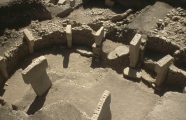
 This is amazing. Archaeologists are unearthing a megalithic temple site in southeastern Turkey that might have been the site of the mythical Garden of Eden. Scientists equate the myth with the evolutionary passage of human beings from a hunter/gatherer to an agricultural society. And with it the rise of civilization and conditions of scarcity. This site is called Göbekli Tepe and is nearly 12,000 years old.
"This place is a supernova", says Schmidt, standing under a lone tree on a windswept hilltop 35 miles north of Turkey’s border with Syria. "Within a minute of first seeing it I knew I had two choices: go away and tell nobody, or spend the rest of my life working here."
Behind him are the first folds of the Anatolian plateau. Ahead, the Mesopotamian plain, like a dust-colored sea, stretches south hundreds of miles to Baghdad and beyond. The stone circles of Gobekli Tepe are just in front, hidden under the brow of the hill.
Compared to Stonehenge, Britain’s most famous prehistoric site, they are humble affairs. None of the circles excavated (four out of an estimated 20) are more than 30 meters across. What makes the discovery remarkable are the carvings of boars, foxes, lions, birds, snakes and scorpions, and their age. Dated at around 9,500 BC, these stones are 5,500 years older than the first cities of Mesopotamia, and 7,000 years older than Stonehenge.

The thesis is this. Historians have long wondered if the Eden story is a folk memory, an allegory of the move from hunter-gathering to farming. Seen in this way, the Eden story describes how we moved from a life of relative leisure - literally picking fruit from the trees - to a harsher existence of ploughing and reaping.
And where did this change take place? Biologists now think the move to agriculture began in Kurdish Turkey. Einkorn wheat, a forerunner of the world's cereal species, has been genetically linked to here. Similarly, it now seems that wild pigs were first domesticated in Cayonu, just 60 miles from Gobekli.
This region also has Biblical connections, tying it closer to the Eden narrative. Muslims believe that Sanliurfa, a nearby city, is the Old Testament city of Ur. Harran, a town down the road, is mentioned in Genesis twice.
 Maybe this was where they herded the dinosaurs! Oh, wait: the earth is only 6,000 years old. I guess this is just another one of those tests of faith that tricky sky god keeps throwing our way.


 Chaiten, Patagonia