Showing posts with label Truth. Show all posts

31 January 2022

THE LIAR'S PARADOX (Epimenides's too!)

The Epimenides paradox goes something like this:

“Epimenides the Cretan says, ‘that all the Cretans are liars,’ but Epimenides is himself a Cretan; therefore he is himself a liar. But if he be a liar, what he says is untrue, and consequently the Cretans are veracious; but Epimenides is a Cretan, and therefore what he says is true; saying the Cretans are liars, Epimenides is himself a liar, and what he says is untrue. Thus we may go on alternately proving that Epimenides and the Cretans are truthful and untruthful.” Thomas Fowler, The Elements of Deductive Logic (1869)


Another formulation, the so-called Liar’s Paradox goes: ‘Everything I say is false.’ ‘I am lying.’ 


Do not get lost in the truth-functional contradictions implied by these statements. For when you set truth and falsity aside, these statements convey a surprising amount of information. For example, we establish the assumption that:


            (0.1) There is such a thing as a statement of the language.

(0.2) This is a well-formed statement of the language. {function; copula; predicate}


This is obvious. It is the basis of the game we are playing. But moreover, simply by attempting to decide its ambiguity, we affirm that:


            (1.1) Some statements have truth.

            (1.2) Some statements have falsity.


Then, looking at the paradox and acknowledging its essential contradiction, we conclude that:


            (1.3) Some statements have neither truth nor falsity, and thus

            (1.4) are undecidable to our linguistic understanding.


In a world where truth functions determine meaning:


            (2.1) There is more to information than mere MEANING.


What other information can we glean from this logical paradox (other than attempting to solve it by noting that just because the statement “everything I say is false” is false does not imply that everything else I say is true, or, as is the case with most philosophers, explaining it away by saying that we are applying truth values ambivalently in the language and the metalanguage)? We can ascertain data about the speaker Epimenides, or the so-called Liar (L), who makes these statements:


            (3.1) L can make certain well-formed statements of the language about himself.


Whether they are true or false matters not at this point to us. Thus,


            (3.2) L is not necessarily a reliable witness about himself.


And while we can make no inferences about L’s self-consciousness of the truth or falsity of his statements, we can certainly assert that:


            (3.3) L’s statement sows confusion.


For example, if we imagine a contradiction machine, a machine that can calculate statements logically, then such a paradoxical input statement will disable the machine.


Without any further information about his intentions, we cannot determine whether L actually is a liar or or is merely mistaken or whether he’s intentionally sowing confusing or merely playing a game or whether he’s bullshitting us or is merely confused.


Generally, though, our thinking and thus our understanding of reality and, what’s more, our understanding of who we are is necessarily limited by the language we use. And Epimenides’s paradox here points us to merely one facet of this limitation.


To ask the question of meaning, to ask what it all means, is to ask the wrong question. It is to voluntarily stop at the gates of the prison that constrains us: the prison of language.

03 December 2009

Truth, Politics, & Running—A Follow-Up


A quick follow-up to this post. In that earlier Family-of-Values post, I discussed the nature of truth as both a political and journalistic value. This clip of Dana Perino, the former spokesperson for the President of the United States (G.W. Bush) illustrates the point.

She is simply and obviously wrong when she states that "We did not have a terrorist attack on our country during President Bush's term." It's a ludicrous statement on its face, but she says it with a straight face as if she believes it. This is why I do not miss the former administration: one could never tell when they were lying or were ignorant, and trying to sort it out was maddening. Recall Scott McClelland telling the press that Karl Rove and Scooter Libby had assured him they had nothing to do with outing CIA operative Valerie Plame when their (and VP Cheney's) fingerprints were all over the operation.

Here, it's not clear whether Perino is lying, or mistaken, or actually believes that 9/11 happened on someone else's watch. And it doesn't matter which. She is simply wrong.

Hannity had an obligation, likewise, to correct the record. Surely he knew different. Yet he said nothing and let the moment pass, doubling the offense.

It's clear neither of them (or the other guest, Varney) cared one whit for the truth of the matter. They are nihilistic with respect to the value of truth.

There are undoubtedly some who watch that program who believe what she said. And others who would like to believe it, forgetting how the conservative administration fell asleep at the switch. It is part of the misleading, revisionist narrative these conservatives hope to weave.

Remember the phrase cui bono? Loosely translated it means "Who benefits?" Who benefits from such a pernicious lapse of truth-telling? Not the current administration or its party. Whenever the Bushians engaged in these sorts of Rovian tactics, it was always for their own benefit. It's odd how self-serving their 'mistakes' always tended to be...

-------------------
On a separate "blegstitution" note, one of my readers—Frances Madeson—has nominated my Blunderbuss post for the 3QuarksDaily Politics Prize. Thanks, Frances. I am honored. And even if you disagreed with my opinion on the matter (JMP?), I ask you to go over to 3QuarksDaily, read the nominated posts, and vote—preferably for me. The nominated posts are in alphabetical order, so mine is at the end. [I will append this message to all my posts until the voting deadline.]

-------------------
Oh yeah, one other thing, following up my Fringe posts. Here I am at mile marker 9. Note the shoes. LOL. ROFLMAO.

24 November 2009

Family of Values: Truth


This is an inaugural post in what I propose to be an on-going, though intermittent, series discussing some core Western values—e.g., Truth, Knowledge, Meaning, Beauty, Justice, Fairness, Equality, Respect, Love, Goodness, Kindness, Wisdom, Creativity, Rationality, Freedom, Order, The Good Life, etc.

In 1986, Harry Frankfurt first published an essay in the magazine 'Raritan' entitled On Bullshit. Bullshit is, essentially, a disregard for the the truth of what one says. It isn't quite lying—which is deliberately stating something that is untrue—it is, on Frankfurt's account, something worse. When later published in book form in 2005, Frankfurt's essay seemed to capture the zeitgeist of the time. Public figures were more interested in advancing an agenda than speaking truth. Sales and marketing and PR forces were more interested in selling credit default swaps or SUVs or mid-East wars or fraudulent memoirs or $5/gallon oil than counting their true costs.

Bullshit heedlessly admixes truths with untruths. Bullshit leaves the hearer confused, foundering, scrambling for a purchase on reality. In politics, bullshit is particularly useful in a politics of a certain style. This style does not fret about hypocrisy or correspondence with reality; rather, it uses every means at its disposal to assail its adversaries. That is its sole purpose. That is to say, bullshit is a tool in the politics of destruction, rather than construction. It is part and parcel of the politics of force, rather than of consensus. Inconvenient truths, on this model, are scorned. Truth-tellers in the Bush administration, e.g., were often ridiculed (Paul O'Neill, Richard Clarke) or silenced (Lawrence Lindsay, climate scientists) or publicly attacked (Plame/Wilson) or simply shit-canned (Shinseki).

Why is truth so devalued in our society? Philosophers have long recognized that truth is a "meta" value. To say something is true is to make a value-statement about a statement-of-fact. We don't say 'the snow is true', e.g. We say, rather, 'snow is white.' And, along with Alfred Tarski, we say further "the statement 'snow is white' is true if and only if snow is white."

So, when we say something is a "meta" value we are dealing in the world of modernism, the world of analysis, the world of metaphysics (semantics) strictly construed: a Tractarian world, if you will, where what matters is 'what is the case.' We are dealing with normative statements about other statements, not statements about the world. And the only legitimate statements are statements that are grounded in knowledge. Truth does not exist in the real world; it exists only as a value in our attempt to understand facts about the real world.

We are living, however, in what many would call a post-modern world. A world where authenticity, simplicity, and action are prime. Not a world of thought, complexity, and reflection. In such a world, it doesn't really matter what you think; it matters what you feel. It doesn't matter whether you understand something; it matters what your opinion is. It doesn't matter what you know; it matters what you believe. It doesn't matter what is true; it matters who you are and what your attitude is—say or do what you will. So long as your point-of-view prevails.

But there is nothing new about this post-modern world; it is a reversion to the world of the sophists, the target of much of Socrates's arguments. In this morass, truth is merely one among any number of competing values (if that), and the people who try to tell the truth are shouted down either by the people with the platforms and the agendas or the ignoramuses (or, more likely, a toxic combination of both).

Truth is uninteresting, boring even. Journalists who try to be truthful are grey. Factual. So what if snow is white? So what if Saddam Hussein had nothing to do with the atrocities of 9/11? So what if Iraq had no WMD? So what if the surpluses in the public treasury have been siphoned off by politically-connected private interests who, in turn, use their wealth and influence to prop up their political benefactors? So what if Dick Cheney tells a flat-out lie on camera to Gloria Borger? So what if the sky is falling?

Advocacy journalists, on the other hand, are interesting. Dynamic. Yellow. They can rant and rave and say pretty much whatever they please ungoverned by (or at least not restricted to) truth, so long as their ratings or readership stays high—which they will.

As an aside: It's amazing how much that passes for 'news' on the cable news networks originates from Public Relations firms. That, I think, is the story of the age that continues to go untold. Rather than investigating and reporting, these news organizations passively and mostly unquestioningly rely on what they are spoon-fed by professionals whose job it is to advance the agendas of their clients, whether they be celebrities or politicians or government entities.

To end this first piece in this series, I'll leave you with a quote from this article which calls contemporary journalists to be accountable for truth:
"we need journalists who scrutinize and question not just government officials, PR releases, and leaked documents, but their own preconceptions about every aspect of their business. We need journalists who think about how many examples are required to assert a generalization, what the role of the press ought to be in the state, how the boundaries of words are fixed or indeterminate in Wittgensteinian ways, and how their daily practice does or does not resemble art or science." Carlin Romano, "We Need 'Philosophy of Journalism'". 11/15/09 The Chronicle Review (h/t the estimable Arts & Letters Daily)

26 October 2008

Truth Will Out

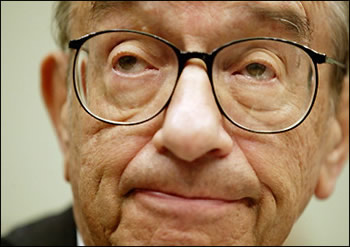
On Thursday October 23, 2008, former Chair of the Federal Reserve, Alan Greenspan, testified before Congress. In that testimony, under questioning from Rep. Henry Waxman (D-MI) he stated:
REP. HENRY WAXMAN: The question I have for you is, you had an ideology, you had a belief that free, competitive -- and this is your statement -- "I do have an ideology. My judgment is that free, competitive markets are by far the unrivaled way to organize economies. We've tried regulation. None meaningfully worked." That was your quote.

You had the authority to prevent irresponsible lending practices that led to the subprime mortgage crisis. You were advised to do so by many others. And now our whole economy is paying its price.

Do you feel that your ideology pushed you to make decisions that you wish you had not made?

ALAN GREENSPAN: Well, remember that what an ideology is, is a conceptual framework with the way people deal with reality. Everyone has one. You have to -- to exist, you need an ideology. The question is whether it is accurate or not.

And what I'm saying to you is, yes, I found a flaw. I don't know how significant or permanent it is, but I've been very distressed by that fact.

REP. HENRY WAXMAN: You found a flaw in the reality...

ALAN GREENSPAN: Flaw in the model that I perceived is the critical functioning structure that defines how the world works, so to speak.

REP. HENRY WAXMAN: In other words, you found that your view of the world, your ideology, was not right, it was not working?

ALAN GREENSPAN: That is -- precisely. No, that's precisely the reason I was shocked, because I had been going for 40 years or more with very considerable evidence that it was working exceptionally well.
The news media has seized on this and expressed shock that Methuselah—I mean, Greenspan—could be so candid in admitting fault. For years Mr. Greenspan's word alone was sufficient to sway Congress not to impose regulations on complex financial transactions, to worry about non-existant inflation, not to worry about deficits, etc. He was treated with the greatest deference, even when he spoke a vague, gobbledy-gook economics jargon that few Congress members or members of the press could understand. Much media time and labor was spent trying to parse his words.

To me, this admission of fault is not the most shocking aspect of this piece of testimony. What is astonishing is his absolute faith in ideology. He isn't saying that having an ideology is wrong; he is saying that his own ideological framework needs to be tweaked.

An ideology in the soft sciences (the social sciences like sociology, poli-sci, economics, psychology) is more like a literary theory or a theology than a theory in the hard sciences. It is a belief in the absolute ability of an abstraction to explain actual facts and the subsequent attempt to explain, or reconcile, all observable facts in terms of its principles and axioms. Where the facts don't fit, they can be changed (recast, spun, revisioned, ignored) to suit the ideology. Facts in the soft sciences are squishy, themselves open to interpretation. Faith in an ideology is thus easily justified. Reified. Moreover, there is a recursive (or cybernetic) quality to soft facts: they are subject to feedback. And if, as in Greenspan's case, the ideologue is in such a position of power to shape events, results can be altered, data controlled, information limited (positive results trumpeted, negative results buried, distorted, or actually concealed) to make it seem the ideology is correct. The purpose for this, of course, is to increase the power of the ideologue; for once the ideologue admits failure of the ideology, then there is no further need for the ideologue. That is why these guys never admit mistakes, or even question their own assumptions, when they are in office. Never underestimate the power of self-delusion among the ideologues—whether it be religionists or atheists, post-modern identity politics literary critics, free-market economists, Marxist historicists, neo-con political scientists—especially when they have the power to influence the results.

Greenspan's 'come-to-Jesus' moment before Congress is remarkable, then, for a number of reasons. He admits to being in the thrall of an ideology(!), pronounces it flawed and in need of tweaking(!), but does not concede that life can—and perhaps should—go on in the absence of such. In fact, he claims an ideology is necessary to life. If truth is subject to the dicta of ideology (especially a self-reifying, self-delusional ideology), then expect disaster, or at least crisis, when reality intrudes. In an analogous context, Freud refers to the return of the repressed in the psyche of the individual. An earlier writer likewise noted:

Nay, indeed, if you had your eyes, you might fail of
the knowing me: it is a wise father that knows his
own child. Well, old man, I will tell you news of
your son: give me your blessing: truth will come
to light; murder cannot be hid long; a man's son
may, but at the length truth will out.
Shakespeare, The Merchant of Venice, 1600:
Maybe it is my training in philosophy, but, to me, truth is an absolute value, not part of a value system or subject to some ideology. Understanding reality, getting it right to the best of my limited ability, is crucial to life, not trying to form fit facts into some mental construct or "conceptual framework" (which may or may not be misguided). Truth is never, as some claim, obvious. One of the most powerful men of our age, one of its wisest according to conventional wisdom, has just admitted to living his life under the influence of an ideology and allowing it to color his judgments—judgments that have had enormous real-world consequences for us all. And, from my point of view, he is unrepentant in his abject dependence on his delusions.

04 February 2008

On the couch

A rich guy decides he wants have some fun, so he decides to go to see a shrink.  He is a habitual liar.  He vows to make up stories about himself while he is on the couch, to create a purely fictional life for the psychoanalyst to see what kind of responses he gets.  His analyst makes good faith interpretations of the man's false statements about himself (as presented) while on the couch.  The question is:  can the doctor arrive at any truth about the man himself?

This little scenario raises interesting questions on the theme we abandoned a few posts back, as well as many others.  For one thing, it is a metaphor for the relationship between the fiction writer and the reader or critic who feels she can infer something about the biography of the writer from the text of his writings.  Some readers feel that they could not possibly like a writer or his works because they do not like the characters he creates, and, by implication, the writer is necessarily like his creations.

This interests me at the aesthetic level because I am a fiction writer.  For inspiration, I draw on my own experiences as a springboard for my fiction ("write what you know").  But I use my imagination and I dramatize my experience; that is, I try to conform my experience to the form and rhetoric of fiction.  I do not believe my writing, then, bears any resemblance to my life nor my characters to me.  Still, when we speak of fiction we often speak of its 'truth'.  What, then, is that truth?  Does something 'true' about me leak out of my fictional characters' responses to their dramatic situations? Do my stories betray something about who I really am?

Should I be worried?