After last week's change in format in which we laid out what may be two of the BIGGEST news items in human history (no joke: [1] an extinction event that may include us + [2] evidence of possible extraterrestrial life) plus one of the greatest frauds ever perpetrated on the world, we return to aggregating links about our planet's most precious resource—and there are plenty!
Scientists are finding further evidence of how Greenland is melting. [The Times link has amazing drone video and remarkable graphics.] Why does this matter? Greenland's ice sheets sit on land, so when they melt they cause the oceans to rise—unlike, say, a melting iceberg which is the example climate change denialists always cite, claiming that melting ice is like an ice cube in a glass of water and does not contribute to rising sea levels.
Permafrost warming in Alaska is 'accelerating', threatening to release dangerous levels of the greenhouse gas methane into the environment. Researchers worry that this could cost the world's economies trillions of dollars more in damages.
This year's snowpack in the High Sierras was the worst in the past 500 years, and the snow's water content was only 5% of its historical average over the same period.
Hurricane Patricia, the most powerful cyclone ever recorded in the Western Hemisphere, struck land on the west coast of Mexico bringing torrential rainfall and flooding as far north as Michigan.
The recent flooding in South Carolina is the result of at least the 6th 1-in-a-1000-year rain event in the U.S. since 2010.
This year's 'dead zone' in the Gulf of Mexico, a result of excess rainfall and nutrient runoff from the Mississippi River, is larger than average and much larger than expected.
Iran's Lake Urmia, once the planet's sixth largest salt lake (larger than Utah's Great Salt Lake) has dried up to a mere 10% of its size, similar to what happened to the Aral Sea in Central Asia, exposing a vast salt desert.
The Obama administration has created two new marine sanctuaries in the U.S., the first such in 15 years, one in a portion of Lake Michigan and the other in the Potomac River.
In a 2-1 ruling, a panel of the Sixth Circuit Court of Appeals has blocked U.S. efforts to keep its streams and wetlands clean.
U.S. Representative Lamar Smith (R-TX), chairman of the House Science Committee, has launched a wide-ranging, open-ended inquisition into climate scientists' recent findings that global warming is not in some sort of pause or hiatus, subpoenaing email records and other communications of internal deliberations from NOAA and the National Centers for Environmental Information. There are currently no allegations of corruption or wrongdoing.
Oxybenzone, an ingredient in most sunscreen brands, is killing coral, causing DNA damage in both adults and larval stage animals. This only adds to the effects of warmer water temperatures on delicate coral marine life, i.e., "coral bleaching" that is happening world wide.
No one is quite sure how to solve the world's water problems, but there is much work to be done.
A Dutch company called Elemental Water Makers is working to use 100% renewable energy to desalinate seawater with a pilot project in the British Virgin Islands—the type of solution this blog has been advocating for years.
28 October 2015


19 October 2015
This Week in Water
As the UN Climate Change Conference in Paris approaches, I want to change the format for this week's TWIW post and interject an argument and some editorial opinion. Normally, TWIW is a news aggregator replete with interesting links to issues and news about our planet's most important resource. If you want to take a look at past posts, simply click on the "This Week in Water" link in the "Labels" below.
Sometimes there is so much news that it becomes difficult to see the forest for the trees—or the ocean for the waves as the case may be. As with the last post about the discovery of evidence of flowing water on Mars, this week brings us three VERY BIG items and, in this instance, they deserve some discussion and thought.
Item #1—Exxon Evidence. Evidence has come to light that Exxon has had specific internal knowledge about the drastic, deleterious effects of man-made global warming since the 1980s—to wit, melting glaciers and polar ice and rising sea levels. Yet, internal documents show that the company used its vast marketing and political power not only to conceal this fact from the world but has been actively lying about it to its shareholders, the public, and regulators. In the meantime, it has used this knowledge to figure out how to improve its extraction of even more damaging fossil fuels from the earth. "Genocidal Behavior" and "Sociopathic Greed" hardly begin to describe this concerted series of potentially planet-murdering actions. In a truly free market with valid 'price discovery mechanisms', these costs would/should necessarily have to be borne by the company and figured into its balance sheet; yet Exxon-Mobil (and other fossil fuel extraction-based companies and their suppliers and supporters) continues to receive billions of dollars in U.S. tax breaks and subsidies and to profit from its criminally insane behavior while ignoring the public costs of their business. Questions about the viability of possible legal and/or political remedies are, hopefully, arising globally, though the damage may be irreparable. And the fact is there may be no specific laws to punish and remediate these companies' actions.
Item #2—Extinction Event. The planet is currently facing what scientists are calling its Sixth Great Extinction Event, and some are asking whether humans can survive this catastrophe. This results partially from a collapse of the food chain originating in our ocean ecosystems due to rising levels of atmospheric carbon dioxide and warming global climate.
Item #3—Extra-terrestrials? Back in 2010 I posted a piece about so-called Kardashev civilizations. [Go on, read it; it's pretty cool. It'll open in a new window. Besides, this post isn't going anywhere.] Now, astronomers have discovered an anomalous star in our galaxy some 1500 light years away that shows some signs that might be indicative of an alien civilization approaching a Type II Kardashev civilization, namely one which is able to harness the energy of a star to fuel its development. (By contrast, earth's civilization is ~0.7 on the Kardashev scale because we are barely beginning to capture solar, wind, hydro, and tidal power) One explanation for the behavior of light from this star is that there are advanced life forms constructing a Dyson Sphere around their sun. Of course, there are plenty of other hypotheses to be eliminated before anyone can claim this for certain. Still, it's potentially HUGE news—I mean, the biggest news in human history. (How does this relate to water, you might ask? If there is such a civilization, they must certainly have some form of watery world resources. Okay, it's tenuous, but it's such a huge piece of news I couldn't resist.)
One fairly straightforward conclusion to draw from these Items is that our planet's continued reliance on fossil fuels (due, mostly, to the economic and political power of the extraction industries) is killing us, and if we want to advance and perhaps even to survive as a civilization and possibly a species we need to change our behavior radically, moving to sustainable energy practices before it's too late. How this can seem even remotely controversial continues to baffle me.
29 September 2015
This Week in Water
Really, there is only one piece of water news this week:
NASA has discovered evidence of flowing salt water on Mars.
That is to say: NASA HAS DISCOVERED EVIDENCE OF FLOWING SALT WATER ON MARS!!!!!!!
NASA has discovered evidence of flowing salt water on Mars.
 |
| Dark lines indicate where water flows on Mars |
That is to say: NASA HAS DISCOVERED EVIDENCE OF FLOWING SALT WATER ON MARS!!!!!!!
22 September 2015
This Week in Water
I've been away and been distracted; apologies. A lot has happened in our watery world in my absence so let's get to it, focusing this week on the threats to our oceans.
Scientists are claiming the upcoming Paris climate talks are paying insufficient heed to the dangers posed by global warming to the world's oceans.
Scripps oceanographers have found the fourth lowest Arctic sea-ice minimum ever recorded this year and surprising turbulence under the surface.
As reported here many times over the years, rising seas threaten U.S. coastal cities such as San Francisco in the near- to mid-term future.
Long-term warming trends coupled with this year's super strong El Niño are causing unprecedented bleaching and death of Hawaii's coral, and the outlook is not good.
This year's dead zone in the Gulf of Mexico, at approximately 6,474 square miles, is significantly above average and larger than forecast even in June.
The impact of the 1989 Exxon Valdez oil spill in Alaska's Prince William Sound has been far greater than anyone thought, including heart defects in salmon and herring due to exposure to crude oil toxins in the seawater.
A newly discovered underwater volcano in the Pacific Ocean is spewing carbon dioxide, thereby further acidifying the ocean and turning vibrant coral gardens to carpets of algae.
A pristine underwater ecosystem of ocean life has been discovered off the south coast of Australia at unexpected depths.
The U.S. Navy has agreed to reduce underwater explosive testing and mid-range sonar training off the coasts of California and Hawaii that have killed a number of whales, dolphins, seals, and sea lions and adversely affected the hearing abilities of many others.
The Everglades Foundation of Palmetto Bay has announced a $10 million prize to entrepreneurs who come up with a solution to the world's growing algae populations. The algaefication of the oceans and freshwater ways (including so-called dead zones) is caused by phosphorus and nitrogen and other chemical runoff from fertilizers and from sewage treatment.
The University of Hawaii at Manoa's Hawaii Undersea Research Laboratory (aka HURL) has been exploring the deep seas since the 1980s. [Great article from the NY Times about HURL's important work.]
31 August 2015
Somewhere Over the Rainbow: Maui Wowee!
Adventure time on the Valley Isle (click pics to embiggen slide show):
 |
| Old Japanese cemetery—but why on a sand dune? |
 |
| Sunset in Lahaina |
 |
| Hiking in the West Maui mountains: Waihee Ridge Trail. Yes, it's a sheer drop on either side |
 |
| The footing was, to say the least, tricky |
 |
| You can't be afraid to get your feet wet or use your hands to scramble |
 |
| But, wowee! Worth it it was: OVER the rainbow, volcano, + ocean. Yes, OVER the rainbow |
 |
| Then turn 180º for this paradisal view as the clouds lifted: We counted 14 waterfalls from this vantage, many over 1000'. Magical Maui! |
 |
| Post-hike. Sore feet. |
 |
| View on the Hana Road |
 |
| Muddy Bamboo Forest hike past Hana |
 |
| Can't even see the top! |
 |
| Don't like wet hiking? Try a caldera in an extinct volcano above the clouds |
 |
| Silver Sword—a plant unique to Haleakala at 10,000' |
 |
| Selfie with trail across the volcano visible. Approx. 11 miles across (for scale) |
 |
| !!!!!! |
 |
| That's all uphill on the way back |
 |
| A rainbow 'round the sun! |
 |
| "Slow down, Daddy. There's a turn up ahead you don't want to miss!" "Doesn't anyone want to play 'Thelma & Louise?'" |
 |
| "Y'know, I think that's where all our information is stored now." "Really, Daddy? Really?" |
 |
| Maui sunset from our friends' lanai in Kula at 3000' |
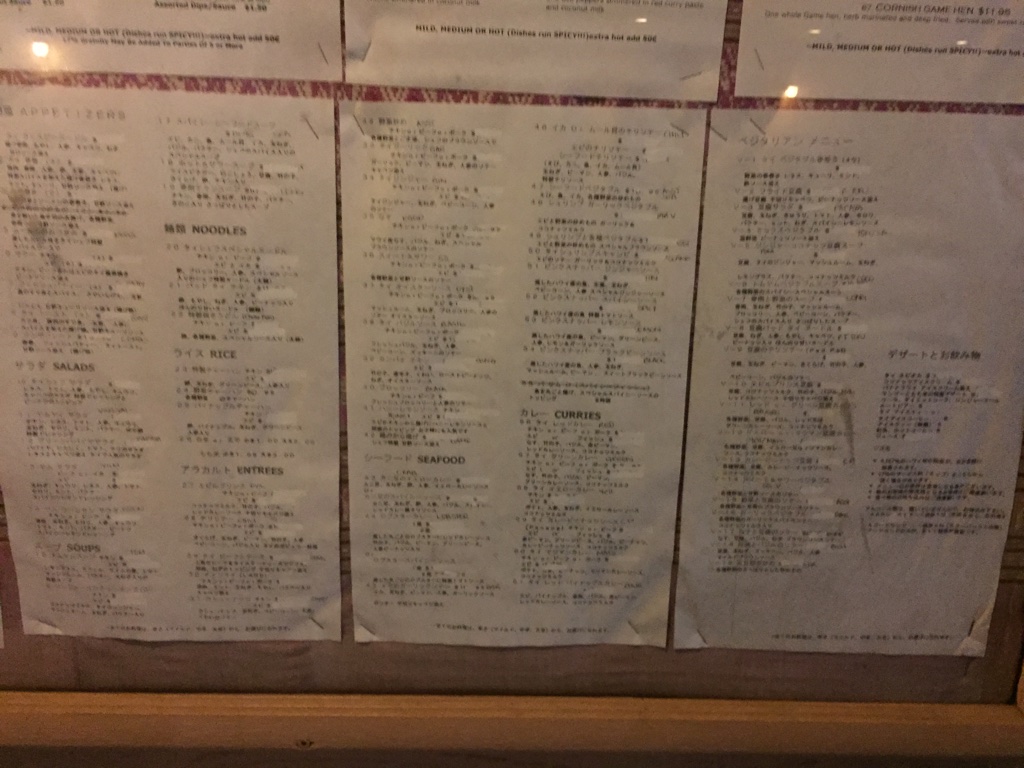 |
| Does your Thai restaurant menu look like this? It should! |
28 August 2015
I'm Back
And I have pics! Enjoy.
(click pics to embiggen slide show)
(click pics to embiggen slide show)
 |
| Is it me, or does the Red River seem dry? |
 |
| Narrow band of green + parched land around the Colorado River |
 |
| Ditto |
 |
| Leaving the continent. Hurricane Delores lurking out at sea. |
 |
| Why isn't your airplane painted like a salmon? |
 |
| Iconic view of Diamondhead from Waikiki |
 |
| Honolulu from Diamondhead with western mountains as backdrop. (Because it was there) |
 |
| The East-West Institute at UH at Manoa |
 |
| Stand of rare yellow bamboo |
 |
| I have no idea what this portends. (Above Kailua) |
 |
| For your Japanese bluegrass listening pleasure |
 |
| Searing my mackerel sashimi at Izakaya Naru |
 |
| Humuhumunukunukuāpua'a, (Try saying that. No Singing. See below.) aka Hawaiian Reef Trigger fish: the beautiful State Fish |
 |
| Scorpionfish, also seen while diving off Oahu. There were some cool white-tipped reef sharks and large sea turtles there, too! |
 |
| How do you say swimming pool in Hawaiian? Waimea Valley, North Shore, Oahu |
 |
| Farewell Indian feast at Cafe Maharani, our favorite. |
[Sorry about that, folks. Maybe this will get that saccharine taste out of your mouth.]
08 August 2015
The Next Two Weeks in Water
Once again, my lovelies, I must away—this time to visit son Wisdomie. It's doubtful I'll be posting for the next couple weeks. I may have the opportunity to tweet (if you're following me look for pics!). If you notice a pin drop on your blog's hits stats map somewhere out in the middle of the Pacific Ocean, never fear! it will most likely be mine. So, it will be the next two weeks in water for Jim H. Until then, there are plenty of links in my previous "This Week in Water" post to keep you worried. And let's hope we don't make news like we did a couple years back when we dove Lehua off Ni'ihau.
And not to worry, Bruno, Lily, and Sasha have will have plenty of company here to look after them while we're away.
And not to worry, Bruno, Lily, and Sasha have will have plenty of company here to look after them while we're away.
06 August 2015
This Week in Water
Enough about me. Let's get back to the urgent stuff like the sustainability of life on Planet Earth and the peril of its most precious resource.
Rising ocean temperatures, attributed to global climate change, are pushing closer toward the North and South Poles, imperiling many ocean habitats and species.
Though their political leaders continue to deny it, climate change is taking its toll on Texas: among other things, extreme weather events and flooding are becoming increasingly common.
May was the wettest month in U.S. history, especially in places like Texas and Oklahoma.
Climate change, rising oceans, storm surges, and heavy rainfall threaten the biggest U.S. cities. Washington, DC, is sinking into the ocean even as seas rise.
California's historic drought is beginning to kill its redwoods and other iconic trees.
Rising air and water temperatures have killed half of the Columbia River's sockeye salmon.
The wettest rainforest in the U.S. has gone up in flames.
The world's glaciers are melting at the fastest rate since record-keeping began.
Thailand's vital rice belt is drying up due to unusually severe drought.
Water at a number of Olympic venues in Rio de Janeiro contains dangerously high levels of viruses and bacteria like that found in raw sewage. Needless to say, the athletes are not happy.
No one is quite sure how to deal with the vast amount of radioactive water stored near the Fukushima nuclear plant after the 2011 tsunami disaster there.
Debris washed up on Reunion Island (near Madagascar) has been identified as being from Malaysian Air Flight 370 which disappeared mysteriously in the Indian Ocean last year.
Weighing the huge environmental costs of the enormous new Nicaragua Canal.
Japanese scientists have come up with a method to extract lithium from seawater.
An invasive species of microbial alga has taken up residence inside the cells of Caribbean coral animals improving their ability to withstand heat stresses from the global rise in ocean temperature but retarding their reef-building capabilities.
California senators have introduced emergency drought relief legislation.
Renewable energy is killing the nuclear power industry, at least for some investors.
Apple, Microsoft, Google, and other major U.S. firms have committed $140 billion to address climate change.
I know I keep beating this drum, but here's another approach to desalinating sea water with solar power. [Aside: Seriously, finding the right technology to accomplish this task is a superhighway to becoming famously wealthy and saving the planet. Doing well by doing good! There are plenty of investment opportunities out there for us little guys, as well.]
The deserts of the American West were lush wetlands up until about 8000 years ago. [Aside: I've posted pics of the seafloor-like area around Salt Lake City.]
An enormous aquifer has been discovered in Namibia.
Hot springs have been discovered below the Gulf of California.
A massive hidden salt-water ocean has been discovered beneath the Tarim basin in northwestern Xinjiang, China, one of the driest places on Earth.
If you didn't see video of this story, you must: Environmental activists suspending themselves from a bridge over the Willamette River in Portland, OR, and others in kayaks on the water stalled an icebreaker belonging to Royal Dutch Shell from exiting the port and going to sea. It was headed to the Arctic to assist in one of the first Arctic drilling operations in history. The protestors were eventually removed by authorities, and the ship made its way northward.
05 August 2015
"Go to Lost Wages"
The last two legs of Road Trip 2015 took us 216.4 miles from Williams, AZ, to Las Vegas and then, two days later, 270.3 miles to Los Angeles, two relatively light days of driving.
En route to Vegas we detoured through Sedona, AZ, via Oak Creek Canyon. The drive is considered one of the top five most beautiful in the country by Rand McNally. I will not disagree. Sedona is a cute, new-Agey sort of oasis purportedly rife (apparently like Woodstock, NY) with cosmic "vortexes" (sic) that provide positive energy to its visitors. We had a nice sandwich there.
Near Vegas we stopped at Hoover Dam, a 1930s monument to slide-rule engineering, hydraulic energy, and BIG Government. The water levels were way down.
In Las Vegas, I avoided the impulse to gamble, slept late, enjoyed a few decent meals, and took in the sights while Wisdaughter & partner caught up with old friends who live there (+ whatever).
On I-15 on the Nevada/California border, we topped a hill and saw what looked like three gigantic Eye of Sauron towers guarding the valley floor surrounded by a vast mirage of a body of water. Turns out, it's the Ivanpah Solar Power Facility, the largest solar array in the country—another monument to BIG Government renewable energy production. Thousands of solar panel mirrors spread over five square miles focus the sun's light on the 500' tall tower tops, and this reflects on cars driving by. [Sorry no pics. If you're interested, check out the linked website.]
We made a tactical mistake attempting to drive from Vegas to LA on Sunday morning. Turns out, it's when everybody from SoCal does the same thing after a weekend of debauchery. We drove I-15 through the Mojave Desert in a perpetual traffic jam which was made worse because it had been closed the day before by wild fires. Fortunately, the fires were doused by the remnants of Hurricane Delores which dumped a single day record rainfall on SoCal, smashing as well the monthly record for July in a mere few hours. Flooded desert did not, however, put a sizable dent in the record drought. Unfortunately, the heavy rainfall and dark, low clouds slowed traffic down even more than usual, turning what should have been a four-hour drive into about an eight-hour ordeal. Literally, the only rainfall we encountered on the entire trip was one of the driest places in America, and it was "super historic".
Notwithstanding, we delivered Wisdaughter, her partner, and their cars safely to LA and U.S.C., got them moved in, had a brief look-see downtown, enjoyed a couple of good meals (Izakaya, yo!), hit up IKEA, constructed some furniture, and flew home, sadder but richer for the experience.
Now, pics. Click pics to embiggen slideshow.
 |
| 2000' Red Rocks and White Rocks on the Oak Creek Canyon drive |
 |
| Red Rocks near Sedona |
 |
| Iconic view near Sedona |
 |
| Sedona "energy" |
 |
| More of the same |
 |
| Wait! Who told Ansel Adams he could shoot pics from my car. (h/t Wisdoc) |
 |
| Low water levels around the turbines at Hoover Dam |
 |
| I-15 bridge at Hoover Dam |
 |
| That '30's aesthetic |
 |
| The Dam, 700' thick & 700' high |
 |
| Fake NYC in fake Las Vegas |
 |
| The ONLY avenue in Vegas |
 |
| Chihuly ceiling in a casino |
 |
| Dinner (French) with a view of the Bellagio fountains |
 |
| New Yorker cartoon |
 |
| Fake Paris in fake Vegas |
 |
| Best road sign: name a road using only the last 3 letters of the alphabet |
 |
| You know you're in LA when... |
 |
| An Izakaya feast |
 |
| And we arrive at our destination |
 |
| Lovely USC campus |
Subscribe to:
Posts (Atom)