More photographs from my visit to that picturesque, high desert oasis by the Inyo National Forest called Mono Lake for you to enjoy. There is just so much happening in each shot, and the character and color of the water seems to change by the moment.
But first, true story: the other night I was scrolling through the movie channels on my electric teevee machine, and my eye alighted on the opening of Clint Eastwood's 'High Plains Drifter', and I was like "Wha?" And sure shootin', it was filmed almost entirely at Mono Lake. Fortuity? Serendipity? Who knows. Naturally, I couldn't NOT watch.
(as always click pic to embiggen slide show, or right click to open expandable, downloadable, desktop quality photo)
Is there any such thing? Let's investigate—for good or ill. A blog about fiction and literature, philosophy and theology, politics and law, science and culture, the environment and economics, and ethics and language, and any thing else that strikes our fancy. (Apologies to Bertrand Russell)
25 March 2016
23 March 2016
Mono Lake (This Week in Water, Kinda' Sorta') Pt. 2
As promised, more photos from my shoot at Mono Lake (as always, click to embiggen slideshow, right click for expandable, downloadable page):
I apologize if some seem repetitious, but lighting, line, color, shape, texture, form, or pattern seemed to change almost by the moment. Enjoy!
FYI: I have new lockscreens on my iPhone and a new desktop on my iMac now!
21 March 2016
Mono Lake (This Week in Water, kinda' sorta') Pt. 1
This is not really a new #ThisWeekInWater, but it sorta' is.
Sometimes you get lucky. We all know people who are photogenic. They may look undistinguished in real life, but when you see them in a photograph they look amazing. There are also places that are photogenic, and I stumbled on one of them last week.
A little backstory: A couple weeks back, Wisdoc & I went with our neighbors, Chris & Ginger, to the Booth Western Art Museum in Cartersville, GA, to see a terrific photography exhibition entitled "Ansel Adams: Before & After." There, I saw some striking photographs of a place I'd never heard of called Mono Lake (Wikipedia article here) and wondered where it was.
The next weekend, Wisdoc & I flew out to the Left Coast to take Wisdaughter skiing for Spring Break at Mammoth Lakes, California. As long-time readers may recall, last year, while skiing at Deer Valley, Utah, I fell, hit my head, and nearly wrecked my shoulder. This year I decided to treat the time as a writer's retreat. (And yes, if you're interested, I managed to get some good work done.) But when I began studying the map of the Eastern Sierras and Yosemite and the Owens Valley, I discovered that Mono Lake was only about a half-hour drive from Mammoth. So I borrowed Wisdoc's pretty good digital camera and decided to make a day of it.
The result? Several posts worth of photographs. The thing is, when reviewing them, there was hardly a bad shot in the hundreds I took. And, for the most part, it had nothing to do with my own skills at framing and shooting. This place just happens to be one of the most photogenic places on earth. I mean it! If you love to take pictures, grab yourself a decent camera and go to Mono Lake. (Heck, some of my faves I took with my paltry iPhone camera). You'll start thinking you're not a rank amateur shutterbug.
Prepare to be wowed! (or not). Here's the first batch.
And, as always, click pics to embiggen slide show or right click thumbnail for expandable pic.
More to follow.
Sometimes you get lucky. We all know people who are photogenic. They may look undistinguished in real life, but when you see them in a photograph they look amazing. There are also places that are photogenic, and I stumbled on one of them last week.
A little backstory: A couple weeks back, Wisdoc & I went with our neighbors, Chris & Ginger, to the Booth Western Art Museum in Cartersville, GA, to see a terrific photography exhibition entitled "Ansel Adams: Before & After." There, I saw some striking photographs of a place I'd never heard of called Mono Lake (Wikipedia article here) and wondered where it was.
The next weekend, Wisdoc & I flew out to the Left Coast to take Wisdaughter skiing for Spring Break at Mammoth Lakes, California. As long-time readers may recall, last year, while skiing at Deer Valley, Utah, I fell, hit my head, and nearly wrecked my shoulder. This year I decided to treat the time as a writer's retreat. (And yes, if you're interested, I managed to get some good work done.) But when I began studying the map of the Eastern Sierras and Yosemite and the Owens Valley, I discovered that Mono Lake was only about a half-hour drive from Mammoth. So I borrowed Wisdoc's pretty good digital camera and decided to make a day of it.
The result? Several posts worth of photographs. The thing is, when reviewing them, there was hardly a bad shot in the hundreds I took. And, for the most part, it had nothing to do with my own skills at framing and shooting. This place just happens to be one of the most photogenic places on earth. I mean it! If you love to take pictures, grab yourself a decent camera and go to Mono Lake. (Heck, some of my faves I took with my paltry iPhone camera). You'll start thinking you're not a rank amateur shutterbug.
Prepare to be wowed! (or not). Here's the first batch.
And, as always, click pics to embiggen slide show or right click thumbnail for expandable pic.
![]() |
| Algae near the shore |
More to follow.
10 March 2016
This Week in Water
Oh, Jim H., what further and on-going depredations of our planet's most precious resource will you aggregate (much to our general annoyance) this week?
Flint, Michigan news. Still no remediation. Still no accountability.
Seas have been rising faster the last century than at any time in the past 2800 years, much of it due to global warming.
Locally, tidal flooding closed Tybee Island, GA.
Cyclone Winston, the worst storm ever recorded in the southern hemisphere, left tens of thousands homeless in Fiji.
El Niño storms have brought billions of gallons of water into California's parched reservoirs. Snowfall in the Sierras is way above average.
Coral reef islands provide hospitable habitats for phytoplankton production and thus for healthy ecosystems in otherwise barren oceans. Some fear coral may not survive into the next century. Excess acidity in the oceans is warping the skeletons and bleaching young coral, a result of carbon dioxide emissions.
They had to truck in snow for the ceremonial start of this year's Iditarod sled-dog race in Alaska.
Radiation from Japanese nuclear reactor Fukushima has now contaminated as much as one-third of the world's oceans.
Indian Point, New York City's nuclear power plant, is leaking 'uncontrollable radioactive flow' in the Hudson River.
After Flint, water testing methods are coming under increasing scrutiny.
Delhi, India is experiencing a severe water crisis. More here.
U.S. tech leaders are calling for a comprehensive innovative strategy to map a secure water future for the country and the world.
Iraq's largest dam is at risk of bursting, threatening millions of people around Mosul downstream.
Is China building a powerful radar on a disputed island in the South China Sea?
@FloridaMan: A scuba diver survived after apparently being sucked into a nuclear power plant intake pipe in South Florida.
Giant, and I do mean GIANT, waves shut down a 12-mile stretch of the Kamehameha Highway on the North Shore of Oahu. Who would want to go there, you might well ask? Well, Eddie Would Go! And, indeed, Eddie Aikau went. And so did his 66 year old brother Clyde. [Full Disclosure: That's one of my favorite beaches in the world. In summer, the water is as calm as a lake. You can stand in the water up to your neck and never get any up your nose. Oh, and the water's so clear you can count your toes 5' below the surface. Babies play in the gently lapping waves. Not winter!]
18 February 2016
This Week in Water
Yes, it's that time again. Let's get to it, shall we?
The on-going crisis in Flint, MI, is...well...on going. Follow it here.
Members of the Isle de Jean Charles Band of Biloxi-Chitimacha-Choctaw Native Americans have become the first community of official climate refugees in the U.S.
Greenland's melting ice sheets, besides adding huge amounts of water to the world's oceans, may be releasing 400,000 metric tons of phosphorous every year.
Microsoft co-founder Paul Allen's yacht destroyed 80% of a protected coral reef in the Cayman Islands.
The growing risk of worldwide water shortages may be worse than scientists originally estimated, affecting upwards of 4 billion people for at least one month of the year.
Hedge fund managers are not simply investing in water assets but are buying up water rights in the Western U.S. Is Wall Street the answer to the water crisis in the West? (Gives a new meaning to the term 'liquid assets', no?)
New Jersey Governor and failed U.S. GOP Presidential Candidate Chris Christie has privatized his state's water supply.
Better water management techniques could halve the world's food gap by 2050 and buffer some of the harmful effects of global warming on crop yields.
It looks like this year's El Niño, one of the most potent on record, may be winding down.
A giant iceberg stranded and killed up to 150,000 Adélie penguins in Antarctica.
The Atlantic Ocean is absorbing 50% more carbon than it was a decade ago.
Microscopic, mixotrophic organisms may have an impact larger than previously known on the ocean's food web and the global carbon cycle.
After six years of planning, NOAA has had to scrap its proposal to expand the size and focus of Hawaii's Humpback Whale National Marine Sanctuary.
How much water is there on Planet Earth? It's shockingly less than you might imagine. Here's a visualization.
Scientists have discovered a legendary boiling river in the Peruvian Amazon.
There's a massive underworld of lava tube caves with permanent ice inside 14,000ft. Mauna Loa, one of the Big Island of Hawaii's volcanos.
New Horizons Spacecraft discovers even more water ice on Pluto than previously thought.
The on-going crisis in Flint, MI, is...well...on going. Follow it here.
Members of the Isle de Jean Charles Band of Biloxi-Chitimacha-Choctaw Native Americans have become the first community of official climate refugees in the U.S.
Greenland's melting ice sheets, besides adding huge amounts of water to the world's oceans, may be releasing 400,000 metric tons of phosphorous every year.
Microsoft co-founder Paul Allen's yacht destroyed 80% of a protected coral reef in the Cayman Islands.
The growing risk of worldwide water shortages may be worse than scientists originally estimated, affecting upwards of 4 billion people for at least one month of the year.
Hedge fund managers are not simply investing in water assets but are buying up water rights in the Western U.S. Is Wall Street the answer to the water crisis in the West? (Gives a new meaning to the term 'liquid assets', no?)
New Jersey Governor and failed U.S. GOP Presidential Candidate Chris Christie has privatized his state's water supply.
Better water management techniques could halve the world's food gap by 2050 and buffer some of the harmful effects of global warming on crop yields.
It looks like this year's El Niño, one of the most potent on record, may be winding down.
A giant iceberg stranded and killed up to 150,000 Adélie penguins in Antarctica.
The Atlantic Ocean is absorbing 50% more carbon than it was a decade ago.
Microscopic, mixotrophic organisms may have an impact larger than previously known on the ocean's food web and the global carbon cycle.
After six years of planning, NOAA has had to scrap its proposal to expand the size and focus of Hawaii's Humpback Whale National Marine Sanctuary.
How much water is there on Planet Earth? It's shockingly less than you might imagine. Here's a visualization.
Scientists have discovered a legendary boiling river in the Peruvian Amazon.
There's a massive underworld of lava tube caves with permanent ice inside 14,000ft. Mauna Loa, one of the Big Island of Hawaii's volcanos.
25 January 2016
This Week in Water
I'm sure no one on the U.S. East Coast needs to be told what's happening this week in water, but here goes:
A massive, historic winter storm (named 'Jonas') smacked the U.S. Atlantic Seaboard with snowfalls over 30 inches and blizzard winds up to 60 mph and coastal flooding affecting nearly 80 million people and leaving at least 27 dead. You might have heard about it.
In other news:
Hurricane Pali, an extremely rare winter hurricane, swept through the Pacific. Meanwhile, Hurricane Alex, the first January hurricane since 1958, formed in the Atlantic Ocean. More here.
The amount of man-made heat energy absorbed by the world's oceans has doubled since 1997.
Canada's ice roads are melting, resulting in food and water shortages to many of that country's remote northern First Nation communities.
Warming trends are affecting Greenland's ability to store excess water and, thus, more melting ice may be running off into the ocean than previously believed.
Research suggests that farmlands in more developed countries that rely on climate stability for high yield agriculture may be more vulnerable to changing conditions—such as increased drought—affected by climate change.
Drought conditions and water shortages are now a threat to what was once the world's wettest place—Cherrapunji in northeastern India.
Though El Niño storms are replenishing many California lakes and aquifers, some scientists fear the state may never fully recover from its historic drought.
Continuing winter flooding along the lower Mississippi River may prove to be among the costliest in history.
The toxic water crisis in Flint, Michigan, continues. Criminal investigations are being initiated and the National Guard has been summoned, yet people still do not have sufficient lead-free water to bathe and cook and drink. The ramifications of this colossal political miscalculation by Gov. Rick Snyder may continue for generations.
President Obama rejected an attempt by congressional Republicans to gut the Clean Water Act and overturn landmark federal regulation seeking to ensure that water used for drinking, bathing, recreation, and energy development is protected.
Some fear that by 2050 there will be more discarded plastic in the ocean than fish.
Restoration of coastal wetlands may play a crucial role in slowing climate change. Saltwater ecosystems of seagrass and marshes and mangrove promote healthy fisheries, sequester carbon in their soils, stave off erosion, and provide defenses to powerful storm surges.
Chile is attempting to harness seawater and solar power in the Atacama Desert, one of the driest places on earth.
Scientists still don't fully understand why water is such a unique liquid, e.g., why ice floats or how it absorbs and releases a large amount of heat without undergoing huge changes in temperature.
Is there water ice on Pluto?
09 January 2016
Wintry Afternoon in Atlanta
| Le déluge: Flooding from November |
| Après moi, le déluge; après le déluge, le debris |
| 15 Years a Trampoline |
| Apparently, this is why I can't grow fresh bananas here—just banana trees |
| Lo, how a rose ere blooming... |
| For the deadheads among you |
| Pondage in winter |
| Is it me, or does Niobe seem particularly forlorn? |
| TFW the tree says you really shouldn't have put the walk so close |
| Loropetalum never fails to delight |
| The winter difference between fescue (foreground) and Bermuda grass |
| The former trampoline deconstructed and set out for pick up |
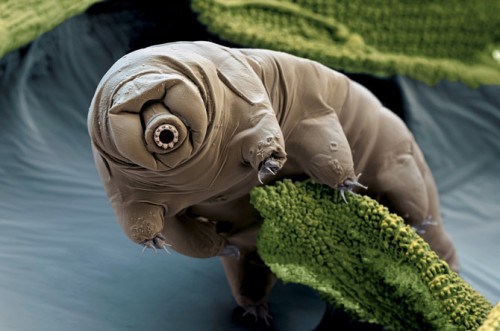
| The mossy area from which I hope to harvest my pet Tardigrades for my new terrarium |
![]() |
| Tardigrade: the most interesting animal in the world |
07 January 2016
This Week in Water
Busy holiday and end-of-year 'real life' issues now past, it's time to kick off the new year, 2016, with another installment of #TWIW.
The full effects of the current powerful El Niño have yet to be felt.
Winter temperatures in the Arctic rose above the freezing point in December as a result of storms originating from El Niño, the same storms that brought historic rains to the southern U.S. and Great Britain.
The U.S. midwest experienced historic flooding of the Mississippi River over the holidays. As did parts of northern England.
For the first time in ten years, California's snowpack is above normal.
Flooding from Typhoon Melor in the Philippines resulted in the evacuation of 725,000 people.
The Florida Keys are experiencing increasingly regular street flooding during high tides, and as temperatures continue to climb so will sea levels around Miami.
Melting Arctic sea ice is associated not only with increased heat absorption but also with increased precipitation in the Arctic.
The North American Great Lakes are warming twice as fast the planet's oceans. So is Israel's Lake Kinneret and many others worldwide.
The most critical ecosystem of Europe's oldest lake, Lake Ohrid in Macedonia, one of the most biodiverse lakes in the world, is being paved over to accommodate increased tourism.
Bolivia's second largest lake, Lake Poopo in the Andes, has dried up.
Scientists have been significantly underestimating humanity's global water footprint by as much as 20%, and some believe we are fast approaching unsustainable levels.
Flint, Michigan has been declared a state of emergency after the state government changed up its water supply and toxic levels of lead and other toxic substances began showing up in the drinking water. You can (and should) follow the news here.
The chemicals in the fluids used in hydraulic fracturing, aka fracking, are known to be associated with developmental and reproductive toxicity. The extent of their concentrations in groundwater supplies affected by fracking requires urgent further study.
The Australian government has given final approval to a giant coal terminal at Abbot Point in northern Queensland, just 12 miles from the Great Barrier Reef.
President Obama signed a new law banning the use of exfoliating plastic microbeads in soaps and shampoos and toothpaste beginning in 2017. These have been making their way into our waterways and water supplies for years.
Orange peels may be able to absorb excess mercury contamination in the water and soil.
Researchers at the University of Hawaii at Manoa and NOAA are crowd-sourcing tsunami sensors on cargo ships and other seafaring vessels to provide more accurate real-time data than current warning systems.
Scientists at Cornell University have developed a reusable polymer that can remove pollutants from flowing water within seconds.
Industry views on the state of water in 2015 here.
Dry ice rather than water could have sculpted those mysterious gulleys on Mars.
14 December 2015
This Week in Water
As we've been anticipating, nearly 200 nations signed an agreement to work to reduce the man-made sources of global warming. Details here. Many felt it did not go far enough because it specifies no specific actions and provides no mandatory sanctions, but it represents a step in the right direction and, by setting frameworks, goals, and intentions going forward, is far better than no agreement at all.
Meanwhile, in the real world:
Scientists are piecing together the data respecting ocean temperatures over the last 5 million years and their correlation with global climate.
Falling oxygen levels caused by warming oceans may prove to be a greater threat to the survival of life on Earth than flooding from rising seas. About two-thirds of the Earth's oxygen is produced by the process of photosynthesis in ocean phytoplankton, and this process is disrupted by warming seas. Scientists elsewhere, however, are at a loss to explain an unprecedented rise in the number of phytoplankton in the Northern Atlantic but believe it may result from increased acidification due to high levels of carbon dioxide in the atmosphere. Stay tuned.
View a remarkable set of photographs documenting rapid coral bleaching caused by warming oceans here.
Rising oceans are threatening the Marshall Islands (among others) threatening a way of life. (Some brilliant photography from the The New York Times!)
Abnormally high tides in the Florida Keys have been flooding low-lying areas for months, threatening property values.
Southern India has been hit by floods caused by the heaviest rainfall in more than a century.
China's largest glacier is now retreating at a record pace.
Hundreds of thousands of people were evacuated as Typhoon Melor struck the Eastern Philippines.
As a record-breaking Pacific cyclone season wraps up, Hawaii proved remarkably lucky in dodging no less than 15 major storms.
Scientists discovered a 100+ million year old underground ocean under the Chesapeake Bay.
Scientists have developed a new class of superhydrophobic nanomaterials to protect surfaces from water.
04 December 2015
For Zappadan
There really can be only one Zappa/Mothers tune fit to kick off this Zappadan season:
"The rest of their lives in San Ber'dino."
Subscribe to:
Posts (Atom)