I'm trying to follow the insider baseball, sausage-making aspects of the current impasse in Washington as little as possible. But, to be honest, it's like seeing a couple of locomotives heading for a head-on collision: it's hard to turn away.
This is how I see things—and, again, I'm not DC villager or insider. I have no privileged access to the thinking process (and I use that term loosely) of either side.
There seem to be several issues in the hopper: (1) The 'continuing resolution' or 'CR' which in lieu of a new, agreed-to budget allows the Federal government to keep operating at its current level of funding (post-sequestration); (2) The 'debt ceiling' which the Federal government will hit on or about October 17, the extension of which would allow the U.S. Treasury to continue to pay interest on U.S. Treasury Bonds, i.e., pay the interest on Federal debt that has already been racked up; 3) The implementation of the Affordable Care Act aka 'Obamacare', more specifically the opening of statewide exchanges which allow individuals to purchase health insurance on the open market at collective, or group, rates which, theoretically would drive down the costs of premiums.
The present shut-down is supposedly about number (1) above. The House of Representatives has refused to pass a CR unless President Obama delay (3) or do away with ACA altogether. The House has a Republican majority and has refused to date to pass a clean 'CR' (one without extraneous matter attached), something the Senate has passed. The Republican House has voted some 40 times to repeal ACA. They have attached a similar repeal to the CR, and lately have attached a delay of the individual mandate portion of ACA to the CR.
It seems beyond dispute that the Speaker of the House, John Boehner, could get a majority of Congress members to pass a clean CR if he would agree to bring it to the floor of the House. Most, if not all, Democratic members would vote for a clean CR as would sufficient Republican to garner a majority of total votes. Boehner apparently refuses to do so because he cannot whip a majority of the Republican caucus in favor of bringing a clean CR bill to the floor.
The Republicans who want to repeal ACA will, it is believed, attempt to unseat Boehner as Speaker if he introduces a clean CR.
I've seen this tactic over and over. If you don't want to do a deal, you claim you can't do a deal. Someone else won't let you.
Boehner and the Republicans claim that Obama and the Democrats are refusing to negotiate. This despite the fact that the President met yesterday with leaders of both parties from both chambers. They claim ACA was never 'litigated' or negotiated. This despite the last major election in which Obama was decisively elected over a challenger who vowed 'on day one' to repeal Obamacare. And the full day in 2010 when Obama met with the leaders of the opposition to entertain their arguments about ACA—on national television. Moreover, ACA was passed by both houses of the Congress with Republicans using every procedural means available to stop it, but failing to participate in negotiations to improve or make it better.
This is not the first time the Republicans have used a CR to try and wrest concessions from the President. The last time, the President and the Speaker of the House reached an agreement in principle on a 'grand bargain' which included tax reform and revenue issues as well as budget cuts and entitlement reforms. This deal died when the Speaker took it to his members. And therein lies the problem.
By all appearances (and I cannot tell whether Boehner is playing a double game here), the Speaker does not have the power to negotiate on these matters. Or that, at least, is the face he is putting on the matter. I've seen this tactic on many occasions in my practice of law, as has any judge who deals with commercial matters. In order to knock heads together and force a settlement of a contentious litigation, the judge will often force 'decision-makers' for each party to meet. There can be no "I'll take it back to my people." The person in the room has to be authorized to act. And Boehner, apparently, doesn't have the authority to act on the CR.
This is a big problem. You can't negotiate with someone who doesn't have the authority to make a deal. If Obama and Boehner strike a deal, there is no guarantee that the Republican caucus will approve. So, what's a President to do?
Recall, the faction in the Republican party which is behind this matter campaigned on going to Washington to shut down the government. Shutting it down is what they want. There is statement after statement on the record vowing to shut it down. They met in caucus recently and voted to pursue this strategy. Eighty of them signed a letter recently declaring their intention to shut down the government if Obama refused to stop implementation of ACA. And now they want the press and American public to believe that the shutdown is Obama's fault because he refuses to negotiate with them. They do not want to be held accountable for their avowed plan. One supposes they are relying on the laziness and ignorance of the American public (and the press) which will blame both sides.
It seems to be an intractable mess. What's more, since many of these intransigent Republicans are in gerrymandered districts, there is little to no chance of defeating them in the next mid-term election cycle. As a result of the Citizens United decision by the U.S. Supreme Court, moreover, many of these Republicans are financed by the political arm of the far-right Koch brothers operation, including but not limited to the so-called 'Tea Party' and the U.S. Chamber of Commerce and any number of shady-money organizations.
While the shutdown of the Federal government is a nuisance and is debilitating to many people around the country—much of which these Republicans refuse to acknowledge—the failure of Congress to extend the debt ceiling could be disastrous. And there is every indication that the Republicans want to link the two and use them to increase their leverage over the President and against ACA.
No one seems to be asking why they want the 35 to 40 million people who will obtain affordable health insurance under ACA to lose their chance of being covered for medical costs. They claim it's a disaster, even though it hasn't been fully implemented yet. They claim we can't afford it, even though the rise in health care costs has slowed down significantly and individuals are finding that premium costs are within reach of middle-class Americans now for the first time in a generation.
Similarly, no one seems be asking why they are refusing to abide by their Constitutional duty. The Tea Party Republicans rode to power on a platform of forcing President Obama to abide by the U.S. Constitution which they treat as a sacred document.
Article 1 of the U.S. Constitution lays budgeting authority and responsibility squarely on Congress. Article I, section 9, clause 7 states that "No money shall be drawn from the Treasury, but in Consequence of Appropriations made by Law; and a regular Statement and Account of Receipts and Expenditures of all public Money shall be published from time to time."
It is Congress's Constitutional duty to pass a budget, something it hasn't done in years and something it is refusing to do now unless it forces concessions from Obama on ACA.
Similarly, the Congress has the authority to borrow money to pay for the debts incurred by the government—debts which it and it alone specifically authorized. Article I, Section 8 of the U.S. Constitution states: "The Congress shall have power ...To borrow Money on the credit of the United States."
Moreover, by threatening not to extend the debt ceiling on Oct. 17, these Tea Party Republican Congress members are threatening to violate their Constitutional duty to pay the bills they themselves incurred (e.g., in authorizing wars in Iraq and Afghanistan, tax cuts for wealthy Americans and corporations). Amendment XIV, Section 4 of the U.S. Constitution states: "The validity of the public debt of the United States, authorized by law ... shall not be questioned."
Congress authorized the expenditure of the money (N.B. Once Congress authorizes expenditures, the Executive (i.e., President Obama in this case) must carry out Congress's wishes.) Congress authorized the borrowing of money to pay for these budgeted expenditures. Now, Congress has to pay that money back. Just because the costs of its actions exceeded its intake of revenue, it is not relieved of its responsibility.
Yet, this is what is being threatened by a faction of Republicans. Default on authorized, legitimate debts of the U.S. And no one seems to be capable of holding them responsible for their actions. Not John Boehner—whose intentions and motives in this are at best questionable. Is he merely craven? Seeking to hold onto his Speakership? Or is he in cahoots with the Tea Party faction in his caucus—despite his pleas to the contrary? Why does he refuse to bring a clean CR to the floor? Why is he allowing his members to threaten the 'validity of the public debt'?
Nor are their constituents, apparently, capable of holding this minority responsible. They are well-funded and organized and seem to be dug in.
I've tried to present this without resort to rhetoric or emotional terms such as 'hostage-taking'. This is my analysis of the law and the facts as I see them. What the resolution of this is is simply beyond me.
03 October 2013


27 September 2013
Sentimental Riff: Weekend Playlist
Adny, Ross the Boss, & Handsome Dick nailed it first (1975):
Then came Joey & the boys, this from Rock 'n' Roll High School—Boo yeah! Riff Randle! (1978)
Revived and blown to Smithereens (1989)
Bonus Points: Norwegian Style: Turbonegro (1998)
-----------------
Extra Credit: Speaking of The Dictators and the Ramones, now that Autumn's upon us, here's a half century of California Sun:
Joe Jones (1961)
The Rivieras (1964)
The Dictators (1975)
The Ramones (1977)
Gyllene Tider (1981) (in Swedish!!)
Los Straitjackets (2005)
The Postelles (2011)
Tim Timebomb & Friends (2013)
Then came Joey & the boys, this from Rock 'n' Roll High School—Boo yeah! Riff Randle! (1978)
Revived and blown to Smithereens (1989)
Bonus Points: Norwegian Style: Turbonegro (1998)
-----------------
Extra Credit: Speaking of The Dictators and the Ramones, now that Autumn's upon us, here's a half century of California Sun:
Joe Jones (1961)
The Rivieras (1964)
The Dictators (1975)
The Ramones (1977)
Gyllene Tider (1981) (in Swedish!!)
Los Straitjackets (2005)
The Postelles (2011)
Tim Timebomb & Friends (2013)
25 September 2013
This Week in Water
This week, a virtual torrent.
Some believe the radiation in the fuel pool at Fukushima Unit 4 is a potential existential threat to humanity and that TEPCO and the Japanese government are incapable of dealing with the situation.
British Petroleum ("BP") wants to suspend settlement payments to U.S. Gulf Coast residents and businesses affected by the 2010 Deepwater Horizon oil spill. Former U.S. Vice President Dick Cheney's Halliburton has pleaded guilty to destroying evidence in the same matter.
How much arsenic is tolerable in our drinking water?
The recent flooding in Colorado has spawned at least 10 separate oil and gas spills. You might have known this, but I'll bet you didn't know that the recent thousand-year Colorado flooding was a direct result of Colorado's political initiatives in legalizing marijuana, liberalizing abortion regulations, and decadent homosexual activity of public figures—at least according to one radio Christianist.
Algae biofuels have proven to be remarkably efficient and cut carbon emissions by up to 70% by comparison to petroleum.
The car of the future might be made using magnesium extracted from seawater.
The second annual IF Water Conference took place in Louisville, KY this week, exploring issues relating to Earth's most precious resource.
Water scarcity affects as many as 2 billion people worldwide and is getting worse. And global warming isn't helping. This despite the 5 new aquifers recently discovered in the Turkana region of Kenya.
Dam operations can either be beneficial or detrimental to the local ecosystem and should be studied and evaluated on that basis.
Some Floridians have filed to pump 100,000 gallons of water a day out of their local aquifer. They have no intention of doing so but hope to prevent others—big Agro and developers—from taking this valuable resource. Mississippi soybean planters are planning to reduce the amounts of water withdrawn from the local aquifer for irrigation.
Retreating glaciers in Switzerland are a direct signal of global warming. Their rate of shrinkage is increasing. As is the decline in Arctic sea ice—something which accelerates the pace of warming. As is the accelerating decline of the world's coral reefs. One of the reasons coral reefs are declining has to do with overfishing of top predators like sharks.
Overfishing is devastating the world's fish stocks. Hong Kong's government will no longer allow shark fin, bluefin tuna, or black moss on State menus.
According to the U.S. Geological Survey, drought in the U.S. is a creeping, incremental disaster that isn't getting sufficient attention because it is wide-spread and its progress uneven. Nearly 1 in 10 U.S. watersheds is 'stressed' as demand for water outpaces supply. China is being forced to face its own water scarcity crisis. As is Australia.
Rising sea levels have prompted the sinking island state of Kiribati, inhabited since 3000 BC, to explore the possibility of transitioning to man-made floating islands. And, yes, Congressman Steve King (R-Iowa), scientists do know how to measure sea levels. Willful ignorance is self-destructive for humanity.
A major earthquake struck a remote part of western Pakistan this week. It was so powerful it caused a new island to rise 70 feet out of the sea off the country's southern coast.
A monster typhoon, Super-Typhoon Usagi, considered the most powerful storm on the face of the Earth in more than a quarter century, was headed toward Hong Kong and Taiwan. Torrential rains have killed dozens in the Philippines.
A plague of jellyfish is having deleterious effects all over the world on fisheries, shipping, power plants, and even global warming and the biodiversity and acidification of the oceans. Some, however, have the advantage of being edible. Watch for more jellyfish recipes at your local seafood restaurant.
Scientists are using ear wax, plugs of up to a foot long, to determine what is killing off endangered blue whales. It can also provide a record of chemical pollution in the oceans.
Paleontologists in Peru have uncovered 40 million year-old fossils of ancient whales in the Ocucaje desert that could provide clues to the link between marine mammals and their terrestrial ancestors.
Greenpeace activists protesting oil exploration had a run-in with armed Russian sailors in the Arctic. Putin called them pirates then retracted it.
A New Jersey man caught the notorious testicle-eating Pacu fish, an invasive species kin to Piranha and native to the Amazon, in a lake near Passaic, NJ. I'd advise you guys to avoid skinny dipping there. Speaking of testicles, certain female squid can change their appearance to make them look like they have testes. They do this in order to spurn the advances of male squid.
In sports, Larry Ellison's U.S.A. Oracle yachting race team has staged an incredible comeback in the America's Cup coming from an 8-1 deficit to the Kiwis from New Zealand to tie the series of races at 8-8. Weather permitting, the final is scheduled for today in San Francisco Bay. UPDATE: Looks like Ellison's team won. Just wow!
By the way, contrary to Internet rumor, upgrading your iPhone to iOS 7 will NOT make it waterproof. Just thought you needed to know.
Some believe the radiation in the fuel pool at Fukushima Unit 4 is a potential existential threat to humanity and that TEPCO and the Japanese government are incapable of dealing with the situation.
British Petroleum ("BP") wants to suspend settlement payments to U.S. Gulf Coast residents and businesses affected by the 2010 Deepwater Horizon oil spill. Former U.S. Vice President Dick Cheney's Halliburton has pleaded guilty to destroying evidence in the same matter.
How much arsenic is tolerable in our drinking water?
The recent flooding in Colorado has spawned at least 10 separate oil and gas spills. You might have known this, but I'll bet you didn't know that the recent thousand-year Colorado flooding was a direct result of Colorado's political initiatives in legalizing marijuana, liberalizing abortion regulations, and decadent homosexual activity of public figures—at least according to one radio Christianist.
Algae biofuels have proven to be remarkably efficient and cut carbon emissions by up to 70% by comparison to petroleum.
The car of the future might be made using magnesium extracted from seawater.
The second annual IF Water Conference took place in Louisville, KY this week, exploring issues relating to Earth's most precious resource.
Water scarcity affects as many as 2 billion people worldwide and is getting worse. And global warming isn't helping. This despite the 5 new aquifers recently discovered in the Turkana region of Kenya.
Dam operations can either be beneficial or detrimental to the local ecosystem and should be studied and evaluated on that basis.
Some Floridians have filed to pump 100,000 gallons of water a day out of their local aquifer. They have no intention of doing so but hope to prevent others—big Agro and developers—from taking this valuable resource. Mississippi soybean planters are planning to reduce the amounts of water withdrawn from the local aquifer for irrigation.
Retreating glaciers in Switzerland are a direct signal of global warming. Their rate of shrinkage is increasing. As is the decline in Arctic sea ice—something which accelerates the pace of warming. As is the accelerating decline of the world's coral reefs. One of the reasons coral reefs are declining has to do with overfishing of top predators like sharks.
Overfishing is devastating the world's fish stocks. Hong Kong's government will no longer allow shark fin, bluefin tuna, or black moss on State menus.
According to the U.S. Geological Survey, drought in the U.S. is a creeping, incremental disaster that isn't getting sufficient attention because it is wide-spread and its progress uneven. Nearly 1 in 10 U.S. watersheds is 'stressed' as demand for water outpaces supply. China is being forced to face its own water scarcity crisis. As is Australia.
Rising sea levels have prompted the sinking island state of Kiribati, inhabited since 3000 BC, to explore the possibility of transitioning to man-made floating islands. And, yes, Congressman Steve King (R-Iowa), scientists do know how to measure sea levels. Willful ignorance is self-destructive for humanity.
A major earthquake struck a remote part of western Pakistan this week. It was so powerful it caused a new island to rise 70 feet out of the sea off the country's southern coast.
A monster typhoon, Super-Typhoon Usagi, considered the most powerful storm on the face of the Earth in more than a quarter century, was headed toward Hong Kong and Taiwan. Torrential rains have killed dozens in the Philippines.
A plague of jellyfish is having deleterious effects all over the world on fisheries, shipping, power plants, and even global warming and the biodiversity and acidification of the oceans. Some, however, have the advantage of being edible. Watch for more jellyfish recipes at your local seafood restaurant.
Scientists are using ear wax, plugs of up to a foot long, to determine what is killing off endangered blue whales. It can also provide a record of chemical pollution in the oceans.
Paleontologists in Peru have uncovered 40 million year-old fossils of ancient whales in the Ocucaje desert that could provide clues to the link between marine mammals and their terrestrial ancestors.
"“To see the world in a grain of sand…”, this is the first line of William Blake's poem “Auguries of Innocence” [N.B.: Also too my motto for which see above right] which describe a series of paradoxes about innocence, evil and corruption. But in a biological sense, this line can also describe how “a grain of sand” could gives a glimpse of how evolution works using the remains of planktonic foraminifera which resemble grains of sand to the naked eye and date back hundreds of millions of years."A yachter discovered an underwater pyramid estimated to be some 200 feet high in the waters off the Azores Islands. The pyramid appears to be perfectly shaped and oriented by the cardinal points of the compass.
Greenpeace activists protesting oil exploration had a run-in with armed Russian sailors in the Arctic. Putin called them pirates then retracted it.
A New Jersey man caught the notorious testicle-eating Pacu fish, an invasive species kin to Piranha and native to the Amazon, in a lake near Passaic, NJ. I'd advise you guys to avoid skinny dipping there. Speaking of testicles, certain female squid can change their appearance to make them look like they have testes. They do this in order to spurn the advances of male squid.
In sports, Larry Ellison's U.S.A. Oracle yachting race team has staged an incredible comeback in the America's Cup coming from an 8-1 deficit to the Kiwis from New Zealand to tie the series of races at 8-8. Weather permitting, the final is scheduled for today in San Francisco Bay. UPDATE: Looks like Ellison's team won. Just wow!
By the way, contrary to Internet rumor, upgrading your iPhone to iOS 7 will NOT make it waterproof. Just thought you needed to know.
23 September 2013
Realisms and Beauty
Here’s a philosophical problem that continually plagues me as a writer:
Is the primary aesthetic goal of a work of art, specifically in this case literary works of art such as the short story or novel, (a) to accurately portray a feeling or (b) to make the audience feel?
Let’s expand and define:
The portrayal of the private, emotional life of a fictional character is certainly an, if not the principle, aim of literary fiction. The writer plunks an invented character into some situation and explores that character’s experience—inner and outer. The character becomes a sort of virtual field (or virtual mind) to whom and upon and within which this experience occurs, analagous, say, to the two-dimensional action space of a painting.
Accuracy of the portrayal of this inner experience, what we might call its 'psychological realism,' is a quality often and widely (though certainly not universally) admired (as, of course, is how well-realized a world the writer depicts and how compelling a situation s/he creates: what we might call its 'narrative realism'). How truly human does this character seem? How well does the writer present the fullness of this character's interior life and his/her emotional engagement with the given situation?
But is this all? No.
In the classic formulation, this imitation of life serves to bring about an experience of catharsis in the audience. This is the purpose of tragedy: "There but for the grace of the gods (or fate or serendipity or overcoming my own flaws or whatever) go I."
Aristotle identifies the emotions tragedy produces in its audience. In summary strokes, tragedy is the depiction of the downfall of a noble hero due either to some flaw (hamartia) in his nature (e.g., pride) or, certainly in the older tragedians, to the actions of the gods. Feelings of disappointment, guilt, anger, resentment, shame, etc. are the sorts of feelings that might be depicted in the tragic hero, and the lifelikeness of their depiction is part of the art of the writer.
But, for Aristotle, these are not the same sorts of feelings the tragic work produces in its audience. The purpose/aim of a tragic work of art is to arouse the emotions of fear and pity in the audience. As the audience, we fear for the tragic hero. Though he does not recognize it, we know he is heading for a fall. And we pity him because we see aspects of ourselves in him. Once we come to this realization, we are able to overcome the same sort of hubris that might very well bring us low.
But, and this is the point, the depicted emotions are not the same as the emotions aroused in the audience. The audience's emotions are reactive, responsive to those of the tragic hero (and, of course, his plight). Sympathetic, if you will.
This helps frame the issue for me: Does the accuracy and, let's say, poignancy of the depiction of the nobility of the hero and his/her situation, the nature of his/her flaw, and the violence of his/her downfall determine the nature and quality of the audience's reaction? Is there a direct causal relation between the verisimilitude of the psychological and narrative realism and the nature and quality of the sympathetic emotions evoked from the audience? The closer our identification with the hero the more profound our catharsis?
Again: As the writer is my primary concern the perfection of my depiction of the narrative, and more specifically the psychological, realism or should I focus principally on how I want the audience to feel upon reading the narrative?
Some might say there isn't any real difference. Just write well and let the audience respond how it will.
I want readers to identify with my characters. I want them to feel sympathy for my characters' predicaments and plights. I am less concerned with whether they like a particular character than that they find her interesting/intriguing. I want them to experience a character's complexity—emotional and otherwise. To this end, my aim is akin to that of realism, both narrative and psychological.
(Aside: Thesis: I go beyond mere realism(-s) if I am able to depict a unique situation or a portray a new, or even fuller, emotional consciousness. But that's a point for another day.)
But this begs the main question. It is not just through literal, realistic depictions of situations or inner states of consciousness or even physical reactions that writers reach and, indeed, affect the emotions of their readers. Rather, it is primarily through techniques of persuasion.
As the writer, I want to show you how the overarching power of love can fulfill a life's course and make you feel the sadness of a missed chance at true love. (Love in the Time of Cholera). I want to show you how a selfish, adulterous act can be unwittingly cruel to an underserving character and can, in fact, destroy your own life—so don't do it! (Madame Bovary, Anna Karenina). I want to show you how religious belief can have a positive/negative impact on your life and, in fact, on society in general and persuade you to convert your lifestyle. (Brothers Karamazov, Origin of the Brunists) I want to portray the presence of evil in the world in all its multifaceted, larger-than-life-and-death enormity and terror and leave you in awe of its abject beauty and power. (Blood Meridian, Omensetter's Luck) I want to show you the power that unseen conspiratorial forces exercise over our daily affairs and make you feel that perhaps it's reasonable to be afraid, very afraid—paranoid even. (Gravity's Rainbow, and A-game Pynchon) I want to show you how certain political/social/economic situations are manifestly unjust and ultimately untenable and move you to want to change them. (Disgrace, and anything from early Coetzee) I want to show you that fascism is a bad thing so you'll recognize its symptoms in yourself and be repulsed by its very presence. (Animal Farm, 1984, Lord of the Flies, Auto-da-Fe)
Affecting catharsis. Scaring. Shaming. Educating. Moralizing. Sermonizing. Proselytizing. Propagandizing. These goals are not different in kind, merely in degree.
And how do I achieve these types of ends? Rhetoric, affective language, figurative language—the tools of aesthetics. Blatant or subtle manipulations. The realisms of discursive language—psychological and narrative—are, on this view, subsidiary concerns.
Granted, situational poignancy and its accurate depiction can take us partially there, can move us—but only to a certain extent. It takes persuasive power to amplify its effect and make it stick. And these same techniques can either "beautify" or "ruin" the work. That is to say, the techniques of beautification can quite easily be used for purposes other than aesthetic.
Therein lies the dilemma. And the delicate balancing act of/for the writer/artist.
I know this post has been longish and a bit rambling, and I apologize. Yet it has helped me clarify the problem I began with: As a writer, should I be more concerned about trying to keep my characters' actions (and emotions) true to (that character's) experience as I've envisaged it or should I constantly be keeping in mind how I hope to move my audience by my depiction? Should I be more concerned about the realism of the piece or its aesthetics? Which is more important, the verisimilitude or the message? The depiction or the rhetoric?
There is a difference, an important one. Please feel free to weigh in.There are reasoned approaches and well-thought-out positions in both directions on this issue. I'd like to hear from you.
I don't think I'm any closer to a resolution of this issue as a writer, but I do think I have a better handle on what a resolution must entail. Of course, it might turn out that my formulation of the problem is faulty and there's no real issue here. If so, how might that look? Or maybe there's something other than emotionality at stake?
Is the primary aesthetic goal of a work of art, specifically in this case literary works of art such as the short story or novel, (a) to accurately portray a feeling or (b) to make the audience feel?
Let’s expand and define:
The portrayal of the private, emotional life of a fictional character is certainly an, if not the principle, aim of literary fiction. The writer plunks an invented character into some situation and explores that character’s experience—inner and outer. The character becomes a sort of virtual field (or virtual mind) to whom and upon and within which this experience occurs, analagous, say, to the two-dimensional action space of a painting.
Accuracy of the portrayal of this inner experience, what we might call its 'psychological realism,' is a quality often and widely (though certainly not universally) admired (as, of course, is how well-realized a world the writer depicts and how compelling a situation s/he creates: what we might call its 'narrative realism'). How truly human does this character seem? How well does the writer present the fullness of this character's interior life and his/her emotional engagement with the given situation?
But is this all? No.
In the classic formulation, this imitation of life serves to bring about an experience of catharsis in the audience. This is the purpose of tragedy: "There but for the grace of the gods (or fate or serendipity or overcoming my own flaws or whatever) go I."
Aristotle identifies the emotions tragedy produces in its audience. In summary strokes, tragedy is the depiction of the downfall of a noble hero due either to some flaw (hamartia) in his nature (e.g., pride) or, certainly in the older tragedians, to the actions of the gods. Feelings of disappointment, guilt, anger, resentment, shame, etc. are the sorts of feelings that might be depicted in the tragic hero, and the lifelikeness of their depiction is part of the art of the writer.
But, for Aristotle, these are not the same sorts of feelings the tragic work produces in its audience. The purpose/aim of a tragic work of art is to arouse the emotions of fear and pity in the audience. As the audience, we fear for the tragic hero. Though he does not recognize it, we know he is heading for a fall. And we pity him because we see aspects of ourselves in him. Once we come to this realization, we are able to overcome the same sort of hubris that might very well bring us low.
But, and this is the point, the depicted emotions are not the same as the emotions aroused in the audience. The audience's emotions are reactive, responsive to those of the tragic hero (and, of course, his plight). Sympathetic, if you will.
This helps frame the issue for me: Does the accuracy and, let's say, poignancy of the depiction of the nobility of the hero and his/her situation, the nature of his/her flaw, and the violence of his/her downfall determine the nature and quality of the audience's reaction? Is there a direct causal relation between the verisimilitude of the psychological and narrative realism and the nature and quality of the sympathetic emotions evoked from the audience? The closer our identification with the hero the more profound our catharsis?
Again: As the writer is my primary concern the perfection of my depiction of the narrative, and more specifically the psychological, realism or should I focus principally on how I want the audience to feel upon reading the narrative?
Some might say there isn't any real difference. Just write well and let the audience respond how it will.
I want readers to identify with my characters. I want them to feel sympathy for my characters' predicaments and plights. I am less concerned with whether they like a particular character than that they find her interesting/intriguing. I want them to experience a character's complexity—emotional and otherwise. To this end, my aim is akin to that of realism, both narrative and psychological.
(Aside: Thesis: I go beyond mere realism(-s) if I am able to depict a unique situation or a portray a new, or even fuller, emotional consciousness. But that's a point for another day.)
But this begs the main question. It is not just through literal, realistic depictions of situations or inner states of consciousness or even physical reactions that writers reach and, indeed, affect the emotions of their readers. Rather, it is primarily through techniques of persuasion.
As the writer, I want to show you how the overarching power of love can fulfill a life's course and make you feel the sadness of a missed chance at true love. (Love in the Time of Cholera). I want to show you how a selfish, adulterous act can be unwittingly cruel to an underserving character and can, in fact, destroy your own life—so don't do it! (Madame Bovary, Anna Karenina). I want to show you how religious belief can have a positive/negative impact on your life and, in fact, on society in general and persuade you to convert your lifestyle. (Brothers Karamazov, Origin of the Brunists) I want to portray the presence of evil in the world in all its multifaceted, larger-than-life-and-death enormity and terror and leave you in awe of its abject beauty and power. (Blood Meridian, Omensetter's Luck) I want to show you the power that unseen conspiratorial forces exercise over our daily affairs and make you feel that perhaps it's reasonable to be afraid, very afraid—paranoid even. (Gravity's Rainbow, and A-game Pynchon) I want to show you how certain political/social/economic situations are manifestly unjust and ultimately untenable and move you to want to change them. (Disgrace, and anything from early Coetzee) I want to show you that fascism is a bad thing so you'll recognize its symptoms in yourself and be repulsed by its very presence. (Animal Farm, 1984, Lord of the Flies, Auto-da-Fe)
Affecting catharsis. Scaring. Shaming. Educating. Moralizing. Sermonizing. Proselytizing. Propagandizing. These goals are not different in kind, merely in degree.
And how do I achieve these types of ends? Rhetoric, affective language, figurative language—the tools of aesthetics. Blatant or subtle manipulations. The realisms of discursive language—psychological and narrative—are, on this view, subsidiary concerns.
Granted, situational poignancy and its accurate depiction can take us partially there, can move us—but only to a certain extent. It takes persuasive power to amplify its effect and make it stick. And these same techniques can either "beautify" or "ruin" the work. That is to say, the techniques of beautification can quite easily be used for purposes other than aesthetic.
Therein lies the dilemma. And the delicate balancing act of/for the writer/artist.
I know this post has been longish and a bit rambling, and I apologize. Yet it has helped me clarify the problem I began with: As a writer, should I be more concerned about trying to keep my characters' actions (and emotions) true to (that character's) experience as I've envisaged it or should I constantly be keeping in mind how I hope to move my audience by my depiction? Should I be more concerned about the realism of the piece or its aesthetics? Which is more important, the verisimilitude or the message? The depiction or the rhetoric?
There is a difference, an important one. Please feel free to weigh in.There are reasoned approaches and well-thought-out positions in both directions on this issue. I'd like to hear from you.
I don't think I'm any closer to a resolution of this issue as a writer, but I do think I have a better handle on what a resolution must entail. Of course, it might turn out that my formulation of the problem is faulty and there's no real issue here. If so, how might that look? Or maybe there's something other than emotionality at stake?
19 September 2013
This Week in Water
It's been a strange, busy week in water. But, then again, aren't they all? Let's get to it:
First, check these magnificent photos of a jaguar attacking a caiman in Brazil. A taste:

First, check these magnificent photos of a jaguar attacking a caiman in Brazil. A taste:

Over Russian objections, New Zealand hopes to create the world's largest fishing-free ocean sanctuary in the pristine waters off Antartica. The U.S. is supportive.
A dam under construction on the Mekong River in Laos threatens the diversity of fish and wildlife.
The recent massive and deadly flooding in Colorado has fueled fears of the spread of mosquitos which transmit inter alia West Nile virus.
Two hurricanes converged on Mexico from west and east, sending crocodiles into Acapulco's city streets.
Sea bass stocks in the European Union have fallen to 20 year lows and countries such as the U.K. are thinking about imposing quotas on commercial trawling.
Bacteria in three expanding low oxygen zones in the Pacific Ocean off Chile and Peru contribute to the production of nitrogen in the atmosphere. This further weakens the sea's ability to absorb carbon dioxide. (See below)
An eight-state commission that sets water quality standards for the Ohio River is seeking to delay enforcement of new, more stringent mercury standards by up to two years while it considers relaxing those rules.
Environmentalists unveiled unprecedented footage of a legendary sea serpent, a 36 foot, 500 pound, giant oarfish (Regalecus glesne), the world's largest bony fish, in an effort to highlight the dangers of ocean bottom trawling.
The oldest living fish in captivity celebrated its 80th year at the Shedd Aquarium in Chicago. Granddad, an Australian lungfish, arrived in Chi-town for the 1933 Chicago World's Fair.
A beach patrol on San Francisco's Ocean Beach discovered a human foot in a running shoe that had washed ashore. No sign of the rest of the body has been found.
Authorities recovered two vehicles from an Oklahoma lake that contained the bodies of five people who may have been missing since possibly the 1950s.
The motion picture documentary Blackfish, about the plight of Orcas in captivity, highlights how insensitive treatment creates a sort of psychosis in these extremely bright and emotionally complex mammals that has resulted in at least four trainer deaths in recent years. I encourage you to see it.
As mentioned above, parts of Colorado in the American west are experiencing 1000-year floods caused by torrential rains. The numbers of dead and displaced are still being tallied. Property damage and destruction is immense.
The Colorado flooding has raised serious concerns about the possible release of toxic chemicals into local rivers from flood-stricken hydraulic fracking operations.
Colorado's richest oil field has similarly been buried in floodwater, and people downstream in places like Nebraska are justifiably worried about contaminated drinking water. No one has any idea whether, where, and, if so, how much any of these wells are leaking. Though 5250 confirmed gallons of oil has spilled into the South Platte River.
The aforementioned torrential Mexican rains show no sign of letting up. Meanwhile, the death toll, currently at 57, is likely to increase.
Beef and corn production in Kansas has been drawing down water from the High Plains Aquifer at an unsustainable rate more than six times the natural rate of recharge. The High Plains Aquifer supplies 30% of the nation's irrigated groundwater.
Texans are squabbling over who owns the rights to the groundwater under their land. The law in this area, as with riparian rights in general, is murky and therefore contentious.
Meanwhile, in a what may be the biggest news of the week, two enormous fresh water aquifers have been discovered in the drought-stricken region of North Kenya. Issues arise, however, about how to deliver and distribute this resource to the rest of the country and continent.
Access to potable water worldwide is likely to become increasingly difficult as world temperatures continue to rise.
Some believe a new ocean may be forming under the Afar Rift in Ethiopia.
Europeans are attempting to measure and weigh the costs and benefits to improving water quality in the continent's various catchment areas.
TEPCO, the operators of the leaking Fukushima nuclear plant in Japan, dumped more than 1000 tons of contaminated water into the ocean. Meanwhile, as much as 300 tons of contaminated groundwater is seeping into the oceans every day.
More than 233,000 gallons of molasses spilled into Honolulu Harbor from a damaged pipeline owned by Matson Inc. More than 25,000 fish have been killed as a result. Molasses? WTF?
The crippled, capsized Costa Concordia cruise ship was righted during a complicated, 19-hour operation of the coast of Tuscany. Now it can be towed off and scrapped.
Despite reports to the contrary, Arctic sea ice is still at historically low levels.
Researchers at Stanford University have developed a "microbial battery" which produces clean, renewable energy from the bacteria in wastewater. "They hope their technique could be used in wastewater treatment facilities and to break down organic pollutants in the 'dead zones' of oceans and lakes where fertilizer runoff has depleted oxygen, suffocating marine life."
Speaking of wastewater, ever wonder how astronauts use the toilet in zero gravity? Apparently it's a thing.
An icy comet collision billions of years ago might have kickstarted life on Earth by producing molecules that transform into amino acids under the heat of the impact.
18 September 2013
Why Did the Wild Turkey Cross the Road?
Took some time off from the internets and politics and even fiction writing for a few days R & R with Wisdoc in the NC mountains last week. She has just submitted a couple grant applications and we've just packed our youngest off to college. First non-school-recess-related vacay in I don't know how many years.
Drove 100 miles or so on the Blue Ridge Parkway—something you must do at some point in your life. Hiked to/from waterfalls. Ate vegan in the hipsterest area of one of America's hipsterest towns: Asheville—clad in hiking shorts and boots (not Five Fingers this time). Didn't feel out of place, oddly. Took it easier than on some 'forced march' trips we've had in the past.
So, pics. As always, mouse over pic for 'secret' message and/or click to embiggen slide show.
Drove 100 miles or so on the Blue Ridge Parkway—something you must do at some point in your life. Hiked to/from waterfalls. Ate vegan in the hipsterest area of one of America's hipsterest towns: Asheville—clad in hiking shorts and boots (not Five Fingers this time). Didn't feel out of place, oddly. Took it easier than on some 'forced march' trips we've had in the past.
So, pics. As always, mouse over pic for 'secret' message and/or click to embiggen slide show.
 |
| Goats on the Roof, near Tallulah, GA |
 |
| Love the colon! |
 |
| The Cabin |
 |
| The view from the cabin porch |
 |
| First waterfall of the week |
 |
| 'Tis the season |
 |
| For all your one-stop mountain shopping needs, Brevard, NC |
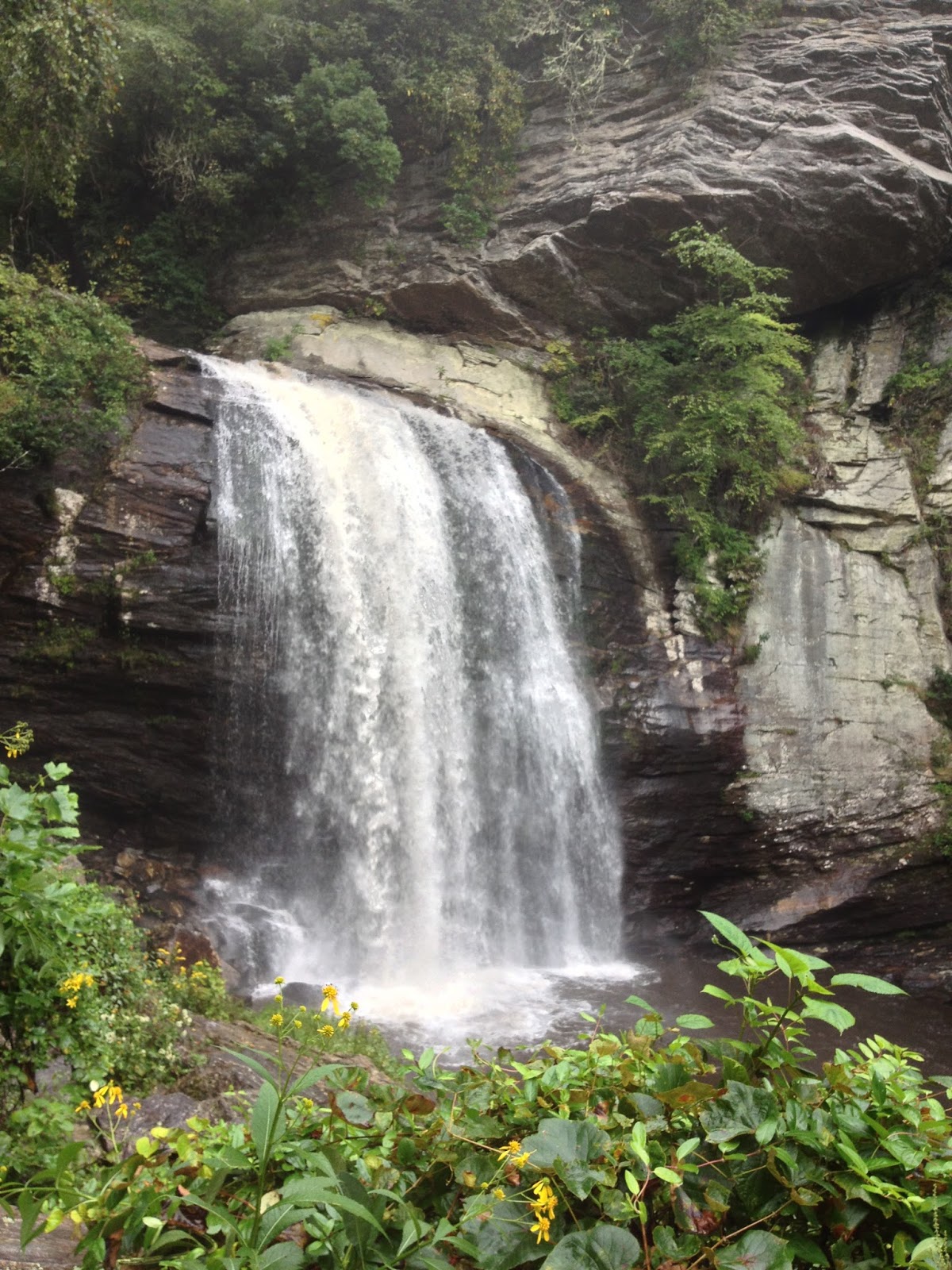 |
| Next waterfall |
 |
| Wisdoc dwarfed by boulder |
 |
| Wisdoc beneath another waterfall |
 |
| Another in the 'things growing on other things' series |
 |
| Sliding Rock, Pisgah National Forest |
 |
| Sky shadows and mountains |
 |
| Mt. Mitchell, NC |
 |
| Vista after vista along the Blue Ridge Parkway, both sides of the road |
 |
| On a magical hike around Mt. Mitchell peak |
 |
| Again with the Blue Ridge Parkway vistas |
 |
| More things growing on other things |
 |
| Last waterfall of the week |
 |
| Mountain muffin |
 |
| Blue ridges at evening (courtesy Wisdoc) |
 |
| Why did the wild turkeys cross the road? |
 |
| Water flowing over rocks (courtesy Wisdoc) |
 |
| Goober |
10 September 2013
My Fringe Odyssey—An Update
The ATL is a great place to run—if you don't mind Hills, Heat, Humidity. Oh yeah, and Elevation (~1000 ft.). This post is about my own running experience here. It's probably more for me than you, so feel free to skip it. I feel a need to mark my milestones.
If you're interested in my running odyssey, you can catch up here. (Reading, of course, from the bottom up—it's a blog, after all.) Long story short: I ran a bit—recreationally—in my 20s as a graduate student, got involved in law and family and more or less quit. After moving to Atlanta in 2000, I tried to start up again but could manage no more than a mile or two without inflicting pain on my hips and knees that lasted for days afterward. I don't do pain well. In August, 2009, I saw Christopher MacDougall on the Daily Show, went out immediately and bought his book, Born to Run, and began teaching myself to run barefoot/minimalist style. I've now been running regularly for 4 years, and this post is an update on my progress.
Beginning around Thanksgiving in 2009, I began keeping a log of my training and race miles. Here are my totals as of today:
In 4 years, I've run a total of just over 1600 miles—400 miles/year on average—337 of which miles have been barefooted (just under a quarter of the total). The rest have been exclusively in Vibram Five Fingers or XeroShoes Sandals. I don't own a pair of traditional running shoes.
I have competed in 49 foot races for a total of 316 miles—one per month. Five of those races were half-marathons (13.1 miles), 16 were 10K (6.2 miles), 13 were 5K (3.1 miles), and a couple were 15K (9.3 miles)—all road races. The remainder were trail runs of varying lengths, from 3.1 miles to 9.3 miles. Only one did I not finish.
My Personal Bests in the standard distance road races are:
5K - 26:18
10K - 55:21
15K - 1:37:27
Half - 2:03:00
Not bad for an old guy—especially one didn't run track or cross country as a youngster and who hasn't been running his entire life. I'm not the fastest person out there, but by no means am I the slowest. I have to admit there's something fairly self-satisfying about a gray-haired old guy in a pair of flip flops or toe shoes passing a fit young athlete in his/her 30s, say, wearing a pair of fancy running shoes in the last couple miles of a middle distance race. I'm not gonna' lie. Racing gets my competitive juices, as well as my endorphins, flowing!
For the record, here are the mileage totals for each shoe: Vibram Bikila - 600 miles; Vibram Sprint - 270 miles; Vibram Trek (used exclusively for trail running) - 151 miles; XeroShoes Huarache - 190 miles. These figures do not include hiking miles or the miles I walk before and after each run.
Now I've just about talked myself into trying to fun a full Mary in December. That's 26.2 miles. It's an intimidating distance, and requires a serious training regimen—one which, unlike the shorter distances, includes dietary issues. I want to do it without hurting myself.
My marathon training will have several components, each of which requires constant attention:
• Improving my barefoot technique—landing forefoot each step, inter alia
• Monitoring my heart rate—keeping it in the aerobic range
• Increasing my base mileage—on a weekly basis
• Coaxing my aging body to achieve a new distance—16 is the most miles I've ever run
• Staying injury-free—not a simple task, but essential for endurance training
• As for technique, I constantly fiddle with it, monitoring each step. The mental focus of barefoot running is more intense than when running in cushiony, impact-softening running shoes. Some of my barefoot running friends call them foot coffins. Good technique effects each of the other components. There's much discussion and debate on the Web about how to run properly barefoot/minimalist style. My earlier posts in this series point to a number of these sites.
• As for aerobic training, Dr. Phil Maffetone has devised a system for endurance training that involves staying below a prescribed, age-relative heart-rate. It increases aerobic fitness and does not tax the more impactful anaerobic functioning. His book, The Big Book of Endurance Training and Running, and website are invaluable in this respect. The key is that a runner can either train for speed or endurance, but not both at the same time. I'm training for the latter.
• As a rule, base weekly mileage should increase by no more than ~10% per week over a 16-week marathon training schedule. This aspect of training should build leg strength and stamina, not sap it. And about three weeks before the race, the weekly mileage should taper.
• LSD once a week is the most important aspect of marathon training. No, it's not what you think. That's the "Long Slow Distance" run, an easy run which pushes out farther each week—though every three weeks or so, it pays to back off and run a shorter distance to allow the body to adapt and rebuild its distance capacity. The LSDs should peak at somewhere between 20 and 23 miles three weeks before the race. If you can do that, the theory goes, you can run the marathon. The remainder of the training should be designed to maintain the shape and fitness you've achieved.
• Technique plays a large part in staving off injury, as does mileage maintenance and rest and recuperation after training runs. Also, where muscle and soft tissue tightness comes into play, Trigger Point Therapy has proved to be a golden solution for me. The notion of 'referred pain' was completely new to me, but has borne out over the last few months since I've been learning how to do it. Foam rollers, the Stick, and a lacrosse ball have been invariably invaluable in my adventures with myofascial self-release.
The marathon I've chosen to run will be on a flat course at sea level in December. This means my training in the heat, hills, humidity, and elevation of the ATL will be magnified. I attempted to train for a marathon two summers ago, but did not make it to the end. I went too hard, too far, too fast and thought I'd hurt myself. What I didn't know then was how to release the tension in my muscles and other soft tissues—Achilles tendinopathy, e.g.—with Trigger Point Therapy.
I am still researching the nutritional issues I mentioned earlier and may or may not post my conclusions upon reaching such.
-----
Edit: Sorry, somehow I deleted the latest version of this post. It might have something to do with Sasha walking across my keyboard while editing. I'm afraid I lost the Comments by Thunder and Big Bad Bald Bastard. My and my cat's apologies.
If you're interested in my running odyssey, you can catch up here. (Reading, of course, from the bottom up—it's a blog, after all.) Long story short: I ran a bit—recreationally—in my 20s as a graduate student, got involved in law and family and more or less quit. After moving to Atlanta in 2000, I tried to start up again but could manage no more than a mile or two without inflicting pain on my hips and knees that lasted for days afterward. I don't do pain well. In August, 2009, I saw Christopher MacDougall on the Daily Show, went out immediately and bought his book, Born to Run, and began teaching myself to run barefoot/minimalist style. I've now been running regularly for 4 years, and this post is an update on my progress.
Beginning around Thanksgiving in 2009, I began keeping a log of my training and race miles. Here are my totals as of today:
In 4 years, I've run a total of just over 1600 miles—400 miles/year on average—337 of which miles have been barefooted (just under a quarter of the total). The rest have been exclusively in Vibram Five Fingers or XeroShoes Sandals. I don't own a pair of traditional running shoes.
I have competed in 49 foot races for a total of 316 miles—one per month. Five of those races were half-marathons (13.1 miles), 16 were 10K (6.2 miles), 13 were 5K (3.1 miles), and a couple were 15K (9.3 miles)—all road races. The remainder were trail runs of varying lengths, from 3.1 miles to 9.3 miles. Only one did I not finish.
My Personal Bests in the standard distance road races are:
5K - 26:18
10K - 55:21
15K - 1:37:27
Half - 2:03:00
Not bad for an old guy—especially one didn't run track or cross country as a youngster and who hasn't been running his entire life. I'm not the fastest person out there, but by no means am I the slowest. I have to admit there's something fairly self-satisfying about a gray-haired old guy in a pair of flip flops or toe shoes passing a fit young athlete in his/her 30s, say, wearing a pair of fancy running shoes in the last couple miles of a middle distance race. I'm not gonna' lie. Racing gets my competitive juices, as well as my endorphins, flowing!
For the record, here are the mileage totals for each shoe: Vibram Bikila - 600 miles; Vibram Sprint - 270 miles; Vibram Trek (used exclusively for trail running) - 151 miles; XeroShoes Huarache - 190 miles. These figures do not include hiking miles or the miles I walk before and after each run.
Now I've just about talked myself into trying to fun a full Mary in December. That's 26.2 miles. It's an intimidating distance, and requires a serious training regimen—one which, unlike the shorter distances, includes dietary issues. I want to do it without hurting myself.
My marathon training will have several components, each of which requires constant attention:
• Improving my barefoot technique—landing forefoot each step, inter alia
• Monitoring my heart rate—keeping it in the aerobic range
• Increasing my base mileage—on a weekly basis
• Coaxing my aging body to achieve a new distance—16 is the most miles I've ever run
• Staying injury-free—not a simple task, but essential for endurance training
• As for technique, I constantly fiddle with it, monitoring each step. The mental focus of barefoot running is more intense than when running in cushiony, impact-softening running shoes. Some of my barefoot running friends call them foot coffins. Good technique effects each of the other components. There's much discussion and debate on the Web about how to run properly barefoot/minimalist style. My earlier posts in this series point to a number of these sites.
• As for aerobic training, Dr. Phil Maffetone has devised a system for endurance training that involves staying below a prescribed, age-relative heart-rate. It increases aerobic fitness and does not tax the more impactful anaerobic functioning. His book, The Big Book of Endurance Training and Running, and website are invaluable in this respect. The key is that a runner can either train for speed or endurance, but not both at the same time. I'm training for the latter.
• As a rule, base weekly mileage should increase by no more than ~10% per week over a 16-week marathon training schedule. This aspect of training should build leg strength and stamina, not sap it. And about three weeks before the race, the weekly mileage should taper.
• LSD once a week is the most important aspect of marathon training. No, it's not what you think. That's the "Long Slow Distance" run, an easy run which pushes out farther each week—though every three weeks or so, it pays to back off and run a shorter distance to allow the body to adapt and rebuild its distance capacity. The LSDs should peak at somewhere between 20 and 23 miles three weeks before the race. If you can do that, the theory goes, you can run the marathon. The remainder of the training should be designed to maintain the shape and fitness you've achieved.
• Technique plays a large part in staving off injury, as does mileage maintenance and rest and recuperation after training runs. Also, where muscle and soft tissue tightness comes into play, Trigger Point Therapy has proved to be a golden solution for me. The notion of 'referred pain' was completely new to me, but has borne out over the last few months since I've been learning how to do it. Foam rollers, the Stick, and a lacrosse ball have been invariably invaluable in my adventures with myofascial self-release.
The marathon I've chosen to run will be on a flat course at sea level in December. This means my training in the heat, hills, humidity, and elevation of the ATL will be magnified. I attempted to train for a marathon two summers ago, but did not make it to the end. I went too hard, too far, too fast and thought I'd hurt myself. What I didn't know then was how to release the tension in my muscles and other soft tissues—Achilles tendinopathy, e.g.—with Trigger Point Therapy.
I am still researching the nutritional issues I mentioned earlier and may or may not post my conclusions upon reaching such.
-----
Edit: Sorry, somehow I deleted the latest version of this post. It might have something to do with Sasha walking across my keyboard while editing. I'm afraid I lost the Comments by Thunder and Big Bad Bald Bastard. My and my cat's apologies.
05 September 2013
This Week in Water
Put on your drysuits and nose plugs, it's that time again.
First the big news of the week: Diana Nyad, age 64, became the first person to swim from Cuba to Florida without use of a protective shark cage. It was her fifth such attempt.
Turns out fish like to listen to music, preferring Bach.
Living evidence for evolution? Here's a video of a bamboo shark walking on the ocean floor.
How about this? Here's a video of a puffer fish creating artistic patterns on the sea bottom. Okay, it's maybe the coolest thing EVER. So cool in fact I'm going to post it here so I can watch it again and again. Seriously, dude is like the Picasso of fish.
Scientists have traced ever-increasing mercury levels in Pacific Ocean fish to coal-fired power plants in China and India.
Hundreds of thousands of dead fish were left floating in the Fu River in the Chinese province of Hubei after a discharge of ammonia. This after more than 16,000 dead pigs were recovered from a Shanghai river earlier this year.
Climate change is threatening fresh water fisheries world wide, even ice fishing in Minnesota.
Some officials in Minnesota want to divert the Mississippi River to replenish a seriously depleted lake.
Conservation easements are at stake in a dispute in California about water diversion tunnels proposed to run under an island owned by the Nature Conservancy. Staten Island, CA, is a prime refuge for inter alia the endangered sandhill crane.
A woman in China was arrested for apparently boiling her abusive husband's dismembered corpse in a pressure cooker.
Did you know this is World Water Week? An international conference convened in Stockholm this week with a plea for the energy, food, and water industries to use the scarce commodity more wisely and to clean up contaminated waters that cause upwards of 5000 deaths a day. "Mortgaging our future by draining water from the ground, surface and sky faster than it can be replaced by nature is untenable," said a spokesman.
Also, September 18 is World Water Monitoring Day.
You've heard of carbon footprinting? What about water footprinting? Do you have any idea how much water you use/waste every day? If it's yellow, let it mellow; if it's brown, flush it down.
The politics of water is moving to the forefront globally and can actually be a source of cooperation. The UN has declared 2013 to be the International Year of Water Cooperation.
One area where this is happening is the area around the Guarani Aquifer in central South America between Argentina, Brazil, Paraguay, and Uruguay.
Hydroelectric dams erected by China and India, Nepal, Bhutan, and Pakistan are beginning to deplete the Himalayan region of water.
Closer to home, if the U.S. Forest Service permits hydraulic fracking for natural gas in and around the George Washington National Forest, the D.C. area could experience the same sort of methane pollution in its drinking water that is currently plaguing Texas, Pennsylvania, and other flyover areas of the U.S.
In areas of California, wineries are straining the local water supply.
Japan is planning to build a half-billion dollar 'ice wall' to try to contain leaking radioactive water from the Fukushima nuclear plant destroyed in the 2011 earthquake/tsunami.
The Nicaraguan government has granted a Chinese businessman the right to build a canal through that country that could rival the Panama Canal.
Australians are attempting to harness the kinetic force of ocean waves (and tides?) to desalinate seawater. Now that's what I call synergy! Brilliant, really.
A coal company has been granted a lease by the Commonwealth of Virginia to build the first wind farm off the coast of that state.
Satellite pictures have revealed two large maelstroms in the South Atlantic Ocean—large enough to suck ships under. The mechanics of these whirlpools are quite similar to those of black holes in space.
Melting snow in Norway has uncovered Neolithic artefacts some 6000 years old, including a remarkably well-preserved woolen tunic.
Engineers are developing a design for a waterflow-based battery that could power electric vehicles over much longer distances than lithium-ion batteries do today.
RustOleum's NeverWet apparently repels water completely.
Japanese astronomers have discovered planets outside our solar system that appear to have water-rich atmospheres.
Oh, and yeah, people stop washing your raw chickens!
First the big news of the week: Diana Nyad, age 64, became the first person to swim from Cuba to Florida without use of a protective shark cage. It was her fifth such attempt.
Turns out fish like to listen to music, preferring Bach.
Living evidence for evolution? Here's a video of a bamboo shark walking on the ocean floor.
How about this? Here's a video of a puffer fish creating artistic patterns on the sea bottom. Okay, it's maybe the coolest thing EVER. So cool in fact I'm going to post it here so I can watch it again and again. Seriously, dude is like the Picasso of fish.
Scientists have traced ever-increasing mercury levels in Pacific Ocean fish to coal-fired power plants in China and India.
Hundreds of thousands of dead fish were left floating in the Fu River in the Chinese province of Hubei after a discharge of ammonia. This after more than 16,000 dead pigs were recovered from a Shanghai river earlier this year.
Climate change is threatening fresh water fisheries world wide, even ice fishing in Minnesota.
Some officials in Minnesota want to divert the Mississippi River to replenish a seriously depleted lake.
Conservation easements are at stake in a dispute in California about water diversion tunnels proposed to run under an island owned by the Nature Conservancy. Staten Island, CA, is a prime refuge for inter alia the endangered sandhill crane.
A woman in China was arrested for apparently boiling her abusive husband's dismembered corpse in a pressure cooker.
Did you know this is World Water Week? An international conference convened in Stockholm this week with a plea for the energy, food, and water industries to use the scarce commodity more wisely and to clean up contaminated waters that cause upwards of 5000 deaths a day. "Mortgaging our future by draining water from the ground, surface and sky faster than it can be replaced by nature is untenable," said a spokesman.
Also, September 18 is World Water Monitoring Day.
You've heard of carbon footprinting? What about water footprinting? Do you have any idea how much water you use/waste every day? If it's yellow, let it mellow; if it's brown, flush it down.
The politics of water is moving to the forefront globally and can actually be a source of cooperation. The UN has declared 2013 to be the International Year of Water Cooperation.
One area where this is happening is the area around the Guarani Aquifer in central South America between Argentina, Brazil, Paraguay, and Uruguay.
Hydroelectric dams erected by China and India, Nepal, Bhutan, and Pakistan are beginning to deplete the Himalayan region of water.
Closer to home, if the U.S. Forest Service permits hydraulic fracking for natural gas in and around the George Washington National Forest, the D.C. area could experience the same sort of methane pollution in its drinking water that is currently plaguing Texas, Pennsylvania, and other flyover areas of the U.S.
In areas of California, wineries are straining the local water supply.
Japan is planning to build a half-billion dollar 'ice wall' to try to contain leaking radioactive water from the Fukushima nuclear plant destroyed in the 2011 earthquake/tsunami.
The Nicaraguan government has granted a Chinese businessman the right to build a canal through that country that could rival the Panama Canal.
Australians are attempting to harness the kinetic force of ocean waves (and tides?) to desalinate seawater. Now that's what I call synergy! Brilliant, really.
A coal company has been granted a lease by the Commonwealth of Virginia to build the first wind farm off the coast of that state.
Satellite pictures have revealed two large maelstroms in the South Atlantic Ocean—large enough to suck ships under. The mechanics of these whirlpools are quite similar to those of black holes in space.
Melting snow in Norway has uncovered Neolithic artefacts some 6000 years old, including a remarkably well-preserved woolen tunic.
Engineers are developing a design for a waterflow-based battery that could power electric vehicles over much longer distances than lithium-ion batteries do today.
RustOleum's NeverWet apparently repels water completely.
The chemistry suggests Mars was once covered by water and all life on Earth may have originated there.
Oh, and yeah, people stop washing your raw chickens!
30 August 2013
This Week in Water
It's that time again. Even though there's a vigorous discussion going on with mistah charley and thunder in the previous post regarding Syria, I wanted to post up some of this week's water news:
Not all bacteria in our water supply are bad.
Not all drinking water has the same chemistry.
China's demand for potable water may soon become a world security issue due to unchecked environmental degradation.
China's demand for bottled water will soon surpass that of the U.S.
The U.S. High Plains aquifer could be 69% depleted in 50 years if current irrigation trends persist.
The so-called Rim Fire in California has moved into Yosemite National Park and is threatening the Hetch Hetchy Reservoir which supplies most of San Francisco's drinking water.
Los Angeles is learning to recycle its runoff water so it can be less dependent on the Colorado River for drinking water.
The U.S. State of Florida is planning to sue the State of Georgia because upstream consumption of water has damaged the former's ecosystem and ecology in and around the Apalachicola Bay.
Water quality in Georgia is under review.
Sewage from Orlando and Orange County, Florida is polluting the Wekiva River.
Pollution in the Indian River Lagoon of Florida is turning the wetlands into a dead zone, killing off inter alia endangered manatees.
Marine biologists believe they have discovered what has been killing so many East Coast U.S. Bottlenose Dolphins: Measles—which result from climate change and pollution depressing their immune systems.
Methane pollution in groundwater may pressure politicians to end fracking in Pennsylvania.
In fact, due to scarcity of potable groundwater, in Texas some firms are learning to frack without the use of water.
Is America drying up? And is the world's largest battery (hint: it's in Virginia) threatened by climate-fueled drought.
Water scarcity is not the same thing as drought, and public policy needs to be cognizant of the difference.
Because of the depletion of groundwater all across the world, effective water management going forward will require private, governmental (both local and federal), academic, and community buy-in, cooperation, and participation. Good luck with that.
The crystal clear waters of East Asia oceans are filthy.
Surface cooling in the waters of the tropical Pacific Ocean has provided a hiatus in global temperature rise. However, there is also a global counter-trend: the increasing acidity of the world's oceans is exacerbating global warming.
The trend of rising sea levels due to global warning was similarly halted in 2010 and 2011 by massive rains in the Australian interior.
[A couple of older stories that are new to me] Hydrogen sulfide—the toxic gas that smells like rotten eggs—in the Black Sea can be used as a renewable source of hydrogen gas to fuel a future carbon-free energy economy.
Likewise, algae, which use energy from the sun to split water molecules and release hydrogen, may be harnessed to the same effect.
Yet another way of freeing hydrogen energy from ordinary water involves the use of powder from high-grade charcoal and micro laser pulses.
Scientists at Berkeley Lab are bringing us ever closer to perfecting artificial photosynthesis which promises to be a clean, green, renewable, sustainable source of energy thanks to funding from the U.S. Dept. of Energy.
What's old is new again: In South America they are re-inventing water wheels to provide direct local hydropower.
Scientists discovered a mega-canyon, 460 miles long and as much as 2600 feet deep, under the ice sheet of Greenland. It has been hidden longer than human history.
Other scientists have detected 'magmatic water' in a crater on the moon.
The ice shell on Saturn's moon Titan extends deeper into its underlying ocean than previously suspected.
NASA scientists believe Europa, one of Jupiter's moons, might have a vast liquid ocean under its own ice shell which, in turn, would make it the likeliest place in our solar system to support life. They would like to land a rover there in the future.
Not all bacteria in our water supply are bad.
Not all drinking water has the same chemistry.
China's demand for potable water may soon become a world security issue due to unchecked environmental degradation.
China's demand for bottled water will soon surpass that of the U.S.
The U.S. High Plains aquifer could be 69% depleted in 50 years if current irrigation trends persist.
The so-called Rim Fire in California has moved into Yosemite National Park and is threatening the Hetch Hetchy Reservoir which supplies most of San Francisco's drinking water.
Los Angeles is learning to recycle its runoff water so it can be less dependent on the Colorado River for drinking water.
The U.S. State of Florida is planning to sue the State of Georgia because upstream consumption of water has damaged the former's ecosystem and ecology in and around the Apalachicola Bay.
Water quality in Georgia is under review.
Sewage from Orlando and Orange County, Florida is polluting the Wekiva River.
Pollution in the Indian River Lagoon of Florida is turning the wetlands into a dead zone, killing off inter alia endangered manatees.
Acid rain and acidic runoff in the U.S. has caused a rise in the alkalinity of Eastern rivers.
Methane pollution in groundwater may pressure politicians to end fracking in Pennsylvania.
In fact, due to scarcity of potable groundwater, in Texas some firms are learning to frack without the use of water.
Nestlé takes 265 million liters a year of Canadian fresh groundwater for free from British Columbia.
Water scarcity is not the same thing as drought, and public policy needs to be cognizant of the difference.
Because of the depletion of groundwater all across the world, effective water management going forward will require private, governmental (both local and federal), academic, and community buy-in, cooperation, and participation. Good luck with that.
The crystal clear waters of East Asia oceans are filthy.
Surface cooling in the waters of the tropical Pacific Ocean has provided a hiatus in global temperature rise. However, there is also a global counter-trend: the increasing acidity of the world's oceans is exacerbating global warming.
The trend of rising sea levels due to global warning was similarly halted in 2010 and 2011 by massive rains in the Australian interior.
[A couple of older stories that are new to me] Hydrogen sulfide—the toxic gas that smells like rotten eggs—in the Black Sea can be used as a renewable source of hydrogen gas to fuel a future carbon-free energy economy.
Likewise, algae, which use energy from the sun to split water molecules and release hydrogen, may be harnessed to the same effect.
Yet another way of freeing hydrogen energy from ordinary water involves the use of powder from high-grade charcoal and micro laser pulses.
Scientists at Berkeley Lab are bringing us ever closer to perfecting artificial photosynthesis which promises to be a clean, green, renewable, sustainable source of energy thanks to funding from the U.S. Dept. of Energy.
What's old is new again: In South America they are re-inventing water wheels to provide direct local hydropower.
Scientists discovered a mega-canyon, 460 miles long and as much as 2600 feet deep, under the ice sheet of Greenland. It has been hidden longer than human history.
Other scientists have detected 'magmatic water' in a crater on the moon.
The ice shell on Saturn's moon Titan extends deeper into its underlying ocean than previously suspected.
NASA scientists believe Europa, one of Jupiter's moons, might have a vast liquid ocean under its own ice shell which, in turn, would make it the likeliest place in our solar system to support life. They would like to land a rover there in the future.
26 August 2013
The Snowden-Manning Axis: A Political, Foreign Policy Argument
Premise 1—The Snowden Axiom: The NSA (and inter alia its Israeli and British counterparts) is hoovering up all the electronic and telephonic signals in the world—or at least, it is claimed, those most relevant to U.S. interests and the war on terror. There are no more secrets.
There is no place more relevant at the present moment to U.S. interests and the war on terror than Syria—especially given its use of chemical weapons of mass destruction.
It is safe to assume the U.S. (and inter alia its Israeli and British counterparts) is hoovering up all the electronic signals emanating in and from Syria.
----------
Premise 2—The Manning Axiom: All-powerful President Obama has authorized and is using drones and drone strikes as the primary means to execute his foreign policy objectives around the world.
He has the (near-tyrannical) ability to use them anywhere, any time, and against anybody he chooses—possibly even against U.S. citizens—and has used them in the past against innocent civilians for little or no apparent reason.
----------
It follows, then, from the Snowden Axiom that: President Obama knows who, up and down the Syrian chain of command, authorized, ordered, and executed the recent chemical weapons strike against Syrian citizens. (The U.N. "investigation" is a sham and merely for show.)
----------
Therefore: President Obama can (and probably should) use targeted, surgical drone strikes against each and every Syrian in the chain of command who authorized, ordered, and executed the chemical weapons strike instead, say, of initiating a boots-on-the-ground war or the sort of air and missile strikes that would draw us into a Middle East civil war.
----------
----------
Where's the fallacy in that argument? Is it in the axiomatic assumptions? You tell me.
----------
----------
Furthermore, if Obama doesn't do this, he's weak and ineffectual as a leader and a commander-in-chief.
Or, he's in the thrall of his military-industrial complex overlords who have too much of a surplus inventory of unused war machines that need to be expended (so they can update their stores and build some more on a cost-plus basis) and too few military personnel in actual combat to keep the top-heavy general staff officers from getting bored.
Or else, he's a cynical war-monger who wants to take this country even further rightward using a boots-on-the-ground war to cement his grasp on power as a Bushian 'war time President'.
Or, all of the above.
[Or, alternatively, the Snowden and Manning axioms are, well, shall we say, over-stated.]
----------
However, if Obama does authorize the use of targeted drone strikes against the perpetrators up and down the Syrian chain of command, it's a tacit confirmation that:
There is no place more relevant at the present moment to U.S. interests and the war on terror than Syria—especially given its use of chemical weapons of mass destruction.
It is safe to assume the U.S. (and inter alia its Israeli and British counterparts) is hoovering up all the electronic signals emanating in and from Syria.
----------
Premise 2—The Manning Axiom: All-powerful President Obama has authorized and is using drones and drone strikes as the primary means to execute his foreign policy objectives around the world.
He has the (near-tyrannical) ability to use them anywhere, any time, and against anybody he chooses—possibly even against U.S. citizens—and has used them in the past against innocent civilians for little or no apparent reason.
----------
It follows, then, from the Snowden Axiom that: President Obama knows who, up and down the Syrian chain of command, authorized, ordered, and executed the recent chemical weapons strike against Syrian citizens. (The U.N. "investigation" is a sham and merely for show.)
----------
Therefore: President Obama can (and probably should) use targeted, surgical drone strikes against each and every Syrian in the chain of command who authorized, ordered, and executed the chemical weapons strike instead, say, of initiating a boots-on-the-ground war or the sort of air and missile strikes that would draw us into a Middle East civil war.
----------
----------
Where's the fallacy in that argument? Is it in the axiomatic assumptions? You tell me.
----------
----------
Furthermore, if Obama doesn't do this, he's weak and ineffectual as a leader and a commander-in-chief.
Or, he's in the thrall of his military-industrial complex overlords who have too much of a surplus inventory of unused war machines that need to be expended (so they can update their stores and build some more on a cost-plus basis) and too few military personnel in actual combat to keep the top-heavy general staff officers from getting bored.
Or else, he's a cynical war-monger who wants to take this country even further rightward using a boots-on-the-ground war to cement his grasp on power as a Bushian 'war time President'.
Or, all of the above.
[Or, alternatively, the Snowden and Manning axioms are, well, shall we say, over-stated.]
----------
However, if Obama does authorize the use of targeted drone strikes against the perpetrators up and down the Syrian chain of command, it's a tacit confirmation that:
- he's a tyrant and an outlaw on the world stage;
- that he does use the NSA to hoover up all the sigint in the world;
- that he can and will authorize and order drone strikes anywhere, any time, and against anyone in the world; and last but not least
- all our worst, most paranoid fantasies are indeed true.
----------
Extra Credit: Agent Mike: Since, pursuant to the U.S. PATRIOT Act, each of the intelligence agencies is supposed to coordinate its efforts with all the others, and even though this is meant to be a piece of satire, you should actually use this as a suggestion to your friends at CIA—you know, run it up the flag pole and see who salutes (or has an itchy drone trigger finger)—instead of, I don't know, adding yet another ridiculous entry to some useless bureaucratic file somewhere on some idiot blogger who doesn't know what he's talking about.
Subscribe to:
Posts (Atom)