(cont'd from previous post)
Sorry about the length of the previous post. I wanted to put up the entire chapter. I'll try to keep posts in this series shorter going forward.
So, to recap: Josh has S.A.D. [Seasonal Affective Disorder], though it is unstated. An unstated pun. Sadness, unacknowledged, is likewise a specter hanging over him—which appears, literally, in an earlier ghostly visitation (dream) scene.
How does he deal? He starts by questioning who he is—the right move philosophically: "differential man" whose ultimate end, of course, is perfect integrity, pure identity, ultimate aloneness, and death. He negotiates his way through the bustling humanity of Grand Central Station. He mourns what he perceives his condition to be—short daylight, overworked, over-stressed, confused, etc. Then comes the crucial question: "Where is the light?" Of course, true to the rules of comedy, the answer comes in the form of something woefully inadequate: the full spectrum lamp. And, ditto, it burns him. Slapstick, yo.
Josh then experiences a natural run of emotional reactions to this grievous situation: denial, anger, mindless busy-ness (running aimlessly around the halls kicking trashcans), etc. He even has an authoritarian impulse when he sees how certain associates leave their lights on and their coats on their chairs to make their bosses think they're burning the midnight oil. But then, he comes to himself; he collects his wits and sets into the task before him, despite his serious exhaustion. Even though he is not yet aware of his ultimate Mosaic sadness, he has a taste of it. His is the response of the healthy psyche: just get myself through one more day and do what I have to do to go on.
Then, in a true revelation of Josh's character, he exercises what a lot of us here on internet refer to as 'the Kind': even though he's furious at his associate for her shoddy work and for abandoning it to him and for putting this additional burden on his already stressed out life, he recognizes her limitations—her personhood—and bites back on his instinctive inhumanity. He is, to my mind, a paragon here—even though he has yet to experience the great epiphany that is central to the novel w/r/t (a) the psychodynamics that have shaped his current trajectory, (b) the true ground of his being, and (c) what I'm calling here the Mosaic sadness.
[to be continued]
17 January 2012


12 January 2012
The Mosaic Sadness, Part 3
Here's an excerpt from my novel, EULOGY. This is Chapter 23. It is late Sunday afternoon on the train from Connecticut to Manhattan. We're about 2/3 of the way through the book. Earlier, Josh Bethune (does not rhyme with "buffoon", but does with "eaten") helped his father euthanize his estranged, terminally ill mother as per her wishes. The funeral's to be late Monday afternoon. He's just found out that his father-in-law, Brad, his mentor at the law firm, is retiring and moving to London. This will leave Josh exposed to some of the politics in the senior ranks at his firm. Brad and his wife Sara are also selling off a big chunk of the family farm, including all the horses except Picaro, their wedding gift to Josh and Nina. Nina, Josh's wife of ten years, is pissed. She's also indicated she may be falling out of love with Josh. Meanwhile, Josh has an emergency motion he needs to file first thing Monday morning with the court before he has to fly South again for his mother's funeral. Amidst all these on-going crises, Josh is circling around what I've been calling the Mosaic Sadness, though here it manifests specifically as a bout of Seasonal Affective Disorder to, what I hope, is comic effect:
-----
There was, to be sure, motion. Or the sensation of motion, call it that, rocking and irregular. I felt it in the space where my spine fused with my hips, a dull ache I guarded lest it spark again into full-fledged agony. There was wind as well, though I could neither see it nor hear it, nor for that matter feel it against my face. The landscape swept by on both sides, and but for the jostling of my body and the grinding of the steel rails the illusion of its moving past like a pair of stock scenery rolls from an old movie might have been complete. My head drooped and my eyelids sagged.
Again, as so often these days, I was alone. Nina had decided not to come back with me. She felt Picaro needed a good grooming, and, I suspect, she had a few things to say about the future of Shadowstone Fields. This was not my battle—yet. Li would drive her back into the city later. Perhaps. I succumbed to the strain and rested my eyes, knowing more would be required of them this evening.
Alone? No. That wasn't quite the term for what I felt; there were others on the train, in my car, even across the aisle from me. What was it? Lonely? Not at all. Lonely implied I needed other people to be complete. No, I was not lonely, had never really felt that way. My mind didn't seem to want to work for me. Solitary? That wasn't right either, though it was closer; still, it made one think of being in prison. I sighed aloud. The woman across from me looked up from her paperback. I rolled my eyes and smiled. I wasn't even sure there was le mot juste in English for this sense I had of myself. Singular, unique? No, no: they didn't work either; too vaunted, smacking of hubris. Alienated? Too harsh, I thought, for it was a comfortable solitude, a safe one, in which I found myself. And besides, that had legal and political connotations. Oh, what was that word? It was on the tip of my tongue, yet just out of reach like the obvious solution to a tricky clue in the Sunday crossword. It wasn't a common term. It even had some technical implications; it seemed like it was a term used in mathematics and maybe in medicine and mechanics, as well. What was it? The train rounded a broad curve. I could see the engine out ahead from my side of the window. Work, brain, work! You've got work to do in the city. A moment passed and then, the aha! moment. Yes, I remembered: differential. That was the word I was looking for. My body shuddered involuntarily, and I shifted in my seat. Differential equation: motion, points in time. Differential diagnosis: ruling out everything that the symptoms did not support. Differential gear: the unequal distribution of power to the wheels of a turning vehicle. Differential: was that the word? Differential Man: Was that what I was? Who I am? Did that somehow define my life? What I was becoming? I chased this thought, this word puzzle, this line of associations downward into an abyss of sleep. A body, an identity, forming, moving through time. An arc, a curve defining my life as I shucked off everything that was different, everything that was not me. Rejecting everything I could not use. Focusing my energies where I felt the strain. Until when? And going where?
The next thing I knew came a light tapping and then a firmer shaking of my arm: "End of the line, buddy." Which was not my name. My doze had been mercifully purged of dreams. I came to slowly, not quite sure where I was and how I had gotten here, trying to piece together what had brought me to this place. A trickle of saliva pooled at the corner of my lips.
Nina and Sara and Holly had all been standing at the fence when Picaro carried me back to the paddock. "Geez, J, I can't say I remember the last time you rode him," Nina had said.
"Whoa, boy," I reined Picaro to a stop he was probably going to make anyway. "That could be because I never have."
"You've never ridden him? Seriously?"
"Seriously. I think I would know."
"Well you look like you've been riding him your whole life," Sara said. "I certainly never would have guessed." Holly squeezed through the fence and came running up. Picaro bent his head low to touch noses with the dog.
Nina and Sara had let this remain my own personal battle. I leaned forward and clapped Picaro on his broad neck. "Good boy," I said and slid my right foot over his back. The instant it touched the ground, while I was still holding onto the front edge of the saddle, he started edging away from me, bucking his hips lightly. "You go on and be that way, big fella'. You show off for the girls. But you and I will always know what happened out there." I spoke quietly into his ear. It flicked me off like a bothersome fly. I took his reins and walked him over, despite his balky protestations, and tied him to the fence. I bent down to scratch Holly behind her ears. She had barked as Nina brought out a currycomb from the barn.
I paused at the door of the train. In the belly of the station, it could have been any time of day or night. I stuck out my head, looked left and right, not yet quite oriented, unsure which was the front of train, then eased down the metal steps. A gamut of lurid theatrical posters watched me shuffle up the concrete ramp to the station. I quickened my pace, glancing at my wristwatch. It was late Sunday afternoon, and most of the food venues were closed, but I found a place where I could grab a pre-wrapped sandwich and a tepid bottle of iced tea. I ran up the marble steps two at a time to the terminal, inhaled at the high vault, made a quick calculation of the density and likely vectors of the afternoon's listless foot traffic, marked an optimal path across the floor, and shot out, half awake. I danced and dodged the light chaos of backpacks and sneakers and shopping bags and strollers.
I dashed up the escalator steps, glided past a security station where I flashed my worn ID to be scanned by the security guard who knew me all too well, jumped in and then out of the waiting elevator, where my ears popped somewhat more painfully than usual—was I coming down with something?—then sliced through the empty hallways of my firm and swept into my office. Why did I wear these shoes? I could never get a pair of loafers that fit: they squeezed the balls of my feet and slipped up and down off my narrow heels. I kicked them off and into a corner where the heel of one scuffed the wall. My big toe protruded from one of my black socks where it had ripped against the inside of the heavy boots I had worn while running down Nina's horse.
A trim packet of papers sat lonely on the corner of my desktop, as expected: the final obstacle of my weekend. Affixed to the pile, a note in bright purple ink on a yellow square of paper in Abby's open, bubbly script informed me she would be back in an hour or so after grabbing a nap and feeding her macaw, Mr. Smithers. "I hope it's OK???" it read. And there behind my chair, in my credenza, the magic drawer that could get me through.
Goddammit! It was barely five and darkness had swept across the sky outside my windows. I vowed to go to the office manager next week and demand a Southern exposure. As soon as I got this funeral thing behind me. This was when my job was most difficult. This was when it hurt the most: the onset of the short-daylight days of the long winter, the receding end of a nigh-on endless weekend, a pile of work in front of me. Most of the firm would return tomorrow morning from a 'weekend' in the sense most people understood: two days away from the office, off of work, spent restfully or in recreation or spiritual uplift with families and friends. I would be pulling myself through the morning, bedraggled and spent, trying to kick-start a week's momentum on the wave of their renewed enthusiasm.
Out my window, a lone falcon, a regular in these bleak midtown skies, hovered over the twilight roofs of the lower buildings, its wings extended, still-seeming for a second. Two. Then, folding and tucking them into its body, it plunged on a sharp, accelerating diagonal until it disappeared below the crenellated parapet of the yellow-stone building where I had seen the solitary woman packing her boxes last night. Perhaps a gimpy, louse-ridden pigeon, or an unsuspecting rat, would be shredded into a meal for its young.
My coffee-maker sucked the last drops of purified water from the reservoir through the heating coils and dribbled them across a thick cone of grounds. Bubbling and steam and the sharp aroma of dark-roasted beans: the false dream of energy. I felt the dull stiffness in my back. I sat down and bent low, my head between my knees, grabbing the insteps of my socked feet. I held them for a minute, took several deep long breaths, felt the pull on my lower back. These stretches, stopgaps really, would have to do until I could see my osteopath later in the week. After the funeral. I rose up, closed my eyes, and leaned my head against the backrest. The spinning world settled to a point just behind the bridge of my nose. Concentration. Concentration. What energy I had left I needed to bring to bear on the brief in front of me. The silence of this place, the loneliness—yes, that was the word for this—would allow for that.
Where is the light? Where is that light? The thought intruded on my meditation, came to me from nowhere, took hold and wouldn't let go. Several winters ago, at the urging of an ad in some forgotten glossy magazine, I had bought a full-spectrum lamp. Now where did I put that thing? Yes, yes. I put it in my 'Miscellaneous' file drawer last spring. Under my three-hole punch and a box of "from the desk of" memos. I took it out, saw the bulb was intact, and plugged it in. Yes. It still worked. Once again I bent over. Grasping the cuff of my left pant leg, I tucked with my thumbs and pulled it about halfway up my calf. I tucked again and pulled the fold until it was even with my knee. As the legs of my jeans were loosely cut, I then made a series of smaller folds to bring the bottom edge above my knee. This had the effect of tightening its grip on my thigh. I repeated the exercise for my right leg and pulled my socks off. They were damp and smelly. I threw them in the corner with my shoes. When I stood, the fold on my right leg slid below the crease of the back of my knee. I rolled it up tighter and higher like I had done as a boy when I wanted to wade into the stream behind my house with Amy and Jason to gig frogs or net minnows. It seemed, according to the ad, certain receptors behind our knees were sensitive to sunlight. And these in turn were keyed into our circadian clocks. The idea here was to trick these sensors into believing there were more hours of sunlight than there really were. If the theory held, I could fool my body out of its usual hibernal drowse and into a state of springlike wakefulness. I had done this regularly during the winters for several years now when I was here at the firm by myself. I could not swear it worked, but I persisted in the hope. As bad as I felt, it was worth a shot. The faux sunlight glowed warm and comforting on the backs of my knees. My toes wriggled freely. I took a small amber bottle from the drawer of my credenza, shook two small white pills into my palm, and popped them onto my tongue. I drowned the alkaline taste on the back of my tongue in a black wash of coffee. My stomach gave a reflexive, anticipatory pang.
Outside, the wind whirred low, hugging the edge of the building. I stood there, skimming the brief. What the hell was this? I flipped the pages. "Abby? God damn it!" Where was she? I reached over and banged the wall joining our offices with the heel of my palm. "Abby? Get in here!" The framed diploma on my wall rattled. My stomach clenched, my jaw tensed. My eyes narrowed to tight slits. I stalked to the door and over to Abby's office next door. My left pant leg sagged down my calf.
"God damn it," I banged open her door. "What is this shit?" Her office was empty, as I should have known it would be. Her ashtray spilled over onto the high clutter of casebooks and files atop her desk. Where the hell was she? I flung the papers to the floor at the front of her desk and stormed off down the hall. At this time on the weekends, this was my own personal race course. I made a circuit around the hallways on my floor, cursing Abby, cursing the work I would have to do to set the brief right, cursing my fate. I careened around sharp corners. I pounded random walls. Light spilled from a few open office doors. Invariably, a book was open on the desk or a jacket was draped over the office chair; associates trying to give the illusion they were still at the office. I turned off lights and slammed doors. Bedcheck. They were fooling no one. I made a mental note of the names and marched on. An empty trash can or two found itself upended.
My anger carried me downstairs. I took the steps two then three at a time. I made a circuit of that floor then went down another floor. Made another circuit. And down and around again. And again, talking to myself the whole time, thinking through what needed to be done to the brief. All the way to the bottom floor of the firm where the proofreaders and word processing pool were, finally coming to myself. I was winded but I barged around the floor in my bare feet and Huck Finn trousers. I knew I must have looked ridiculous, so I slowed up and took a quiet lap around the floor. Though I really didn't care what those people thought of me. Finally, I rounded back upstairs to my office and dropped into my chair. I could feel the blood racing through my body, pounding in my chest and wrists and temples. It was like the firm was my own private gym.
I collected my wits and took a sip of coffee, which by this time was becoming bitter. I downloaded Abby's draft from the server onto my hard drive and dug into the night's worth of revisions. After a moment, though, I stopped. Something wanted my attention. First, I smelled something faintly sulfuric but couldn't figure out what it was. Then I felt the heat from my sun lamp against my calf. Then and only then I felt the fair skin of my naked calf burning. "Yeow!" I leaped up out of my chair, banging my knee on the underside of my desk drawer, and let out a yelp. I reached down and turned the spectrum lamp off. I guessed the lesson here was not to fuck with rhythms of the body. I shoved my pantlegs down and soldiered on, shaking my head at my own idiocy.
Okay, what had to be done here? I settled back into my chair. We needed the judge to act now. Abby's mechanical brief did not convey the necessary sense of urgency. My phone chirped.
"Bethune."
No answer. "This is Josh Bethune. Hello?"
The dial tone insulted my ear.
"Dammit." I slammed the phone down. My anger reignited in my frustration. Okay, now concentrate. The language in Abby's statement of facts needed to be spiced up. All the facts were there, all right, but I wanted the judge—or his clerk or whoever was reading this damned thing—to spit when he read the name 'Berker'. I wanted him to feel visceral disgust. Hers was bland, lifeless. Too objective. My phone chirped again. I pushed the speaker button.
"What is it?"
"Josh?" Abby's voice was timid, low.
"Ianelli. Did you just try to call me?" My voice was louder than I needed it to be.
"Um, no."
"Well, goddammit, somebody did."
"It wasn't me. I was just calling to let you know I'm on the way in. I've had a couple hours sleep."
"Don't bother," I said. A silence passed between us. She knew I was pissed. She waited for me to jump in on her. "Why don't you get some sleep and come in early? Five or five-thirty, so we can pull all the exhibits together and make some copies and get it downtown before the judge gets in." I relented, not letting my own pique destroy her confidence. I needed her.
"Okay. Thanks, Josh. I really could use some sleep."
"Goodnight."
-----
[Critical comments welcomed.]
-----
There was, to be sure, motion. Or the sensation of motion, call it that, rocking and irregular. I felt it in the space where my spine fused with my hips, a dull ache I guarded lest it spark again into full-fledged agony. There was wind as well, though I could neither see it nor hear it, nor for that matter feel it against my face. The landscape swept by on both sides, and but for the jostling of my body and the grinding of the steel rails the illusion of its moving past like a pair of stock scenery rolls from an old movie might have been complete. My head drooped and my eyelids sagged.
Again, as so often these days, I was alone. Nina had decided not to come back with me. She felt Picaro needed a good grooming, and, I suspect, she had a few things to say about the future of Shadowstone Fields. This was not my battle—yet. Li would drive her back into the city later. Perhaps. I succumbed to the strain and rested my eyes, knowing more would be required of them this evening.
Alone? No. That wasn't quite the term for what I felt; there were others on the train, in my car, even across the aisle from me. What was it? Lonely? Not at all. Lonely implied I needed other people to be complete. No, I was not lonely, had never really felt that way. My mind didn't seem to want to work for me. Solitary? That wasn't right either, though it was closer; still, it made one think of being in prison. I sighed aloud. The woman across from me looked up from her paperback. I rolled my eyes and smiled. I wasn't even sure there was le mot juste in English for this sense I had of myself. Singular, unique? No, no: they didn't work either; too vaunted, smacking of hubris. Alienated? Too harsh, I thought, for it was a comfortable solitude, a safe one, in which I found myself. And besides, that had legal and political connotations. Oh, what was that word? It was on the tip of my tongue, yet just out of reach like the obvious solution to a tricky clue in the Sunday crossword. It wasn't a common term. It even had some technical implications; it seemed like it was a term used in mathematics and maybe in medicine and mechanics, as well. What was it? The train rounded a broad curve. I could see the engine out ahead from my side of the window. Work, brain, work! You've got work to do in the city. A moment passed and then, the aha! moment. Yes, I remembered: differential. That was the word I was looking for. My body shuddered involuntarily, and I shifted in my seat. Differential equation: motion, points in time. Differential diagnosis: ruling out everything that the symptoms did not support. Differential gear: the unequal distribution of power to the wheels of a turning vehicle. Differential: was that the word? Differential Man: Was that what I was? Who I am? Did that somehow define my life? What I was becoming? I chased this thought, this word puzzle, this line of associations downward into an abyss of sleep. A body, an identity, forming, moving through time. An arc, a curve defining my life as I shucked off everything that was different, everything that was not me. Rejecting everything I could not use. Focusing my energies where I felt the strain. Until when? And going where?
The next thing I knew came a light tapping and then a firmer shaking of my arm: "End of the line, buddy." Which was not my name. My doze had been mercifully purged of dreams. I came to slowly, not quite sure where I was and how I had gotten here, trying to piece together what had brought me to this place. A trickle of saliva pooled at the corner of my lips.
Nina and Sara and Holly had all been standing at the fence when Picaro carried me back to the paddock. "Geez, J, I can't say I remember the last time you rode him," Nina had said.
"Whoa, boy," I reined Picaro to a stop he was probably going to make anyway. "That could be because I never have."
"You've never ridden him? Seriously?"
"Seriously. I think I would know."
"Well you look like you've been riding him your whole life," Sara said. "I certainly never would have guessed." Holly squeezed through the fence and came running up. Picaro bent his head low to touch noses with the dog.
Nina and Sara had let this remain my own personal battle. I leaned forward and clapped Picaro on his broad neck. "Good boy," I said and slid my right foot over his back. The instant it touched the ground, while I was still holding onto the front edge of the saddle, he started edging away from me, bucking his hips lightly. "You go on and be that way, big fella'. You show off for the girls. But you and I will always know what happened out there." I spoke quietly into his ear. It flicked me off like a bothersome fly. I took his reins and walked him over, despite his balky protestations, and tied him to the fence. I bent down to scratch Holly behind her ears. She had barked as Nina brought out a currycomb from the barn.
I paused at the door of the train. In the belly of the station, it could have been any time of day or night. I stuck out my head, looked left and right, not yet quite oriented, unsure which was the front of train, then eased down the metal steps. A gamut of lurid theatrical posters watched me shuffle up the concrete ramp to the station. I quickened my pace, glancing at my wristwatch. It was late Sunday afternoon, and most of the food venues were closed, but I found a place where I could grab a pre-wrapped sandwich and a tepid bottle of iced tea. I ran up the marble steps two at a time to the terminal, inhaled at the high vault, made a quick calculation of the density and likely vectors of the afternoon's listless foot traffic, marked an optimal path across the floor, and shot out, half awake. I danced and dodged the light chaos of backpacks and sneakers and shopping bags and strollers.
I dashed up the escalator steps, glided past a security station where I flashed my worn ID to be scanned by the security guard who knew me all too well, jumped in and then out of the waiting elevator, where my ears popped somewhat more painfully than usual—was I coming down with something?—then sliced through the empty hallways of my firm and swept into my office. Why did I wear these shoes? I could never get a pair of loafers that fit: they squeezed the balls of my feet and slipped up and down off my narrow heels. I kicked them off and into a corner where the heel of one scuffed the wall. My big toe protruded from one of my black socks where it had ripped against the inside of the heavy boots I had worn while running down Nina's horse.
A trim packet of papers sat lonely on the corner of my desktop, as expected: the final obstacle of my weekend. Affixed to the pile, a note in bright purple ink on a yellow square of paper in Abby's open, bubbly script informed me she would be back in an hour or so after grabbing a nap and feeding her macaw, Mr. Smithers. "I hope it's OK???" it read. And there behind my chair, in my credenza, the magic drawer that could get me through.
Goddammit! It was barely five and darkness had swept across the sky outside my windows. I vowed to go to the office manager next week and demand a Southern exposure. As soon as I got this funeral thing behind me. This was when my job was most difficult. This was when it hurt the most: the onset of the short-daylight days of the long winter, the receding end of a nigh-on endless weekend, a pile of work in front of me. Most of the firm would return tomorrow morning from a 'weekend' in the sense most people understood: two days away from the office, off of work, spent restfully or in recreation or spiritual uplift with families and friends. I would be pulling myself through the morning, bedraggled and spent, trying to kick-start a week's momentum on the wave of their renewed enthusiasm.
Out my window, a lone falcon, a regular in these bleak midtown skies, hovered over the twilight roofs of the lower buildings, its wings extended, still-seeming for a second. Two. Then, folding and tucking them into its body, it plunged on a sharp, accelerating diagonal until it disappeared below the crenellated parapet of the yellow-stone building where I had seen the solitary woman packing her boxes last night. Perhaps a gimpy, louse-ridden pigeon, or an unsuspecting rat, would be shredded into a meal for its young.
My coffee-maker sucked the last drops of purified water from the reservoir through the heating coils and dribbled them across a thick cone of grounds. Bubbling and steam and the sharp aroma of dark-roasted beans: the false dream of energy. I felt the dull stiffness in my back. I sat down and bent low, my head between my knees, grabbing the insteps of my socked feet. I held them for a minute, took several deep long breaths, felt the pull on my lower back. These stretches, stopgaps really, would have to do until I could see my osteopath later in the week. After the funeral. I rose up, closed my eyes, and leaned my head against the backrest. The spinning world settled to a point just behind the bridge of my nose. Concentration. Concentration. What energy I had left I needed to bring to bear on the brief in front of me. The silence of this place, the loneliness—yes, that was the word for this—would allow for that.
Where is the light? Where is that light? The thought intruded on my meditation, came to me from nowhere, took hold and wouldn't let go. Several winters ago, at the urging of an ad in some forgotten glossy magazine, I had bought a full-spectrum lamp. Now where did I put that thing? Yes, yes. I put it in my 'Miscellaneous' file drawer last spring. Under my three-hole punch and a box of "from the desk of" memos. I took it out, saw the bulb was intact, and plugged it in. Yes. It still worked. Once again I bent over. Grasping the cuff of my left pant leg, I tucked with my thumbs and pulled it about halfway up my calf. I tucked again and pulled the fold until it was even with my knee. As the legs of my jeans were loosely cut, I then made a series of smaller folds to bring the bottom edge above my knee. This had the effect of tightening its grip on my thigh. I repeated the exercise for my right leg and pulled my socks off. They were damp and smelly. I threw them in the corner with my shoes. When I stood, the fold on my right leg slid below the crease of the back of my knee. I rolled it up tighter and higher like I had done as a boy when I wanted to wade into the stream behind my house with Amy and Jason to gig frogs or net minnows. It seemed, according to the ad, certain receptors behind our knees were sensitive to sunlight. And these in turn were keyed into our circadian clocks. The idea here was to trick these sensors into believing there were more hours of sunlight than there really were. If the theory held, I could fool my body out of its usual hibernal drowse and into a state of springlike wakefulness. I had done this regularly during the winters for several years now when I was here at the firm by myself. I could not swear it worked, but I persisted in the hope. As bad as I felt, it was worth a shot. The faux sunlight glowed warm and comforting on the backs of my knees. My toes wriggled freely. I took a small amber bottle from the drawer of my credenza, shook two small white pills into my palm, and popped them onto my tongue. I drowned the alkaline taste on the back of my tongue in a black wash of coffee. My stomach gave a reflexive, anticipatory pang.
Outside, the wind whirred low, hugging the edge of the building. I stood there, skimming the brief. What the hell was this? I flipped the pages. "Abby? God damn it!" Where was she? I reached over and banged the wall joining our offices with the heel of my palm. "Abby? Get in here!" The framed diploma on my wall rattled. My stomach clenched, my jaw tensed. My eyes narrowed to tight slits. I stalked to the door and over to Abby's office next door. My left pant leg sagged down my calf.
"God damn it," I banged open her door. "What is this shit?" Her office was empty, as I should have known it would be. Her ashtray spilled over onto the high clutter of casebooks and files atop her desk. Where the hell was she? I flung the papers to the floor at the front of her desk and stormed off down the hall. At this time on the weekends, this was my own personal race course. I made a circuit around the hallways on my floor, cursing Abby, cursing the work I would have to do to set the brief right, cursing my fate. I careened around sharp corners. I pounded random walls. Light spilled from a few open office doors. Invariably, a book was open on the desk or a jacket was draped over the office chair; associates trying to give the illusion they were still at the office. I turned off lights and slammed doors. Bedcheck. They were fooling no one. I made a mental note of the names and marched on. An empty trash can or two found itself upended.
My anger carried me downstairs. I took the steps two then three at a time. I made a circuit of that floor then went down another floor. Made another circuit. And down and around again. And again, talking to myself the whole time, thinking through what needed to be done to the brief. All the way to the bottom floor of the firm where the proofreaders and word processing pool were, finally coming to myself. I was winded but I barged around the floor in my bare feet and Huck Finn trousers. I knew I must have looked ridiculous, so I slowed up and took a quiet lap around the floor. Though I really didn't care what those people thought of me. Finally, I rounded back upstairs to my office and dropped into my chair. I could feel the blood racing through my body, pounding in my chest and wrists and temples. It was like the firm was my own private gym.
I collected my wits and took a sip of coffee, which by this time was becoming bitter. I downloaded Abby's draft from the server onto my hard drive and dug into the night's worth of revisions. After a moment, though, I stopped. Something wanted my attention. First, I smelled something faintly sulfuric but couldn't figure out what it was. Then I felt the heat from my sun lamp against my calf. Then and only then I felt the fair skin of my naked calf burning. "Yeow!" I leaped up out of my chair, banging my knee on the underside of my desk drawer, and let out a yelp. I reached down and turned the spectrum lamp off. I guessed the lesson here was not to fuck with rhythms of the body. I shoved my pantlegs down and soldiered on, shaking my head at my own idiocy.
Okay, what had to be done here? I settled back into my chair. We needed the judge to act now. Abby's mechanical brief did not convey the necessary sense of urgency. My phone chirped.
"Bethune."
No answer. "This is Josh Bethune. Hello?"
The dial tone insulted my ear.
"Dammit." I slammed the phone down. My anger reignited in my frustration. Okay, now concentrate. The language in Abby's statement of facts needed to be spiced up. All the facts were there, all right, but I wanted the judge—or his clerk or whoever was reading this damned thing—to spit when he read the name 'Berker'. I wanted him to feel visceral disgust. Hers was bland, lifeless. Too objective. My phone chirped again. I pushed the speaker button.
"What is it?"
"Josh?" Abby's voice was timid, low.
"Ianelli. Did you just try to call me?" My voice was louder than I needed it to be.
"Um, no."
"Well, goddammit, somebody did."
"It wasn't me. I was just calling to let you know I'm on the way in. I've had a couple hours sleep."
"Don't bother," I said. A silence passed between us. She knew I was pissed. She waited for me to jump in on her. "Why don't you get some sleep and come in early? Five or five-thirty, so we can pull all the exhibits together and make some copies and get it downtown before the judge gets in." I relented, not letting my own pique destroy her confidence. I needed her.
"Okay. Thanks, Josh. I really could use some sleep."
"Goodnight."
-----
[Critical comments welcomed.]
11 January 2012
The Mosaic Sadness, Part 2
[cont'd from previous post]
The Mosaic Sadness is the emotional condition of our mortality. When we realize failure is our destiny—incompletion, disappointment—it is the inevitable response. At the end of life, we may, however, get a chance to look back at all our successes and our failures and realize how puny they all are. And, if we are as fortunate as Moses, we may catch a glimpse of the Promised Land on Canaan's side, to wit: what fulfillment, satisfaction, liberation, community, and success might look like. What the future might hold.
Franz Kafka was exquisitely aware of this condition. It marks much of his best, most enigmatic, writing. And it plagues his later diaries.
Though it should not be a call for self-pity. If this life were the paradise of the Promised Land, there would be no need to strive to better ourselves or our condition. Aspiration would be irrelevant, rendered moot by perfection.
This is entirely in keeping with the theory of literature I've put forth on this blog under the Label Ur-story. Dealing with this existential situation of Mosaic sadness—the recognition and acknowledgement of our mortality—is the substance of literature, and I've attempted to show how a number writers have adressed it.
In the notion of Mosaic sadness, we find the convergence of both theology and literature. It is at the root of what it means to be human, and at the same time it implies our limitation.
We do not live forever. We will not live forever. Some god has decreed it. We can, however, imagine what it might mean to have eternal life, to reach the Promised Land. However, if we are true to ourselves and our situation, we must acknowledge and learn to cope with the foundational sadness that is our essence.
Religious traditions have tried to provide a salve, a consolation, in the form of a Heaven or a Paradise in an afterlife. Look beyond this cruel situation: hope lies in the great beyond. This is their ultimate interpretation of the existential quandary.
Literature details the varied responses of flawed human beings within the finitude of this life to this situation. Get angry. Go to war. Take intriguing journeys. Suffer and moan. Laugh. Love. Seek clues to solve great mysteries. Imagine an alternate reality. Dream the future.
But what if Canaan isn't all it's promised to be?
The Kafka diary entry quoted by Bataille is dated October 19, 1921. Not three weeks later, Kafka sinks even further into existential despair. On second thought, what if the Promised Land is not all it it's cracked up to be? And the wilderness is still Wilderness? In his diary entry of January 28, 1922, he writes:
Moses at least had hope—for his people, if not for himself.
Poor, deluded Moses.
(to be continued)
[Yay! The YouTubes!]
The Mosaic Sadness is the emotional condition of our mortality. When we realize failure is our destiny—incompletion, disappointment—it is the inevitable response. At the end of life, we may, however, get a chance to look back at all our successes and our failures and realize how puny they all are. And, if we are as fortunate as Moses, we may catch a glimpse of the Promised Land on Canaan's side, to wit: what fulfillment, satisfaction, liberation, community, and success might look like. What the future might hold.
Franz Kafka was exquisitely aware of this condition. It marks much of his best, most enigmatic, writing. And it plagues his later diaries.
"Of all writers Kafka was possibly the most cunning: he, at least, was never had! To start with, unlike many modern writers, he wanted to be a writer. He realised that literature, which was what he wanted, denied him the satisfaction he expected, but he never stopped writing. We cannot even say that literature disappointed him. It did not disappoint him – not, at any rate, in comparison with other possible goals. For him, literature was what the promised land was for Moses. ‘The fact that he was not to see the Promised Land until just before his death is incredible,’ Kafka wrote about Moses in his diary. ‘The sole significance of this last view is to show how imperfect an instant human life is – imperfect, because this aspect of life (the expectation of the Promised Land) could last indefinitely without ever appearing to be more than an instant. Moses did not fail to reach Canaan because his life was too short, but because his was a human life.’ This is no longer a mere denunciation of the vanity of one ‘aspect of life’, but of the vanity of all endeavours, which are equally senseless: an endeavour is always as hopeless in time as a fish in water. It is a mere point in the movement of the universe, for we are dealing with a human life." G. Bataille, "Should Kafka Be Burnt?" in Literature and Evil @ 152.On Kafka's view, per Batille, this Mosaic sadness is our existential situation: the water in which we qua fish swim. An ironic, violent, trickster god denies us our heart's desire despite our faithfulness to this god's calling, and only because of our finite humanity—a finitude into which this selfsame god has capriciously flung us (out of, I might add, pique). It is a profoundly religious point of view: nothing we can do can or even should move the great god. And that's probably as it should be.
Though it should not be a call for self-pity. If this life were the paradise of the Promised Land, there would be no need to strive to better ourselves or our condition. Aspiration would be irrelevant, rendered moot by perfection.
This is entirely in keeping with the theory of literature I've put forth on this blog under the Label Ur-story. Dealing with this existential situation of Mosaic sadness—the recognition and acknowledgement of our mortality—is the substance of literature, and I've attempted to show how a number writers have adressed it.
In the notion of Mosaic sadness, we find the convergence of both theology and literature. It is at the root of what it means to be human, and at the same time it implies our limitation.
We do not live forever. We will not live forever. Some god has decreed it. We can, however, imagine what it might mean to have eternal life, to reach the Promised Land. However, if we are true to ourselves and our situation, we must acknowledge and learn to cope with the foundational sadness that is our essence.
Religious traditions have tried to provide a salve, a consolation, in the form of a Heaven or a Paradise in an afterlife. Look beyond this cruel situation: hope lies in the great beyond. This is their ultimate interpretation of the existential quandary.
Literature details the varied responses of flawed human beings within the finitude of this life to this situation. Get angry. Go to war. Take intriguing journeys. Suffer and moan. Laugh. Love. Seek clues to solve great mysteries. Imagine an alternate reality. Dream the future.
But what if Canaan isn't all it's promised to be?
The Kafka diary entry quoted by Bataille is dated October 19, 1921. Not three weeks later, Kafka sinks even further into existential despair. On second thought, what if the Promised Land is not all it it's cracked up to be? And the wilderness is still Wilderness? In his diary entry of January 28, 1922, he writes:
"...I am already a citizen in this other world, which is related to the ordinary world as the wilderness is to cultivated land (I have been forty years wandering from Canaan), look back as a foreigner, am of course also in that other world—that I have brought along as paternal inheritance—the smallest and the most anxious one and am only capable of living there because of the special organization there, according to which even for the lowliest ones there are exaltations that come like lightning, of course also millenial shatterings that crush like the weight of the sea. Should I not be thankful in spite of everything? Would I have had to find my way here? Could I have not been crushed at the border through 'banishment' there, combined with refusal here. Was not because of my father's power the expulsion so strong that nothing could withstand it (not me)? Of course, it is like a reversed wandering in the wilderness and with childish hopes (especially with regard to women): 'I shall nevertheless perhaps remain in Canaan' and meanwhile I have been in the wilderness for a long time, and there are only visions of despair, especially in those times when even there I am the most miserable one of all, and Canaan must represent itself as the only land of hope, for there is no third land for human beings."Kafka's sadness is double: "Canaan requires conformity, and the desert, which may provide refuge from the misery of Canaan, cannot protect against despair and illusory hopes." B. Goldstein, Reinscribing Moses: Heine, Kafka, Freud, and Schoenberg in a European Wilderness @ 63-64.
Moses at least had hope—for his people, if not for himself.
Poor, deluded Moses.
(to be continued)
[Yay! The YouTubes!]
TELEVISION
"Marquee Moon"
"Marquee Moon"
I remember
how the darkness doubled
I recall
lightning struck itself.
I was listening
listening to the rain
I was hearing
hearing something else.
how the darkness doubled
I recall
lightning struck itself.
I was listening
listening to the rain
I was hearing
hearing something else.
Life in the hive puckered up my night,
the kiss of death, the embrace of life.
There I stand neath the Marquee Moon Just waiting,
Hesitating...
I ain't waiting
the kiss of death, the embrace of life.
There I stand neath the Marquee Moon Just waiting,
Hesitating...
I ain't waiting
I spoke to a man
down at the tracks.
I asked him
how he don't go mad.
He said "Look here junior, don't you be so happy.
And for Heaven's sake, don't you be so sad."
down at the tracks.
I asked him
how he don't go mad.
He said "Look here junior, don't you be so happy.
And for Heaven's sake, don't you be so sad."
Well a Cadillac
it pulled out of the graveyard.
Pulled up to me
all they said get in.
Then the Cadillac
it puttered back into the graveyard.
And me,
I got out again.
it pulled out of the graveyard.
Pulled up to me
all they said get in.
Then the Cadillac
it puttered back into the graveyard.
And me,
I got out again.
09 January 2012
The Mosaic Sadness, Part 1

"This is the land I vowed to Abram, Isaac, and Jacob," Yahweh said to him. "'To your seed I will give it,' were my words. It is revealed to your eyes, though your body cannot follow." Moses, servant of Yahweh, died there, in Moab's land, following Yahweh's word. Now he buried him there, in the clay of Moab's land, in a gorge facing Beth-peor: no man has ever seen his grave, to this day. (The Book of J @ 178 (trans. David Rosenberg)
[Moshe was 120 years old when he died, with eyes undimmed and vigor undiminished." (Deuteronomy @ 34:7 CJV]This passage depicts the death of one of the truly great world-historical (or mytho-historical, or both, depending on your point of view) figures of the ancient Near East. A reluctant, ironic leader, at least three of the world's great religions venerate him as the founder of monotheism—Akhenaten's Great Hymn to the Aten excepted. According to the Bible, he negotiated, organized, and led the great exodus of a loosely knit band of Semitic tribes from Pharoanic slavery and, in exile in the wilderness, forged their identity as a nation in thrall to the great god Yahweh. Shepherd, fabulist, magician, miracle worker, liberator, prophet, law-giver, judge, political leader, murderer, warrior/general: these titles have survived five thousand years attached to this man we know as Moses.
In the passage here, Yahweh leads Moses to the top of Mt. Nebo and shows him the proverbial Promised Land—the lands of the Covenant that Yahweh had promised to the Israelites' racial progenitors, Abram, Isaac, and Jacob, in antiquity. Yet, He tells Moses he may not enter this country. The Book of J does not specify why, but later redactors, editors, and commentators allow it is because Moses disobeyed Yahweh in some petty, self-serving manner. There, looking out over the Jordan River, Moses died alone and unremarked in some anonymous ditch.
Moses, whose eyes were unclouded, could see the Promised Land, and even though he was still active, Yahweh refused to let him enter. A congenital stutterer, Moses had mustered all his persuasive powers to negotiate the liberation of the people and serve as their leader, all in service to Yahweh and in reliance on His promise. He remained true to his calling, even though at times his temper and ego got the better of him, and led the people to the very cusp of Canaan.
It's been said there's nothing worse than to die sad and alone. The sadness Moses must've felt there at the end of his life as he looked out over the Promised Land—allegedly 120 years old—knowing he could not go in; the deep disappointment Moses must've felt when he realized Yahweh had no intention of keeping His promise vis-à-vis Moses despite his lifetime of dedicated service; the overwhelming grief that must've consumed Moses in his loneliness as he tumbled into a gorge and died: this is what I shall call 'The Mosaic Sadness.'
(to be continued)
26 December 2011
'Tis the Season

Wisdom of the West is celebrating its fourth anniversary!
My little hobby started out great guns with this mission statement:
"For the past few years I have been writing a book with the title of this blog. Its subjects include such things as first principles, faith vs. reason, life on earth, meaning, communication, love, work, diversity, controversy, knowledge, time, change, power, law, freedom, technology, history, property, economics and markets, the environment, war and peace, religion, and government. I will post my thoughts on these and many other topics in the hope of engaging you, the readers here, in a dialogue about what wisdom our Western civilization is contributing to the great project of humankind here on planet Earth."
And I've been poking away at pretty much that very thing—being all over the place—for four years now. My first year, with all the enthusiasm of the nube/rube, I managed well over 200 posts. Since then I've fallen into a rhythm averaging about half that, like 2+ posts per week. Some weeks I might post 5 times and others none. I've put up some 555 posts in that time
My earliest posts were mostly text + pics (gleaned from the 'net). In recent months, I've taken to posting music videos and compiling linkage. That is to say, there has been less original writing and more entertainment and aggregation—though I do try to make my vids and links topically meaningful. And lately I've taken to posting pictures I've taken: pseudo-photo essays, if you will. One reason for this change is I've been more active writing fiction and trying to get my stories and novel published—however unsuccessfully—and I've been running more (more about that in a subsequent post). And that's okay from my point of view, but it may detract from your experience. For that, I appreciate your continued readership.
Some highlights from over the years (I can't believe I can actually say that) include: my 16-part serial post about my abject chickenshit failure to skydive entitled Thyraphobia, or Purity of Heart is to Fear One Supposedly Fun Thing I'll Never Not Do Again and my Ur-Story series, being a substantive analysis of a number of literary works from my own perspective as a writer. If you're interested, all my serial posts can be found under the heading "Pages" on the right side. Specific titles are itemized within the "Jim's Book Club" label. I've even posted the first five chapters of my novel "EULOGY", labeled as such. As always, you should read from the bottom. [FYI: Comments on any earlier posts (including critiques of my writing) still arrive in my designated email account, so don't be shy. I shall respond, but you'll have to check back.]
I have no plans, at present, to discontinue this little blog o' mine. Though changes may be in the offing. That being said, I do not intend to change the Rembrandt background: "Aristotle with a Bust of Homer." The artist portraying the philosopher contemplating the epic poet: there's something evocative about that for me.
And I hope to keep contact with all those of you who pop in from time to time to read and comment. Making cyberbuddies has been one of the unexpected pleasures of this little pasttime. Thanks.
Finally, in case you missed it the first time, I wanted to re-post this amazing video from the Chamber Music Society of Lincoln Center. Ostensibly, it is Movements 7 and 8 of Olivier Messiaen's Quartet for the End of Time. But it is more. I urge you to watch it to the end of Part 2—and, no, this has nothing to do with the closing of the Mayan cyclical calendar later this year. It's one of the best things I've found in the vast vastness of the information super-highway. It is a thing of sheer beauty. Enjoy:
24 December 2011
Wait, Wait, Don't Tell Me
Going to the gro to pick up some chicken for dinner, and what did I spy?

How seasonal!
Then lo, a miracle appears:

That can't be a real lane, can it?
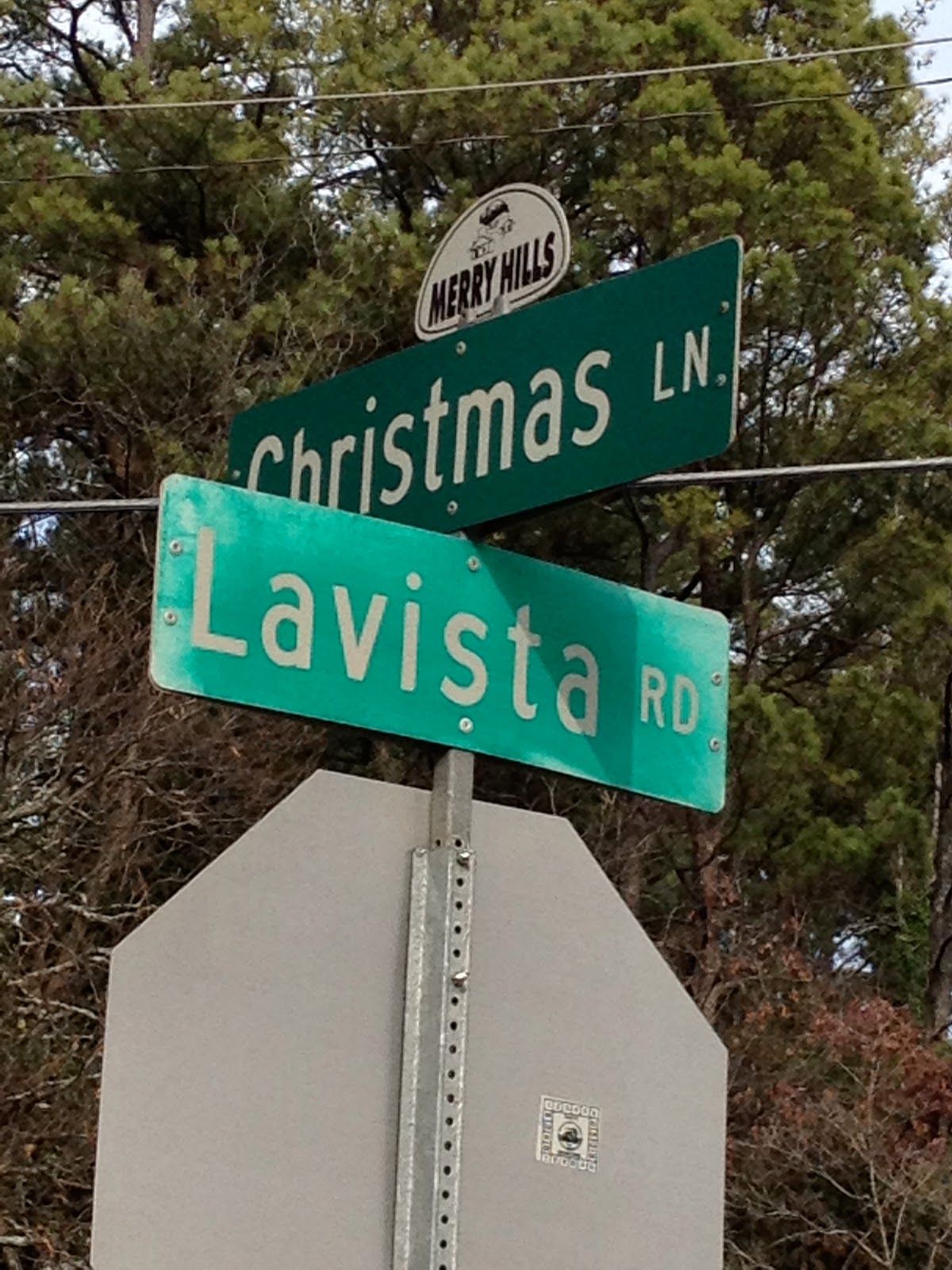
Who'd believe it? In the same neighborhood, no less. Wait, wait: what if they cross? How cool would that be? No, surely they don't.
Wait for it...

Atlanta, man. From my blog to you(rs)!
22 December 2011
Solstice!
I've been away without blogging for a week now. Visiting family in NC. Giftmas. Great weather, food, & family there. Horrible driving today—blinding rain. But we're all home and safe. I've been pretty much without access to the so-called "Information Superhighway," (other than on my portable, hand-held cellular device) so if I haven't commented at your place, it's not you, it's me.
A couple of things: Václav Havel, former DFH & president of Czechoslovakia, died this week. He was not only a politician but a playwright. He led a democratic movement to liberate the Czech people from the USSR and got thrown in the slammer for same. And, in keeping with the Zappadan theme of the last few posts, he was a lifelong fan of Frank Zappa. One of his first official acts as president was to invite Zappa to Czechoslovakia. Liberation, courage, democracy, thoughtful, (counter-) cultural literacy, Zappa, writing: don't know that much about him, but he sounds like my kind of guy.
Oh yeah, "dear" leader Kim Jong-Il died, too. Managed to catch the faux mourners, paid keeners, whore wailers, on the News. Twerp.
Take heart, all: from here on until June, here in the Northern Hemisphere, the days get longer and the nights shorter. Happy Solstice!
Again, sorry I missed the last days of Zappadan here. So, shut up 'n' play yr guitar—this is the indulgent, enduring, musical stuff that I just keep coming back to again and again:
[h/t to TheZappaDiscography over at the YouTubes. When I first starting posting during Zappadan a few years back, most of Z's stuff was unavailable on the internets.]
14 December 2011
Who Will Save Our Souls?
This is a momentous day:
Declaring a doctine of pre-emption, Bush claimed the right for the U.S. to invade any country anytime U.S. leaders perceive an imminent threat to U.S. national security. Many, even some in the military, believe this doctrine and the actions justified by it are in violation not only of "just war" theory but also international law. In other words, the war itself is a war crime.
As a result of the Bush/Cheney/Rumsfeld criminal push for war, 4,483 U.S. troops died in Iraq, 3,531 in combat. As well, official sources note 33,183 U.S. service -men and -women were wounded in Iraq. That number is disputed, and some believe it may be three times that many.
The number of Iraqi civilian dead cannot be reliably estimated, but, based on a study that appeared in the British medical journal Lancet, some have estimated the Iraq body count to be over one million. Official tallies fall way short of this number but are nonetheless substantial.
This is why President Obama's announcement today marking the official end of the war in Iraq is so momentous. It puts an official stop to this criminal war. It puts an official stop to the 'justified' wholesale killing of civilians.
But the costs of this war go beyond body counts. The direct economic costs of the war in Iraq, by most accounts, are well over $1 trillion. This does not include the costs of extra spending to care for veterans from combat through 2050, which may itself total over $1 trillion. Nor does it account for interest to be paid on funds borrowed to fund the war.
In 2008, Nobel laureate Joseph E. Stiglitz estimated the costs of the Iraq war at $3 trillion. He has since determined that estimate to be too low. As WoW pointed out at the time, that estimate did not include opportunity costs or what he calls "what if" costs:
And this gets to the final component of the costs of this war: the price of our souls. Primarily, the companies that profited from this war are those engaged in arms and weapons manufactury, those providing contractual paramilitary services, and those involved in oilfield services industry. These are the destructive angels of our nature—the killing business, the resource exploitation business. Then, of course, there's their bankers and financiers—the speculators and parasites. The Iraq war has made these folks the Masters of the Universe—or at least elevated their mastery to a whole new level.
We may be able to pay back the economic costs of this war, but it will take time and sacrifice. We might even be able to reclaim our collective souls from the destructive forces that currently have us in their clutches. Occupy, I'd say, is a good start. We can never, however, recover the lives lost, U.S. or Iraqi.
The costs in human lives, the economic and financial costs, and the costs to our soul as a civilization: let us hope that the end to this war can reverse this self-destructive trend and put us on the road to a more creative, healthy, and productive future.
Thank you, President Obama, for putting an end to this atrocity. Frankly, it's about time. I know it has taken a great deal of time and energy on your part. I know you have had to battle the entrenched, corrupt forces of militarism and bureaucratic inertia and war-profiteering to get to this point. But it was the right thing to do. The project now is to figure out how to pay for this disaster without sending the entire world into a further economic tailspin and, simultaneously, recover our wounded souls—the better angels of our nature.
-----
From Uncle Meat:
------
Now shut up 'n play ur guitar:
'President Barack Obama marked the end of the U.S. war in Iraq with a salute to American troops at a military base central to the fight and a pledge to support veterans who are returning home to face a difficult economy.
'As your commander in chief, and on behalf of a grateful nation, I'm proud to finally say these two words,' Obama told soldiers at Fort Bragg, North Carolina, home of the 82nd Airborne Division and the Army Special Operations Command. 'Welcome home.'
…
A promise to end the conflict in Iraq was a central element of Obama's campaign for the presidency in 2008. When he took office in January 2009, there were almost 150,000 troops in Iraq. That number has shrunk to less than 8,000 and the number of U.S. military bases in the country has fallen to five from 505. When the pullout is complete, the U.S. presence will be at the embassy in Baghdad, with an array of diplomats, military advisers and contractors.
'There is something profound about the end of a war that has lasted so long,' Obama told troops."Indeed there is. Former President George W. Bush, using a duplicitous and fraudulent Congressional authorization, invaded Iraq under false premises in March 2003. The bases for that authorization—that Iraq possessed weapons of mass destruction and maintained active links to al Qaeda making it a direct and imminent threat to the U.S.—were utterly false.
Declaring a doctine of pre-emption, Bush claimed the right for the U.S. to invade any country anytime U.S. leaders perceive an imminent threat to U.S. national security. Many, even some in the military, believe this doctrine and the actions justified by it are in violation not only of "just war" theory but also international law. In other words, the war itself is a war crime.
As a result of the Bush/Cheney/Rumsfeld criminal push for war, 4,483 U.S. troops died in Iraq, 3,531 in combat. As well, official sources note 33,183 U.S. service -men and -women were wounded in Iraq. That number is disputed, and some believe it may be three times that many.
The number of Iraqi civilian dead cannot be reliably estimated, but, based on a study that appeared in the British medical journal Lancet, some have estimated the Iraq body count to be over one million. Official tallies fall way short of this number but are nonetheless substantial.
This is why President Obama's announcement today marking the official end of the war in Iraq is so momentous. It puts an official stop to this criminal war. It puts an official stop to the 'justified' wholesale killing of civilians.
But the costs of this war go beyond body counts. The direct economic costs of the war in Iraq, by most accounts, are well over $1 trillion. This does not include the costs of extra spending to care for veterans from combat through 2050, which may itself total over $1 trillion. Nor does it account for interest to be paid on funds borrowed to fund the war.
In 2008, Nobel laureate Joseph E. Stiglitz estimated the costs of the Iraq war at $3 trillion. He has since determined that estimate to be too low. As WoW pointed out at the time, that estimate did not include opportunity costs or what he calls "what if" costs:
"two years on, it has become clear to us that our estimate did not capture what may have been the conflict's most sobering expenses: those in the category of "might have beens," or what economists call opportunity costs. For instance, many have wondered aloud whether, absent the Iraq invasion, we would still be stuck in Afghanistan. And this is not the only "what if" worth contemplating. We might also ask: If not for the war in Iraq, would oil prices have risen so rapidly? Would the federal debt be so high? Would the economic crisis have been so severe?
The answer to all four of these questions is probably no. The central lesson of economics is that resources -- including both money and attention -- are scarce. What was devoted to one theater, Iraq, was not available elsewhere."WoW's point was that if those funds squandered in destructive warfare had been put to creative use—investing, say, in green energy sources, shoring up Social Security, developing universal health care, seeding new, productive industries here and even abroad, reducing poverty worldwide, etc.—the potential return on those investments would have made a hugely positive contribution to the standard of living world-wide. Stiglitz, of course, notes that the financial crisis we are currently experiencing is almost certainly attributable to this war.
And this gets to the final component of the costs of this war: the price of our souls. Primarily, the companies that profited from this war are those engaged in arms and weapons manufactury, those providing contractual paramilitary services, and those involved in oilfield services industry. These are the destructive angels of our nature—the killing business, the resource exploitation business. Then, of course, there's their bankers and financiers—the speculators and parasites. The Iraq war has made these folks the Masters of the Universe—or at least elevated their mastery to a whole new level.
We may be able to pay back the economic costs of this war, but it will take time and sacrifice. We might even be able to reclaim our collective souls from the destructive forces that currently have us in their clutches. Occupy, I'd say, is a good start. We can never, however, recover the lives lost, U.S. or Iraqi.
The costs in human lives, the economic and financial costs, and the costs to our soul as a civilization: let us hope that the end to this war can reverse this self-destructive trend and put us on the road to a more creative, healthy, and productive future.
Thank you, President Obama, for putting an end to this atrocity. Frankly, it's about time. I know it has taken a great deal of time and energy on your part. I know you have had to battle the entrenched, corrupt forces of militarism and bureaucratic inertia and war-profiteering to get to this point. But it was the right thing to do. The project now is to figure out how to pay for this disaster without sending the entire world into a further economic tailspin and, simultaneously, recover our wounded souls—the better angels of our nature.
-----
From Uncle Meat:
------
Now shut up 'n play ur guitar:
08 December 2011
Sun, Sun, Sun: Here It Comes
I've been tracking this for years here @ WoW: the cost of photovoltaic solar energy is nearly on par with that of mainstream utilities. Here's why. First, the price of solar panels has plummeted.
"Since 2009, the cost has dropped 70 percent," says Pearce. But more than that, the assumptions used in previous studies have not given solar an even break.
"Historically, when comparing the economics of solar and conventional energy, people have been very conservative," says Pearce. To figure out the true cost of photovoltaic energy, analysts need to consider several variables, including the cost to install and maintain the system, finance charges, how long it lasts, and how much electricity it generates.
Pearce and his colleagues performed an exhaustive review of the previous studies and concluded that the values given those variables were out of whack. For example, most analyses assume that the productivity of solar panels will drop at an annual rate of 1 percent or more, a huge overestimation, according to Pearce.
"If you buy a top-of-the-line solar panel, it's much less, between 0.1 and 0.2 percent." In addition, "The price of solar equipment has been dropping, so you'd think that the older papers would have higher cost estimates," Pearce says. "That's not necessarily the case."Stated another way, we're not talking about any abstract "price discovery" here, even though a truly free market economics would demand it:
The price of solar energy-generated electricity, calculated by a legitimate levelized cost of energy (LCOE) method, is now competitive in many regions with the price of electricity generated by conventional sources.
To be clear, this review of solar photovoltaic LCOE is not one of those “if coal and nuclear paid for the real harm they do” analyses. It is a hard look at the actual numbers.And what's more, apparently the financial data are bearing this out:
Renewable energy is surpassing fossil fuels for the first time in new power-plant investments, shaking off setbacks from the financial crisis….
Electricity from the wind, sun, waves and biomass drew $187 billion last year compared with $157 billion for natural gas, oil and coal, according to calculations by Bloomberg New Energy Finance using the latest data. Accelerating installations of solar- and wind-power plants led to lower equipment prices, making clean energy more competitive with coal.
This from those DFHs over at the Bloomberg.

This is important. Lower priced energy correlates with higher productivity and, often, a higher standard of living—especially if the energy is not monopolized and Corporate is not skimming the profits created by increasingly higher productivity the way they have been over the last twenty years (h/t Occupy!). Think, for example, of cheap, portable desalination of water. Such a technology could stave off at least one future resource war, not to mention save the lives of peoples everywhere. And solar is not the only natural, renewable, abundant source of energy.
Though I do my level best to avoid them, metaphors abound. (h/t blogbud BDR, from whom I'm always stealing turns of phrase.)
Big Picture: Occupy! is not just about the U.S. middle class.
Big (down-the-road) Problem: How do we handle the additional heat thrown off by all this increased energy without cooking the planet?
οἱ οἱ οἱ
Time magazine has named Occupy Wall Street the story of the year. Yep. So what's happening? The DC occupistas are showing serious strategic savvy: they're taking it to K Street, lobbying central, the funnel through which Corporate money purchases its (non-)governance. It is the crucial supply line. And, in grand '60s-style street theater, they've occupied the U.S. Chamber of Commerce holiday party by rolling out the red carpet for the lobbyists' and their Corporate masters' arrivals. Check it:
Brilliant. Who says this generation is lacking in imagination?
On yet another front, occupistas are attempting to occupy unoccupied foreclosed-upon houses. Keep up with them here.
For οἱ πολλοί:
God bless us, every one.
Subscribe to:
Posts (Atom)