(cont'd from previous post)
We suited up and stepped into our harnesses. The harnesses loop tightly around your upper thighs then fasten around your waist and shoulders to keep you from falling forward and out of them.
I spoke with Wisdaughter's dive-buddy, let's call him 'Joey' (he might be a grad student at GIT), and asked about jumping accidents they'd had at the facility. He told me the very harnesses we were just then strapping on were of recent design and had been implemented when the aforementioned paraplegic had somehow passed out on a tandem dive and flipped down and, due to a lack of lower body muscle control, out of his harness. The new design, which loops tightly around your thighs, purportedly keeps you from doing just that. I credited Joey for his forthrightness, explaining that I had researched the very topic of accidents at the dive facility and was wondering just how someone, -plegic or not, could conceivably have fallen out of a tandem harness. He then went through an elaborate pantomime of the incident, taking care to demonstrate how it simply couldn't happen again. Safety and all that.
My dive-buddy, let's call him 'Andy', is a lawyer in Atlanta. He gets his jollies, and supplements his income, by jumping on the weekends. He was very reassuring. He'd done over 1500 jumps without anything anywhere near an incident, he told me. I told him I didn't want to swing around or go up and over the canopy once we'd deployed our chute. I wanted to hang straight underneath it for the spiral down. He looked a bit disappointed (or that's how I interpreted his look) but agreed. That's the best I could do, I felt the need to explain.
Perhaps sensing my trepidation—the terror in my eyes? the quaver in my voice?—he asked me to practice the specific mechanics of the door—The Door!—exit there on the carpet in the dressing room several times. This, I suspect (principally because none of the others in my group was requested to go through the same motions), was his attempt to have me achieve, behaviorally and physically, what, unbeknownst to him, Wisdoc had managed to achieve, inwardly and psychically, in her own door dream—namely, to give me an outward mechanism, i.e., a set of specific set of uncomfortable tasks, to focus on that would distract me and make me forget about whatever inner turmoil it was he intuited I might have been experiencing.
Fortunately or un-, as the case may be, I do have an inner life, and quite an exquisite one from all indications. That is to say, one not so easily lulled or gulled.
As we were rehearsing our exits, tatooed, spiky-haired instructor Jeff came over and announced that there was some sort of glitch with the plane, and they had to shut off its engines. That meant we would have to wait half-an-hour before they would be able to restart it. So we plopped on one of the shabby sofas in front of a big-screen television and watched jump DVDs of members of the groups that had already completed their jumps. There was lots of screaming and joking around and bad, loud rock music in the background. The participants enjoyed watching themselves on the television. One of them, a woman "of a certain age" with bottle-blond hair, bee-stung lips, Botoxed cheeks, too much expensive jewelry, and long, shiny nails, told us how this was going up on her Facebook page so her step-daughter who lived in Colorado could see it and be proud of her. She told us how this was her first time and how scared she'd been at the door, but how she'd been with her husband whose hobby skydiving is and just gone ahead and jumped anyway and Voila! there she was doing it on the big screen.
I had trouble hearing what she was saying; the music on the video was blaring through huge speakers, my jumpsuit was hot, and my harness was pinching my balls. Yet there was no escaping the inevitable inference: if she could do it, anybody could.
And thus down was the psychic gauntlet flung.
(to be continued)
Is there any such thing? Let's investigate—for good or ill. A blog about fiction and literature, philosophy and theology, politics and law, science and culture, the environment and economics, and ethics and language, and any thing else that strikes our fancy. (Apologies to Bertrand Russell)
04 September 2009
02 September 2009
Thyraphobia, or Purity of Heart is to Fear One Supposedly Fun Thing I'll Never Not Do Again (Pt. 4)
(cont'd from previous posts)
I'll be the first to admit I've always had a bit of acrophobia—but only at certain kinds of heights. Walking across a swinging suspension bridge, for example, or being stuck atop a stopped, rickety ferris wheel, or riding up that clanking climb on the first hill of a roller coaster: those sorts of things make me a bit panicky. Not flying in a jet plane, though, nor being inside a tall building, nor going up in the Arch in St. Louis.
[Sidebar: Oddly, I used to get a little queasy standing on the observation deck atop the old World Trade Center when we would entertain out-of-town guests in NYC—which was the only time we ever did those sorts of touristy things—but never up on the Empire State Building. The WTC felt like it was swaying with the wind, which, of course, it was as was the Citicorp Center where I used to work on like the 60th floor which itself would visibly sway in a strong wind. Sometimes at night the swaying would cause doors in empty offices to slam shut because of the counterweighted movement—and yeah, it was kind of spooky say at about 3 a.m. late on a Sunday night when I had a Monday a.m. deadline and nobody was even in the whole building much less on my floor and I was just a little delirious in the first place from a weekend's sleep deprivation. On a further side note, I also used to wonder what would happen if one of the Twin Towers toppled over whenever I would walk under them which was every day for several years while I was in law school (but that's a post for another day. They just seemed so precarious. Naturally, I just chalked it up to projecting my own acrophobia onto those inanimate duoliths [Note to self: Good research topic for causes/motivations of 9/11 masterminds having chosen the WTC's as target? Did they experience the same sort of emotional reaction at some point in the past and have a destructive rather than a phobic projective urge? Gives one pause.]).]
Anyway. The point is I'm exquisitely aware of my acrophobic tendencies, and I take active steps to allay my fear. (1) Whenever possible, I avoid. I would never, for instance, attempt to walk a tightrope or take a job walking iron. I don't rockclimb—though I'll hitch up and go to one of those fake climbing walls and shinny right on up to the top and ring the bell (though I have to admit the first time I tried I got halfway up and froze and had to come down just to test how well I was belayed). And (2) I cope. I close my eyes and use yoga breathing and relaxation techniques I learned in drama class and during college. Sometimes I even try to visualize, you know, a happy place sort of thing, too. And usually it works.
Fact is prior to my attempt at skydiving, as I said, I'd been fairly successful at overcoming my acrophobia (that is conquering my panics), primarily because my panicked responses had been proportional to the stimuli—and the stimuli had been relatively mild. I don't freak out on roller coasters or ferris wheels or well-built suspension bridges. I grab on to something—a rope, a rail—, I suck it up, and go on, often even enjoying the experience.
But it's more than a feeling we're talking about here or a mild fright; a panic attack is an overpowering physical sensation. Hell, George Orwell devised an entire system of societal control based solely on the inducement of it: Room 101. And David Chase created six award-winning seasons of premium American pay-TV based on one character's inability to deal with his own unmotivated experience of it. It's disorienting. Discombobulating.
Just so we know what we're talking about here, the DSM IV lists the diagnostic criteria for a panic attack as follows:
(to be continued)
I'll be the first to admit I've always had a bit of acrophobia—but only at certain kinds of heights. Walking across a swinging suspension bridge, for example, or being stuck atop a stopped, rickety ferris wheel, or riding up that clanking climb on the first hill of a roller coaster: those sorts of things make me a bit panicky. Not flying in a jet plane, though, nor being inside a tall building, nor going up in the Arch in St. Louis.
[Sidebar: Oddly, I used to get a little queasy standing on the observation deck atop the old World Trade Center when we would entertain out-of-town guests in NYC—which was the only time we ever did those sorts of touristy things—but never up on the Empire State Building. The WTC felt like it was swaying with the wind, which, of course, it was as was the Citicorp Center where I used to work on like the 60th floor which itself would visibly sway in a strong wind. Sometimes at night the swaying would cause doors in empty offices to slam shut because of the counterweighted movement—and yeah, it was kind of spooky say at about 3 a.m. late on a Sunday night when I had a Monday a.m. deadline and nobody was even in the whole building much less on my floor and I was just a little delirious in the first place from a weekend's sleep deprivation. On a further side note, I also used to wonder what would happen if one of the Twin Towers toppled over whenever I would walk under them which was every day for several years while I was in law school (but that's a post for another day. They just seemed so precarious. Naturally, I just chalked it up to projecting my own acrophobia onto those inanimate duoliths [Note to self: Good research topic for causes/motivations of 9/11 masterminds having chosen the WTC's as target? Did they experience the same sort of emotional reaction at some point in the past and have a destructive rather than a phobic projective urge? Gives one pause.]).]
Anyway. The point is I'm exquisitely aware of my acrophobic tendencies, and I take active steps to allay my fear. (1) Whenever possible, I avoid. I would never, for instance, attempt to walk a tightrope or take a job walking iron. I don't rockclimb—though I'll hitch up and go to one of those fake climbing walls and shinny right on up to the top and ring the bell (though I have to admit the first time I tried I got halfway up and froze and had to come down just to test how well I was belayed). And (2) I cope. I close my eyes and use yoga breathing and relaxation techniques I learned in drama class and during college. Sometimes I even try to visualize, you know, a happy place sort of thing, too. And usually it works.
Fact is prior to my attempt at skydiving, as I said, I'd been fairly successful at overcoming my acrophobia (that is conquering my panics), primarily because my panicked responses had been proportional to the stimuli—and the stimuli had been relatively mild. I don't freak out on roller coasters or ferris wheels or well-built suspension bridges. I grab on to something—a rope, a rail—, I suck it up, and go on, often even enjoying the experience.
But it's more than a feeling we're talking about here or a mild fright; a panic attack is an overpowering physical sensation. Hell, George Orwell devised an entire system of societal control based solely on the inducement of it: Room 101. And David Chase created six award-winning seasons of premium American pay-TV based on one character's inability to deal with his own unmotivated experience of it. It's disorienting. Discombobulating.
Just so we know what we're talking about here, the DSM IV lists the diagnostic criteria for a panic attack as follows:
A discrete period of intense fear or discomfort, in which four (or more) of the following symptoms developed abruptly and reached a peak within 10 minutes:
And, knowing all this, I decided I was man enough to challenge my own phobia and the debilitating panic it induced in me, amp up the stimuli to the extreme, and attempt to skydive.
- palpitations, pounding heart, or accelerated heart rate
- sweating
- trembling or shaking
- sensations of shortness of breath or smothering
- feeling of choking
- chest pain or discomfort
- nausea or abdominal distress
- feeling dizzy, unsteady, lightheaded, or faint
- derealization (feelings of unreality) or depersonalization (being detached from oneself)
- fear of losing control or going crazy
- fear of dying
- paresthesias (numbness or tingling sensations)
- chills or hot flushes
(to be continued)
01 September 2009
Thyraphobia, or Purity of Heart is to Fear One Supposedly Fun Thing I'll Never Not Do Again (Pt. 3)
(cont'd from previous post)
I didn't. I did not march my two beloved children out the door and forbid them from jumping out of a perfectly functional airplane. I was, I suppose, afraid I'd incur their noisy resentment (and louder resistance) and look like an idiot—especially since I'd already agreed to it and PREPAID (sneaky thing that!). At some primitive level I was torn between the urge to protect my cubs—which, by the way, is a very powerful instinct, right up there with self-preservation—and my normal rational self. I knew that thousands of people skydive safely every day, and we were going to jump in tandem with experienced professionals. That thought—and the promise I'd made to my kids—carried the day.
One other thing: that morning, Wisdoc had awoken and said she'd been dreaming about jumping, and, after declaring she had no desire to do it, had changed her mind, and that she, too, wanted to jump. She said she simply saw herself in her dream going through the door over and over and eventually falling safely to the ground. So she was on board to jump now as well. Talk about the power of the unconscious.
We filled out our forms and went through a brief orientation session with "Jeff". Jeff had wild, spiky hair and piercings and tatoos up and down his legs and arms and something like 5,000 jumps under his belt. He was not an adrenaline junky, he swore. He was clean and sober too, he said through bleary eyes—all the instructors there were, even though it was Sunday morning. He said it was perfectly normal to be afraid of jumping. In fact, it would be abnormal not to be a little apprehensive. Everybody, even the instructors who did multiple jumps every day, was. "Fear makes you careful," he said. "Believe me," he said, "none of us are (sic) suicidal."
On the carpet there in the waiting room, we practiced the motions we would need to do to exit the door of the plane and the jutting belly and arched back posture we would need to maintain during freefall. And we met the people who would be clipped to our backs for the ride down and pull the chutes at the appropriate time. So far, so good.
After orientation we had about an hour to mingle with other jumpers. I struck up a conversation with guy in a scuba diving tee shirt. He looked to be about sixty, but he had the truest, smoothest blond hair I've ever seen—even his mustache and goatee and eyebrows. His hair cascaded in gentle locks down below his shoulders. His skin was smooth and hairless and as tanned red as the laces on a baseball. He looked like he could've been a member of Lynyrd Skynyrd. He said he walked iron, which I interpreted to mean he worked construction on skyscrapers—not a job I could ever do, though I did work construction on a twelve-story hospital the year I dropped out of college. I think his name was Jeff, too.
This Jeff and I talked about our favorite places to scuba dive and then about our fears of skydiving. He told me he'd never done it before, but his wife and daughter (who were there with him) had given him a certificate to do so for his birthday. Eventually I asked the question that had been preying on me: "What do you do if you get to the door and decide you just can't jump?" He thought about it a moment and pulled his hair back into a temporary pony tail with both hands and said something so ridiculously cliched I nearly sputtered. He said, quoting "Dirty Harry" and, I suppose, the wisdom of his colleagues who walked the iron-framed skyscraper shells: "Man's got to know his limitations."
But I didn't laugh. I looked him in his crystal-clear blue eyes and saw how sincere he was. I nodded to his experience. It sounded like a statement he'd earned somehow—though I didn't ask. "I guess that's what it is," I said turning my head to look out the mouth of the hangar at the latest group of returning jumpers. Just at that moment a voice on the loudspeaker called his group to suit up. They were the jumpers immediately ahead of us. "See you when you get down," I said. "Good luck."
Clearly the fear had its grips on me.
(to be continued)
I didn't. I did not march my two beloved children out the door and forbid them from jumping out of a perfectly functional airplane. I was, I suppose, afraid I'd incur their noisy resentment (and louder resistance) and look like an idiot—especially since I'd already agreed to it and PREPAID (sneaky thing that!). At some primitive level I was torn between the urge to protect my cubs—which, by the way, is a very powerful instinct, right up there with self-preservation—and my normal rational self. I knew that thousands of people skydive safely every day, and we were going to jump in tandem with experienced professionals. That thought—and the promise I'd made to my kids—carried the day.
One other thing: that morning, Wisdoc had awoken and said she'd been dreaming about jumping, and, after declaring she had no desire to do it, had changed her mind, and that she, too, wanted to jump. She said she simply saw herself in her dream going through the door over and over and eventually falling safely to the ground. So she was on board to jump now as well. Talk about the power of the unconscious.
We filled out our forms and went through a brief orientation session with "Jeff". Jeff had wild, spiky hair and piercings and tatoos up and down his legs and arms and something like 5,000 jumps under his belt. He was not an adrenaline junky, he swore. He was clean and sober too, he said through bleary eyes—all the instructors there were, even though it was Sunday morning. He said it was perfectly normal to be afraid of jumping. In fact, it would be abnormal not to be a little apprehensive. Everybody, even the instructors who did multiple jumps every day, was. "Fear makes you careful," he said. "Believe me," he said, "none of us are (sic) suicidal."
On the carpet there in the waiting room, we practiced the motions we would need to do to exit the door of the plane and the jutting belly and arched back posture we would need to maintain during freefall. And we met the people who would be clipped to our backs for the ride down and pull the chutes at the appropriate time. So far, so good.
After orientation we had about an hour to mingle with other jumpers. I struck up a conversation with guy in a scuba diving tee shirt. He looked to be about sixty, but he had the truest, smoothest blond hair I've ever seen—even his mustache and goatee and eyebrows. His hair cascaded in gentle locks down below his shoulders. His skin was smooth and hairless and as tanned red as the laces on a baseball. He looked like he could've been a member of Lynyrd Skynyrd. He said he walked iron, which I interpreted to mean he worked construction on skyscrapers—not a job I could ever do, though I did work construction on a twelve-story hospital the year I dropped out of college. I think his name was Jeff, too.
This Jeff and I talked about our favorite places to scuba dive and then about our fears of skydiving. He told me he'd never done it before, but his wife and daughter (who were there with him) had given him a certificate to do so for his birthday. Eventually I asked the question that had been preying on me: "What do you do if you get to the door and decide you just can't jump?" He thought about it a moment and pulled his hair back into a temporary pony tail with both hands and said something so ridiculously cliched I nearly sputtered. He said, quoting "Dirty Harry" and, I suppose, the wisdom of his colleagues who walked the iron-framed skyscraper shells: "Man's got to know his limitations."
But I didn't laugh. I looked him in his crystal-clear blue eyes and saw how sincere he was. I nodded to his experience. It sounded like a statement he'd earned somehow—though I didn't ask. "I guess that's what it is," I said turning my head to look out the mouth of the hangar at the latest group of returning jumpers. Just at that moment a voice on the loudspeaker called his group to suit up. They were the jumpers immediately ahead of us. "See you when you get down," I said. "Good luck."
Clearly the fear had its grips on me.
(to be continued)
25 August 2009
Thyraphobia, or Purity of Heart is to Fear One Supposedly Fun Thing I'll Never Not Do Again (Pt. 2)
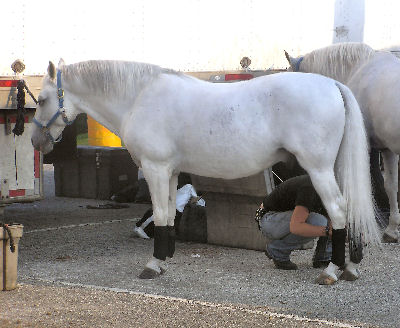
About thirty or so people were sitting in folding soccer chairs on the hangar's apron facing the runway, chatting, smoking cigarettes, and occasionally glancing up into the sky. As we walked toward them, I naturally looked up. Large white cumulus clouds let in patches of sky blue sky. Just at that moment, I saw something about the size of a deer tick on a Lipizzaner's rump . It was the figure of a man falling in a puff through one of the clouds directly overhead. Whoa!
I craned to see him. He grew larger and larger as he plummeted directly toward me. Soon, others came into view. Then, after what seemed like a really long time, the first man opened his chute. A black and grey canopy with some sort of military insignia unfurled above him. Right behind him the other black figures opened identical chutes, probably a jump group from the local army base. I watched them sail down, spiraling round and round toward the drop zone about a hundred yards from where I was standing, swooping in one-by-one between two lines of colorful banners fluttering in the breeze, tugging on their controls and pulling up, stopping in mid-air about two feet off the ground, and setting down gently and precisely on a marker in the grass between the runways just as the plane that had, apparently, taken them up landed. Wow!
No one there, the regulars apparently, seemed particularly moved by this incredible feat. No applause. We, on the other hand, watched the men, who were all dressed in black coveralls, land, gather their parachutes, and stride back to the hangar, our mouths agape, staring back and forth at each other in disbelief. "OMG, we're gonna' do that," Wisdaughter said, clapping her hands.
"We better go in to register," I said. My neck ached. The others in my group, Wisdoc, Wisdommy, and Wisdaughter, could hardly contain their excitement. They chattered as we stepped into a dark room, the blinds on its windows pulled tight to keep out the glare of the sun. Its walls were lined with sofas and vending machines. A young woman at a plexiglas window confirmed our appointment and handed us out some forms—kind of like at the dentist's office.
This seems like a good place to explain how we got there in the first place. Wisdaughter had just turned eighteen and had declared that the one thing she could legally do on her birthday that she couldn't have done the day before was to skydive. So, she said, that is what she would like for us all to do—as a party and her present, our last family outing (ex our long-awaited scuba diving trip) before she had to head off to college. Wisdommy, who's a tad older was gung-ho and couldn't believe he hadn't thought of the same thing on his birthday last year. Wisdoc said she didn't want to jump, but was supportive and would cheer them on from the ground. I had said, "Okay, here's what I'll do: You guys go ahead. I'll suit up, strap into the gear, go up in the plane with you, and make a decision at the door whether to jump. I can't promise anything." If nothing else, I am sufficiently self-aware to at least suspect I might seize up at the last second.
Now, before you are allowed to skydive, you have to fill out a number of CYA forms absolving anybody and everybody in the known, civilized world of any and every kind of legal liability, real or imagined, whatsoever henceforth and forevermore, including, but not limited to the airport, the owner of the land under the airstrip, the air traffic controllers, the airplane manufacturer, the parachute and parachute paraphernalia manufacturers, the skydive company (its employees, owners, subsidiaries, heirs, and assigns), the pilots, the people jumping with you, the chute packers, the owners of the Quonset hangar, etc., etc. Understandably. The skydive company, itself a limited liability corporation, by my reading, was hidden in a maze of like sixteen other limited liability corporations each with different places of doing business from like Michigan to Florida; they weren't going to make it easy if you decided to go back on your entirely voluntary agreement not to sue: it would take thousands of dollars of discovery just to figure out whom to sue and where to locate their assets.
But I'm a lawyer. I'm used to that stuff, though, admittedly, I'd never seen quite such a defensive shell game. And, from my preliminary research, in all the thirty-plus years the skydive company had been in business, they'd only had two serious accidents: one when a paraplegic flipped over and fell through his tandem harness and the other when a just-married couple's chutes had gotten tangled on the way down.
What struck me like a ball peen hammer to the temple, though, on the first page of the stack of papers we received, in something like 36-point bold font, was a centered statement reading something like: "Skydiving is an extremely high-risk activity. You could seriously injure yourself or lose your life even if everything goes right." In a slightly smaller font, but no less attention-getting, it identified the company sponsoring this high-risk company as "The Uninsured [...] Company." This got my Spidey-sense all tingly. What in the hell was I getting not just myself, but my family, into?
I wanted to get up, grab the papers from their hands, and march them out the door that very second.
[to be continued]
23 August 2009
Thyraphobia, or Purity of Heart is to Fear One Supposedly Fun Thing I'll Never Not Do Again
Recently, however, I experienced an intensity of emotion that shattered my usual calm, wrung me out like a cheap ShamWow!. Unlike anything else I have ever felt in my entire life, this was as naked and raw an emotion as I can imagine ever having—and living to tell the tale.
It was fear. Sheer unalloyed terror. Petrifying panic. An irrational,* (*I'll qualify this later) existential** (**ditto) dread that made me want to rip off my skin and leap out of myself. And what's more, I brought it on myself.
Let me back up. I've done many things in my life that many people would be afraid of doing: I've played organized American football and disorganized rugby, I've caught a H.S. kid with an 86 mph fastball, I've climbed a 12,000 foot volcano and stared down its sheer inner cliff walls into its vast smoldering caldera, I've bushwhacked through trackless jungle and spent three hours sitting on the side of an African mountain with a troop of gorillas, I've talked my way out of what could've been a dicey situation when a Congolese guerilla leveled his AK-47 at me and demanded to see what my U.S. money looked like, I've played with large (non-poisonous) snakes, on vacation this month I had a tarantula fall out of a tree onto my hand, I've scuba dived with 6-10 ft. long black-tipped reef sharks and snorkeled straight into a school of barracudas, I've swum through a coral cave at a depth of 90ft., I've sat out on the beach on a starless night and watched a heavy lightning and thunder storm, I've been in a plane struck by lightning, I've piloted a glider plane, I've spoken and even sung in front of crowds ranging from a handful to over a thousand, I've acted and starred in stage plays, I've disagreed with and even corrected a federal judge in open court (gulp), I've demanded a raise and a promotion and said if I didn't get it I'd quit, I've quit a job, I've been in the operating theater during open heart surgery and held a living human heart in my hand, I've eaten sushi, I've made a life commitment to my spouse, I've sired children.
All that is by way of saying I'm not a fearful person generally. Have I ever been afraid in my life? Of course; I'm human. Have I been able to get a handle on this fear, contain it, and act in the face of it? Yes (see above). In fact, one motif in my (still unagented and thus unpublished) novel, EULOGY, deals with the protagonist's confrontation of roughly six or seven of the commonly-cited ten most common fears. And what are these fears? According to this site, they are as follows:
- Fear of public speaking (Glossophobia)
- Fear of death (Necrophobia)
- Fear of spiders (Arachnophobia)
- Fear of darkness (Achluophobia, Scotophobia or Myctophobia)
- Fear of heights (Acrophobia)
- Fear of people or social situations (Sociophobia)
- Fear of flying (Aerophobia)
- Fear of open spaces(Agoraphobia)
- Fear of thunder and lightning(Brontophobia)
- Fear of confined spaces(Claustrophobia)
But this—the fear I experienced—this was way beyond anything I'd ever felt before. It was an animal terror so pure it consumed me entirely; it took over my body—which, of course, means it took over my mind—and refused to let me go.
And what was the cause of this siege? A doorway. θύρα in the the Greek (transliterated thura- or thyra-), thus thuraphobia or thyraphobia: fear of doors. A doorway about three feet wide and five feet tall. Curved, with a rolling plexiglas door. I was invited to go through the door, encouraged, nearly forced. But I couldn't—not wouldn't, mind you. Could not. My body, at some pre-cortical, reptilian-brained level, simply rebelled. "I"—the rational, conscious self of me that intended, indeed wanted to go through that door—was unable to move.
Why? Because on the other side of this door was a drop of about 14,000 feet. Some two and a half miles straight down.
(to be continued)
18 August 2009
A Slumgullion
| The Daily Show With Jon Stewart | Mon - Thurs 11p / 10c | |||
| Heal or No Heal - Medicine Brawl | ||||
| www.thedailyshow.com | ||||
| ||||
Is it me, or does this segment from last night's The Daily Show with Jon Stewart bear a strong resemblance (in POV and substance, at least) to my previous post? With the obvious exception that theirs is funny. I've been a fan of TDS since the Craig Kilborn days. In fact, I remember thinking when JS replaced him that it would no longer be any good. I was wrong. TDS, in the tradition of such political comedians/satirists as Pat Paulsen, early Al Franken, and many others, is a tremendous program which cuts through all the political bullshit. If I were to find out (hint, hint) that one of the writers of the show had actually read my blog and used an idea or was inspired by what I wrote, I would be thrilled!
----------
Here's another idea: let's put all those who tote guns to Congressional or Presidential town halls in "Second Amendment zones" modeled on the "free speech zones" the Secret Service used for protesters against the former president and his party. As a matter of law, I don't believe the Second is any more sacrosanct than the First. There, they can talk amongst themselves, compare their signage, and brandish or whatever it is they do with their firearms.
----------
In other news, you can find a podcast of J.M. Coetzee reading from his forthcoming work—Summertime—here.
----------
If you're into old-fashioned reading, Hunger Mountain has reprinted George Saunders's first short-story, "A Lack of Order in the Floating Object Room" here.
----------
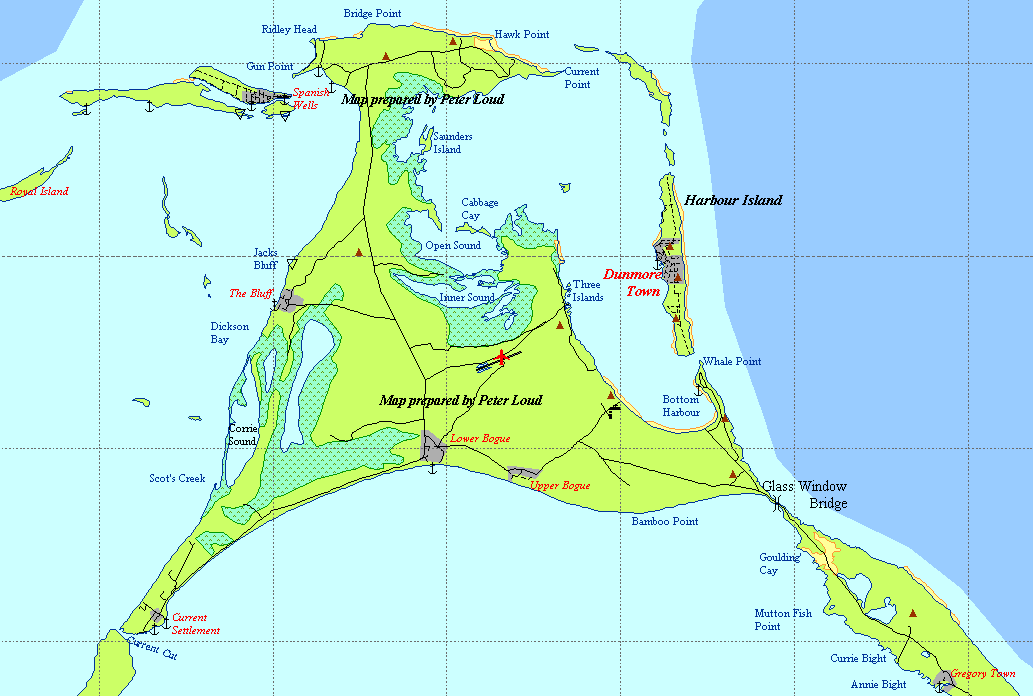
The diving in Harbour Island was, on average, about a B/B-; though, one day, the last, it was A- when we swam through a coral arch at 110ft alongside a six-foot barracuda into an outcropping of elkhorn and staghorn corals and giant barrel sponges at about 75ft where huge schools (100s each) of amberjacks and large mahogany snappers and several varieties of parrotfish (including the rare midnight) were feeding, spotting large specimens of all four varieties of Caribbean angel fish(!) (the Queen being my favorite)—85ft visibility, 83 degree water temp. Brilliant! On several dives, we swam across coral 'nurseries' like the one in Finding Nemo with tons of tiny baby fish of many varieties feeding on the coral and hiding out from predators and the currents. The reefs were vibrant, no visible bleaching or damage in the 12 spots we hit. Best sighting: a pair of large eagle rays during a 10 knot (that's fast, by the way) drift dive through the appropriately named "Current Island" cut. I swam right between them!
In my spare moments, I continued my trek through the addictions and obsessive athletics of Infinite Jest; but, on my return, I discovered I was nevertheless behind the Infinite Summer pace. I'm a slow reader (a good man), and thorough, which is a problem when dealing with an encyclopedic text by a polymathic mind. IJ is so chock-full of information, it was making me nauseous (see J.P. Sartre). It's so easy to get lost in all the details, to get bogged down, to lose motivation. Yet, there are some moments of absolutely fine writing that make it worthwhile. Still, I was getting discouraged, knowing full well that if I set it down I would probably never be able to pick it up again.
This article by Scott Esposito at Conversational Reading, however, has persuaded me to keep at it. Thanks, Scott, for pointing out the forest.
I can't go on, I'll go on—though at my own pace.
14 August 2009
ABC: Always Be Closing
Okay, let's be clear about one thing: Say what you will about the former U.S. administration, they were well-versed in the black arts of marketing.
Case in point: Pres. G.W. Bush, the huckster-in-chief, and his cronies sold this country an unnecessary (war of choice, adventure) war of aggression (designed principally to stabilize the price and flow of Middle Eastern oil so U.S. and multinational oil companies could more predictably calibrate their—and their suppliers' and servicers'—profits) as an existential war on terror, just like his father, that cagey old snake-oil salesman, before him. Recall, too: George Herbert Herbert Bush tried to sell tort reform (i.e., putting a cap on the amounts juries and judges can award for pain and suffering of patients who prevail in medical malpractice and product liability cases) as a panacea for health care.

Their M.O. in both cases seems to have been identifying a real (at least for them) problem (Sadam Hussein's chokehold on the price and flow of oil, on the one hand, and "tassel-loafered trial lawyers" who are the bane of corporate profit, on the other [notice a trend here?]) and, instead of attacking the problem head-on, linking it to what they rightly-identified as a more-salable casus bellum (respectively: 9/11 + GWOT and health-care reform), i.e., something the people would buy. Right causes, wrong (pet) targets.
Now, their methodology—and this is what the current administration doesn't quite get—was not to make the end-product crucial to their own political ends (which, of course, it absolutely was), but to convince 50% +1 of the upright citizens of the direness of the threat and screw the rest: scare them to control them.
In other words: FRAUD. Got that?
To their credit, they were incredibly disciplined. They put up a unified front: the PATRIOT Act, DHS's unified control over the intelligence that penetrated the spheres of the decision-makers, the Pentagon. They bamboozled, degraded, and ostracized State, turning it into their PR organ. They cowered Congress. The bait-and-switch they pulled on Iraq was breath-taking in scope: 'we're going to take Saddam out because he's got WMD ("We know where they [Iraq's WMD] are. They're in the area around Tikrit and Baghdad and east, west, south, and north somewhat...") and he collaborated with OBL on 9/11'; 'well, not WMD but WMD capacity'; 'well, he had WMD, we know 'cause Don sold 'em to him, but we don't know what he did with 'em'; Saddam was a tyrant: he gassed his own people for pity's sake and he's a threat to his neighbors'; 'it was all about regime change'; 'they'll greet us with chocolates and flowers'; etc.
Think about this: there were literally millions of people protesting the invasion of Iraq in the streets not only of this country, but around the world. No one paid attention to them—not the government, not the media, and hence not the rest of the citizenry. The administration just went ahead and did what it intended to do all along. Today, by contrast, a minuscule handful of shouter-downers at a few, usually-lazy August town hall meetings, because they are getting airtime on CNN, FoxNews, MSNBC, CNBC, talk radio, newspapers, etc., are seemingly having an outsized influence on the direction of health care reform. They might even be able to kill it on behalf of their corporate and Republican sponsors. Why is that? Discipline.
Likewise, the previous administration had timing. Another thing the current admin doesn't seem to quite get. Remember Andrew Card's (GWB's PoS CoS's) great slip w/r/t the run-up to the unprovoked invasion (rape?) of Baghdad? `From a marketing point of view, you don't introduce new products in August.'' We are certainly seeing the wisdom of this POV today as a highly-organized and vociferous minority is making a unified attempt to derail health care reform by disrupting congress members' and Senators' otherwise sleepy constituent meetings.
Those guys knew how to run a marketing campaign. I am not being nostalgic, simply observant. They were supply-siders all the way. They knew how to sell their product (that is to say, ram it down our throats), even though people didn't really want or need it. The Obama administration simply doesn't seem to have those chops. And that's not necessarily a bad thing. I'm just saying...
President Obama is, by trade, logical, a rational persuader, a consensus-builder. Yes, health care reform may be what this country direly needs right now. And, yes, his policies may indeed be exactly the right solution at precisely the right moment. But he's not willing to scare people into buying it. He doesn't want to appear to be a fraud. He wants people to accept the rightness of his POV. Base marketing (which so often is tainted by fraud) qua style just seems alien (distasteful) to him.
Today we read that "he's willing to be a one-term president if that's what it takes to get health care and energy reform." How noble. How misguided: self-sacrifice for the good of the country. That's what Jesus was famous for—and look what happened to him.
Being Mr. Nice Guy is not what's going to close the deal. The President has got to make health care (and energy) reform absolutely urgent for the people. Fact is it is, but he's got to overcome the ignorance and intransigence of the mob and the demagogs and drive home what's at stake—the rank, urgent self-interest for these people in having reform. He's got to get down in the mud and make reform as crucial and urgent as the false urgencies of the 'death panels' and 'socialism' and 'naziism' and not letting 'some gov'ment bureaucrat' decide whether to 'put grandma down'.
Maybe he's gulling us (trans. see 'rope-a-dope' ). Maybe he's letting the opposition have its say in the public square. Maybe he's allowing them, rabid as they are, to bluster and blow themselves out, exposing their own ignorance and intransigence in the process. Maybe he believes he can absorb the political blows and still come out on top. Maybe he's planning to compromise. Maybe he's planning to counterattack. It's not clear now.

Maybe he's waiting until September to unveil his true marketing plan... Who knows. All I know is coffee is for closers.
(This post is in response to this fine post by an acquaintance of mine Drew Westen, not that HuffingtonPost needs to be linked to by me.)
Case in point: Pres. G.W. Bush, the huckster-in-chief, and his cronies sold this country an unnecessary (war of choice, adventure) war of aggression (designed principally to stabilize the price and flow of Middle Eastern oil so U.S. and multinational oil companies could more predictably calibrate their—and their suppliers' and servicers'—profits) as an existential war on terror, just like his father, that cagey old snake-oil salesman, before him. Recall, too: George Herbert Herbert Bush tried to sell tort reform (i.e., putting a cap on the amounts juries and judges can award for pain and suffering of patients who prevail in medical malpractice and product liability cases) as a panacea for health care.
Their M.O. in both cases seems to have been identifying a real (at least for them) problem (Sadam Hussein's chokehold on the price and flow of oil, on the one hand, and "tassel-loafered trial lawyers" who are the bane of corporate profit, on the other [notice a trend here?]) and, instead of attacking the problem head-on, linking it to what they rightly-identified as a more-salable casus bellum (respectively: 9/11 + GWOT and health-care reform), i.e., something the people would buy. Right causes, wrong (pet) targets.
Now, their methodology—and this is what the current administration doesn't quite get—was not to make the end-product crucial to their own political ends (which, of course, it absolutely was), but to convince 50% +1 of the upright citizens of the direness of the threat and screw the rest: scare them to control them.
In other words: FRAUD. Got that?
To their credit, they were incredibly disciplined. They put up a unified front: the PATRIOT Act, DHS's unified control over the intelligence that penetrated the spheres of the decision-makers, the Pentagon. They bamboozled, degraded, and ostracized State, turning it into their PR organ. They cowered Congress. The bait-and-switch they pulled on Iraq was breath-taking in scope: 'we're going to take Saddam out because he's got WMD ("We know where they [Iraq's WMD] are. They're in the area around Tikrit and Baghdad and east, west, south, and north somewhat...") and he collaborated with OBL on 9/11'; 'well, not WMD but WMD capacity'; 'well, he had WMD, we know 'cause Don sold 'em to him, but we don't know what he did with 'em'; Saddam was a tyrant: he gassed his own people for pity's sake and he's a threat to his neighbors'; 'it was all about regime change'; 'they'll greet us with chocolates and flowers'; etc.
Think about this: there were literally millions of people protesting the invasion of Iraq in the streets not only of this country, but around the world. No one paid attention to them—not the government, not the media, and hence not the rest of the citizenry. The administration just went ahead and did what it intended to do all along. Today, by contrast, a minuscule handful of shouter-downers at a few, usually-lazy August town hall meetings, because they are getting airtime on CNN, FoxNews, MSNBC, CNBC, talk radio, newspapers, etc., are seemingly having an outsized influence on the direction of health care reform. They might even be able to kill it on behalf of their corporate and Republican sponsors. Why is that? Discipline.
Likewise, the previous administration had timing. Another thing the current admin doesn't seem to quite get. Remember Andrew Card's (GWB's PoS CoS's) great slip w/r/t the run-up to the unprovoked invasion (rape?) of Baghdad? `From a marketing point of view, you don't introduce new products in August.'' We are certainly seeing the wisdom of this POV today as a highly-organized and vociferous minority is making a unified attempt to derail health care reform by disrupting congress members' and Senators' otherwise sleepy constituent meetings.
Those guys knew how to run a marketing campaign. I am not being nostalgic, simply observant. They were supply-siders all the way. They knew how to sell their product (that is to say, ram it down our throats), even though people didn't really want or need it. The Obama administration simply doesn't seem to have those chops. And that's not necessarily a bad thing. I'm just saying...
President Obama is, by trade, logical, a rational persuader, a consensus-builder. Yes, health care reform may be what this country direly needs right now. And, yes, his policies may indeed be exactly the right solution at precisely the right moment. But he's not willing to scare people into buying it. He doesn't want to appear to be a fraud. He wants people to accept the rightness of his POV. Base marketing (which so often is tainted by fraud) qua style just seems alien (distasteful) to him.
Today we read that "he's willing to be a one-term president if that's what it takes to get health care and energy reform." How noble. How misguided: self-sacrifice for the good of the country. That's what Jesus was famous for—and look what happened to him.
Being Mr. Nice Guy is not what's going to close the deal. The President has got to make health care (and energy) reform absolutely urgent for the people. Fact is it is, but he's got to overcome the ignorance and intransigence of the mob and the demagogs and drive home what's at stake—the rank, urgent self-interest for these people in having reform. He's got to get down in the mud and make reform as crucial and urgent as the false urgencies of the 'death panels' and 'socialism' and 'naziism' and not letting 'some gov'ment bureaucrat' decide whether to 'put grandma down'.
Maybe he's gulling us (trans. see 'rope-a-dope' ). Maybe he's letting the opposition have its say in the public square. Maybe he's allowing them, rabid as they are, to bluster and blow themselves out, exposing their own ignorance and intransigence in the process. Maybe he believes he can absorb the political blows and still come out on top. Maybe he's planning to compromise. Maybe he's planning to counterattack. It's not clear now.
Maybe he's waiting until September to unveil his true marketing plan... Who knows. All I know is coffee is for closers.
(This post is in response to this fine post by an acquaintance of mine Drew Westen, not that HuffingtonPost needs to be linked to by me.)
13 August 2009
30 July 2009
What Does It Take?
Several industry professionals have had the opportunity to read and review my (still unpublished and unagented) novel EULOGY. Here are some of their comments:
---------------
As my teenagers would say:
"Wait! What's that? Waah, waah, waah. Is that the waahmbulance?"
"Sir, would care for some bread and cheese with your whine?"
"Hey, maybe we can go to Waahndy's instead for a burger and some french cries."
"Get over it."
--------------
There. The pity party's over. Sorry. I try not to indulge.
I'm taking a break from WoW and the internet for some scuba diving with Wisdoc and the aforementioned smart-alecks here:
.
Best,
Jim H.
8/18/09 Edited to replace picture.
Agent 1: "We were mightily impressed by the descriptive power of these pages and your ability to create compelling, true-to-life characters. That being said, [...] doesn’t feel that she’s the right person to represent your novel. I know we don’t need to remind you how subjective a business this is. You are certainly a talented writer and there’s no doubt that you’ll find the right agent who has the all-out enthusiasm that you deserve."
Editor 1: "From page one, Eulogy was a pleasure to read for its distinctive prose style, its close observations, and its elegant and precise vocabulary (protagonist and author alike clearly masters of le mot juste!). The writing style, the tempo, and the crisis-filled storyline lend the work a taut intensity and a heightened sense of reality that are exciting to experience. The tension that carries through much of the novel is nicely offset by fine passages of reflection. Lyrical, moody descriptions of place and frank yet graceful erotic moments left strong marks. .... I think you’re justified in feeling confident about the marketability of this work (I see film potential, too). The life Josh leads is very 21st-century Manhattan, yet the issues he grapples with are of broad perennial interest."
Editor 2: "The novel establishes several substantial lines of tension. Joshua’s marriage is failing, he and his wife emotionally separated due to insecurities and philosophical and artistic persuasions. Joshua’s career in a powerful law firm leaves little time for himself or for his marriage, and his father-in-law and mentor’s departure to London seems to put his own career into jeopardy. He faces the moral responsibility of helping his father to assist in his mother’s death, and this death forces him to physically and emotionally return to a past that he renounced long ago. It is clear to the reader that these various facets of his life pressure him to define himself according to others’ needs and perceptions, and he is about to break under the strain. This matrix of lines of tension presents a portrait of a complex life that is about to break open or to break apart. "So what does it take to get a novel published?
---------------
As my teenagers would say:
"Wait! What's that? Waah, waah, waah. Is that the waahmbulance?"
"Sir, would care for some bread and cheese with your whine?"
"Hey, maybe we can go to Waahndy's instead for a burger and some french cries."
"Get over it."
--------------
There. The pity party's over. Sorry. I try not to indulge.
I'm taking a break from WoW and the internet for some scuba diving with Wisdoc and the aforementioned smart-alecks here:
Best,
Jim H.
8/18/09 Edited to replace picture.
28 July 2009
Palin For President! Seriously.
Now, this is one Palin and one election I can endorse heartily: "As a long-distance traveller, [Michael] Palin has paid his dues, which is a fortunate position to be in for the prestigious role he has just taken up, as president of the Royal Geographical Society (RGS). Python man is now the nation's [i.e., Great Britain's] First Geographer." Palin's brief is to try to bring some excitement back to the study of geography: "For some reason, geography is not seen as a popular subject in school. It's seen as very unglamorous. Yet when I was at school, I can remember geography offering me the chance to get out and go on field trips and go on walks, and I loved maps, I loved atlases, I loved learning about other countries and places where things were different from our own – and that's all covered by geography." (h/t)
Subscribe to:
Posts (Atom)