08 August 2016

Frameworks, Pt. 3

Picking up where we left off Part 2, we were trying to think through what I take to be the best case for Donald Trump—or at least the best case the GOP and Trump are trying to make for his candidacy. (Note: Part 1 of this series can be found here.)

Recall: Trump's strategy involves expanding, solidifying, and energizing what he considers to be his base and getting them to turn out to vote in hopefully unprecedented numbers come November.

How does Donald Trump hope to win? By selling outrage.

In practically every single campaign rally or press release or campaign statement or personal tweet, Trump says or does something that would in any other year be deemed outrageous, and possibly disqualifying, in a presidential candidate. It's almost impossible to keep up with his outrages. It's all very entertaining. There has never been a candidate quite like him.

He uses vague adjectives—"huge", "great", "bad", "the best", etc. He insults people—both politicians and celebrities and otherwise. He draws attention to protestors, demeans them, and even encourages his followers to boo them (or worse). He attacks the media covering his spectacles. He draws conclusions from demonstrably false assumptions. He recirculates rumors and gossip. He makes vague, veiled implications that can lead sympathizers to one conclusion about what he believes and critics to an entirely different inference (often referred to as 'dog-whistle' politics). He misleads and lies while at the same time, and often in the very next sentence, telling accepted truths and bromides that confirm the assumptions of prejudices of his followers. He is quite deft at these tactics.

And, I would submit, these are not gaffes. It doesn't matter whether what he says is true or false. You can keep your fact-checkers; for by the time they've broken down whatever he has said most recently and shown it to be false or misleading, he has moved on to another statement. Facts do not matter to Donald Trump. What matters is the outrage and controversy whatever he says or does creates. It is a carefully crafted marketing strategy, one modeled on a professional wrestling/reality TV model. Let me elaborate.

In my Twitter account back on July 31, I ran the following quote from the monogram called "On Bullshit" by moral philosopher Harry Frankfort:
What bullshit essentially misrepresents is neither the state of affairs to which it refers nor the beliefs of the speaker concerning that state of affairs. Those are what lies misrepresent, by virtue of being false. Since bullshit need not be false, it differs from lies in its misrepresentational intent. The bullshitter may not deceive us, or even intend to do so, either about the facts or about what he takes the facts to be. What he does necessarily attempt to deceive us about is his enterprise. His only indispensably distinctive characteristic is that in a certain way he misrepresents what he is up to.
This is the crux of the distinction between him and the liar. Both he and the liar represent themselves falsely as endeavoring to communicat the truth. The success of each depends upon deceiving us about that. But the fact about himself that the liar hides is that he is attempting to lead us away from a correct apprehension of reality; we are not to know that he wants us to believe something he supposes to be false. The fact about himself that the bullshitter hides, on the other hand, is that the truth-values of his statements are of no central interest to him; what we are not to understand is that his intention is neither to report the truth nor to conceal it. This does not mean that his speech is anarchically impulsive, but that the motive guiding and controlling it is unconcerned with how the things about which he speaks truly are.
It is impossible for someone to lie unless he thinks he knows the truth. Producing bullshit requires no such conviction. A person who lies is thereby resonding to the truth, and he is to that extent respectful of it. When an honest man speaks, he says only what he believes to be true; and for the liar, it is correspondingly indispensable that he considers his statements to be false. For the bullshitter, however, all these bets are off; he is neither on the side of the true nor on the side of the false. His eye is not on the facts at all, as the eyes of the honest man and of the liar are, except insofar as they may be pertinent to his interest in getting away with what he says. He does not care whether the things he says describe reality correctly. He just picks them out, or makes them up, to suit his purpose.
Trump generates conflicts and controversies in his public appearances and statements because he knows they will draw attention to him. That is his true enterprise. It brings free television network coverage and large crowds to his rallies. Audiences attend and tune in in the hopes of being entertained in much the same way TV audiences and stadium crowds are entertained by fake, highly produced wrestling matches.

[N.B.: This is a very sly and savvy move on Trump's part because it plays into the structural constraints of corporate news broadcasting. The corporations who own the 24-hour cable news networks have a legal, institutional duty to make a profit for their owners and shareholders. In fact, it is singularly their principal duty. The way their news operations make money is by generating ad revenue. The costs of ads are determined by ratings in competition with their rival networks. Trump coverage—protestors at his rallies, outrageous statements, name-calling, etc.—brings ratings, drives up ad costs, and therefore increases their profits. It's often referred to as "earned media"—a ridiculous euphemism. It's a lovely synergy Trump knows how to take full advantage of—and does!]

So, Trump's outrages generate eyeballs on TV and put butts in the seats at his rallies. Butts in the seats and eyeballs mean ratings and popularity. And popularity and ratings bring further coverage and the chance of even higher ratings and greater popularity. The equation here is a simple one, really: Trump believes he can translate these TV ratings and large crowds into votes on election day.

Don't believe me? Take a look at this quote from Trump's interview on This Week with George Stephanopoulos where he makes this assumption explicit:
Look, I think the Republican convention was great or I wouldn't have had the bounce that I had. As you said, I had 3 million people more than she [Hillary Clinton] had on the final night. She had a Thursday, I had a Thursday, she had a speech, I had a speech, I had 3 million people more than she did. And I had a lot of people. There were a lot of people. I think I had 30 million. They had 27 million. I think we're going to do very well in this election.
"My speech had more viewers, therefore we are going to do very well in this election." Could Trump's assumption be spelled out any more clearly than that? That's the key metric animating his entire enterprise. [It is an assumption, however, that remains to be borne out in practice. For example, Mitt Romney and his followers made the same assumption four years ago to disastrous effect, as did John Kerry before him.]

Fearful of a world spiralling out of control? Angry at others who you feel are preventing you from achieving the American dream? Feeling humiliated both personally and by an America in decline abroad—whether in trade, sport, or war? Outraged by a corrupt Establishment—whether it's Obama and Crooked Hillary or Jeb and Lyin' Ted? Angry at the media for their complicity in this decline? Feel like this country needs a strong man who can fix all these problems? Well, frankly, you have bought the outrage Donald Trump and the GOP are trying to sell. You have been well and truly played by a consummate bullshit artist with designs on becoming one of the most powerful men in the world. And I've just shown you the powerful strategy he's employing to achieve it.

Next, Hillary.

06 August 2016

Frameworks, Pt. 2

Assumptions aside, let's look at the strategies suggested by the two parties' conventions and how the candidates are implementing these essential orientations. Starting with Trump and the GOP.

The Republican convention made clear that their strategy this year is to lock down their electoral base, stir them up, and hope they come out to vote in unprecedented numbers. They painted what has been described as a dystopian vision of America, one besieged by terror abroad and chaos and disorder at home, one where economic rot and ruin hamper aspirations, one where government corruption is rampant and pernicious, one where a humiliated America projects weakness around the world in both trade and military affairs.

Donald Trump claims he "alone can fix it" as if by force of personality. He is charismatic and projects a swaggering attitude. Calls himself a winner. Asserts he is stronger and better than any of his rivals. Claims to be a "counter puncher": he doesn't start fights, but he knows how to end them.

In my view, this is precisely what his base (and at least a plurality of the Republican base) wants in its candidate. It is less his principles and policies and knowledge of the issues—or, I would submit, his bleak world view—and more an attitude of superiority and a politics of dominance they want from their candidate. This is slightly different from the traditional, principled conservative Republican approach—but only in degree, not kind. It substitutes charismatic force of personality for conservative principles, but is more concerned with the personal bona fides of the candidate than with whether that candidate's policies will address, much less solve, the problems confronting the country.

Trump projects the image of a wealthy businessman. He is handsome and charismatic. He lives a lavish lifestyle of fame and riches. He has his own jet plane. He is married to a former super model and has doting, beautiful, brilliant, devoted children. His largely male, largely disaffected base identifies with him though most can only dream of having these things.

Trump's partisans feel aggrieved, feel they too deserve this sort of lifestyle. But something is preventing them from attaining these things. And Trump aptly articulates a litany of potential scapegoats (Muslims, Mexicans, Immigrants, Politically Correct Liberals, Establishment Conservatives who have betrayed the base, etc.) to explain why they don't. They want a champion—a counter-puncher—to help them vanquish these bogey men that have put them down and knocked them out. The want Trump to help them reclaim their own personal swagger. And that is precisely what he promises. If Trump wins, America wins; and if America wins, they win. Trump alone is great; only Trump can make America great again; and when America regains its greatness so will his followers.

Trump wants to be seen as the anti-Establishment candidate. And he is without question a political outsider: he is an American businessman and reality television entertainer/celebrity who has never held political office. As the outsider, he is content to pick fights with Establishment figures even in his own party, including everyone from Jeb(!) Bush to Ted Cruz to Paul Ryan to John McCain to Mitt Romney. These feuds only enhance his cachet with his base.

But these intraparty spats are merely the preliminary bouts to his big confrontation with the ultimate Establishment figure: Hillary Clinton. Clinton, to Trump and his base, personally embodies all the evils in the system. By showing he can dominate the entrenched GOP bigshots, he hopes to show he can dominate Clinton and, by the projective principle of transference, dominate the system and, ultimately, the world on behalf of his disaffected followers.

[And, I would note, it is with this anti-Establishment, anti-Hillary appeal—a structural appeal, that is to say—that he specifically reaches out to supporters of Sen. Bernie Sanders, who lost a hard-fought, passionate insurgency campaign against Clinton. Apparently, Trump hopes Sanders' young, idealistic supporters will look past the vast substantive disconnect between the progressive things they want their 'revolution' to accomplish and the policies espoused by Trump and his GOP base and join Trump's anti-Establishment 'movement'.]

(End Part 2)

05 August 2016

Frameworks, Pt. 1

Now that the fields have cleared, I want to try and take an objective look at the current U.S. presidential election. I will begin with an analysis of the two major parties, their candidates, and their campaign strategies. In subsequent posts, I will give my assessment of the race, that is to say my opinion. (N.B.: In this piece, I will try to steer away from actual policy discussion and focus strictly on the politics—the strategies and tactics—because I believe that a structural analysis can be especially telling this cycle.)

I begin with two observational assumptions about the two major parties. The Republican Party tends to want to nominate candidates it deems to be strong leaders. It chooses people and expects them to govern as they see fit—and in candid moments you might even catch party members using the term 'rule'. The GOP expects its candidates to adhere to conservative principles and views, and it entrusts them in office to act according to their own lights. It does not expect its elected representatives to pander slavishly to popular opinion or follow polls, but prefers them to hew to a partisan party line (see, e.g., the so-called Hastert rule).

The Democratic Party, on the other hand, expects its candidates to be sensitive to the desires of the people. Opinion polls and lobbying and opinion leaders are key aspects of this electoral pulse-taking. It wants its elected representatives to be willing to seek consensus among competing constituencies and, where appropriate, to seek compromise on issues in order to get things done.

The critical drawbacks of these two competing views are fairly obvious: Republicans tend toward a more authoritarian or bullying stance whereas Democrats are too easily seen as unprincipled, finger-to-the-wind sell-outs. Republicans, for the most part, expect their elected representatives to represent the interests and views of their base constituency and implement strictly partisan policies by whatever means; Democrats, more or less, expect their elected representatives to represent the majority of the electorate, and their policies tend to be geared toward implementing the greater good for the greatest number.

The parties are in no wise perfect exemplars of these approaches. These are pronounced, observable tendencies, however. Each party, I must assume, believes that its policies will better benefit the country as a whole—or at least their vision of what the country is. And, cynically, each most likely believes that its basic philosophy will result in electoral successes for its partisans.

[For a primer on the philosophical/ethical arguments underlying these two approaches, let me recommend Utilitarianism: For and Against by two brilliant 20th Century philosophers J.J.C. Smart and Bernard Williams. The shorthand synopsis locates the crux of the argument as lying between the competing claims of Consequentialism (For/Smart/Democrats) & Integrity (Against/Williams/Republicans).]

We can see this dynamic in practice this year in two key quotes from the respective convention victory speeches of the two major party candidates: Donald Trump's "I am your voice" and Hillary Clinton's "I hear you." Trump will act as he sees fit; Clinton will do what the majority wants.

(End Part 1)

02 August 2016

Blue Ridge Drive

I didn't spend a lot of time taking pictures on my recent road trip down the length of Skyline Drive, VA (109 miles) and the Blue Ridge Parkway (469 miles) in to NC. Here's a few highlighting the gentle beauty of the region in summer. Elevations anywhere from 3000' to 6500'. (For the record, it was 10-15º cooler than the rest of the low-lying South)

Sunset over Shenandoah from restaurant window
Cabin in the woods
Hiking through an evocative, primeval-feeling mist
Waterfall and Fallen Log
Tiered waterfall
Rustic roadside attraction
Dappled sunlight & shadow falling across rocky creek & rhododendron
Linville Falls, NC
Table Rock over looking Linville Gorge some 2000' below
If you ever have any questions why it's called the "Blue Ridge"
Mountains nearly reaching the belly of the sky

29 July 2016

This Week in Water

I apologize for the break in #ThisWeekInWater posting. I've dived in the Pacific and swam miles in the Atlantic, splashed through Appalachian mountain creeks and run through Georgia torrents in the interim—all the while trying to keep hydrated in the heat. Also, we married off a son at a beach wedding who is, even as I write this, on a honeymoon boat to the Faroe Islands and Iceland. Meanwhile, the world's water issues have not resolved themselves. So for the next few posts we'll be playing a bit of catch-up (if that's even possible).

Climate change—that is to say, global heating—is causing oxygen loss in vast areas of the Pacific, and some fear all life in the ocean may suffocate in the coming decades. This is a real thing.

"A key paper about the threats of climate change to World Heritage sites intentionally left off any mention of the Great Barrier Reef after the Australian government raised an objection..." to UNESCO

Sea level rise has already swallowed five islands in the Pacific's Solomon Islands. Scientists link the destructive rise to human-caused global warming.

Melting permafrost is further exacerbating global heating.

Unsustainable fishing is threatening to cause the extinction of some of the Philippines' largest fish.

Nearly a million gallons of molasses from a sugarcane processing plant spilled into a river in El Salvador, threatening wildlife and humans downstream as well.

Water levels in Lake Mead reached record lows, and despite a relatively wet winter, drought conditions in much of Southern California remain unimproved.

Malaysia's dams and reservoirs have been drying up causing severe shortages.

The World Bank reports that water scarcity, exacerbated by climate change, could cost some regions of the world upwards of 6% of their GDP by 2050, spurring migration and sparking conflict: "High and Dry: Climate Change, Water and the Economy."


That should be enough to keep you busy (if not paralyzed with depression) for now.

30 June 2016

Pacific Paradise, Pt. 6

This will be my last post of photos from Moloka'i. Most of these are from the trek up to Kamakou Preserve, a magnificent tropical rain forested area in the highlands of the island. There's an 8-mile drive up a rough dirt road through cattle farms, then a further 8-mile drive on what is tantamount to a rugged off-road track. From there, you hike several miles through a bog on top of the mountains, maintaining your footing the best you can on a series of 1" x 8" planks. If (and when) you step or slip off the boardwalk, if you don't twist them you sink above your ankles in sucking mud and can easily lose a shoe. For what it's worth, the effort to maintain balance on an 8" board for several miles of climbing requires serious core stability. The area starts at a picnic area about 3000' above sea level and climbs up to more than 5000' elevation and is replete with native foliage preserved by the Nature Conservancy. Enjoy! (as ever, click pics to embiggen slideshow!)

You can also see the island way down there in the 6th pic in Pt. 4 from Kalaupapa Peninsula. Elevation ~3000'.
View of Moloka'i from the road. Elevation ~4000'
Boardwalk & Indigenous Rain Forest. BTW: No snakes or spiders, and few mosquitoes!
Lookout point in the clouds at ~5000' elevation.
Clouds clearing momentarily—Ohi'a plant in the foreground guarding dramatic sheer cliff drop off.
Indigenous Rain Forest Plants
Cliff, Clouds forming, & Circular Rainbow. 3000'
Double Waterfall. Elevation ~3000'
Ancient-style Fish Pond en route to Halawa Bay
Sea cliffs rising into the clouds above Kalaupapa Peninsula (note island in the distance from first pic above) 
Perfect, deserted beach cove back on West End where we stayed
And, yes, sunset from our lanai at dinner time

25 June 2016

Pacific Paradise, Pt. 5

Molokai, Hawai'i, has its equivalent to Maui's famous Hana highway—much shorter of course. We drove to the end of the road at Halawa Bay Beach Park. Due to time constraints we did not get to take the hike inland to the waterfalls. There are a couple other pics from the drive to Halawa in my first and second Molokai posts below—e.g., the jetty & me on the rocks. (Click pics to embiggen slideshow)
Beach cove en route with mountains & clouds as backdrop. Sweet swimming spot with Maui across the strait. 
Hawai'ian house overlooking the ocean
Nene is the state bird, endemic Hawai'ian goose
Gaggle of Nene
Nene
Dramatic view of Halawa Bay from the cliff top
Halawa Bay with waterfall visible

20 June 2016

Pacific Paradise, Pt. 4

Kalaupapa Peninsula is, as the name suggests, a peninsula approximately 2.5 miles by 2.5 miles on the north coast of the island of Molokai, Hawai'i. It juts out from what are purportedly the highest sea cliffs in the world. It was formed when one such cliff sheared off and a volcanic peak arose from the bottom of the ocean millions of years ago. There are only three ways to get there: fly, ride a mule, or hike down the steep three-mile trail. Either way, you need specific permission. (I'm informed that a barge arrives every July as well, bringing supplies to the residents). Once there, there is a four-hour guided tour.

We chose to hike down the 1760' cliff face. Each of the 26 switch backs, thankfully, is numbered. Going down is murder on the knees—because you are, essentially, braking with each step. Going up takes a toll on your thighs and cardio-vascular system. We figured the hike was the equivalent of climbing down then back up a stairway to the top of a 200-story skyscraper—in the tropical heat and humidity.

Kalaupapa was formerly a leper colony. Folks with the disease were shipped here from all over the world and left to fend for themselves. It was brutal until a kindly priest and a dedicated nun brought consolation and community, treating those afflicted like human beings. Of course, leprosy—now known as Hansen's Disease—has been curable for many years. Now, the peninsula is a National Historical Park. And, quite possibly one of the most beautiful spots on earth. Below are some pictures from our hike (click pics to embiggen slideshow!):

Rainbow peeking out from behind sea cliff down which we are hiking
A rocky beach beside the trail at the bottom of the hike down Kalaupapa
The view from the pier in Kalaupapa 
2000' Sea Cliffs
Famous church built by Father Damien
Sea Cliffs (as you face east from Kalaupapa) reaching to the clouds
Sea cliffs, lava rock beach
Sea Cliffs (as you face west from Kalaupapa) + Black Sand Beach beside the trail back up the cliff
Wild goats on the hike up the cliffs
That is the blue of the ocean (not the sky) from the trail! 
Partial view of Kalaupapa Peninsula (2.5 x 2.5 miles) from the trail head
Kalaupapa Peninsula from the air

15 June 2016

Pacific Paradise, Pt. 3

More from Molokai. (as ever, click pics to embiggen slide show)

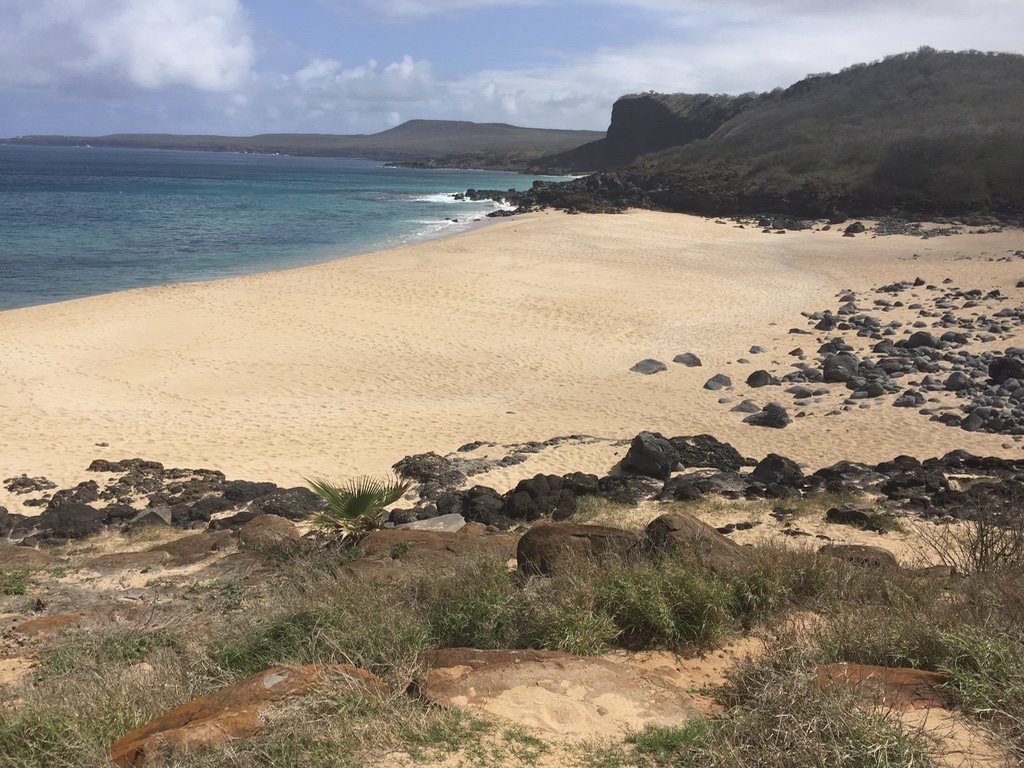
We stayed in a small condo complex out on the West End, facing Oahu (you can see how small it is from the plane shot in my first Moloka'i post). There were four, one of them abandoned. The beaches were empty and damn near perfect. I hiked north along the shore  from our place past pristine, abandoned beaches and across what appeared to be an abandoned golf course gradually being reclaimed by the island. At one time, it must have been a beautiful place to play (if you like that sort of thing), and I understand the PGA used to hold events there. But the developers and managers faltered in the first decade of this century, and now its only denizens are wild turkeys, Axis deer (aka barking deer or chital, a gift in the 1860s to the King of Hawai'i for his hunting pleasure), and mongoose—all also invasive species. I kept asking myself as I walked: Is this the future of our country if a certain developer gets his and his friends' hands on our pristine public lands?) As blogfriend BDR likes to say: "metaphors abound."

Deserted West-end Molokai Beach
A perfect, deserted cove beach on Molokai's west end
Old cart path on the former golf course fairway by perfect deserted beaces
Golf ball landing zone no more!
Former golf course green by the sea
Club house ruins
Resort hotel ruins