Is there any such thing? Let's investigate—for good or ill. A blog about fiction and literature, philosophy and theology, politics and law, science and culture, the environment and economics, and ethics and language, and any thing else that strikes our fancy. (Apologies to Bertrand Russell)
In the wake of the ongoing humanitarian disaster in Haiti, where people are still dying and the devastation and disease persist, pausing to note the deaths of two individual Americans—celebrities of a sort—might seem callous, especially to them.
Howard Zinn, aged 87, died yesterday. He is widely known for his alternative history text: A People's History of the United States: 1492-Present (1980). You can preview it here. His website is here and has information about him, his work and his life.
“There is no flag large enough to cover the shame of killing innocent people for a purpose which is unobtainable.”
The second? J.D. Salinger who, at age 91, also died yesterday. The New York Times obituary can be found here (if it hasn't been sequestered yet behind a pay wall). Salinger, of course, is most famous as the reclusive author of the coming-of-age novel The Catcher in the Rye (1951).
“Among other things, you'll find that you're not the first person who was ever confused and frightened and even sickened by human behaviour. You're by no means alone on that score, you'll be excited and stimulated to know. Many, many men have been just as troubled morally and spiritually as you are right now. Happily, some of them kept records of their troubles. You'll learn from them—if you want to. Just as some day, if you have something to offer, someone will learn something from you. It's a beautiful reciprocal arrangement. And it isn't education. It's history. It's poetry.”
Both books, each in its own way, managed to crack the veneer of the status quo: Zinn's the prevailing myth of America's manifest destiny and innocence in world affairs, and Salinger's the unquestioned authority of the adult world. Both railed against pervasive hypocrisy and lies and inhumanity. Each is a classic in its own right.
Sometimes it seems there is nothing one can do but weep. Or hope
One of the most brilliant men who ever lived, Gottfried Wilhelm Leibniz (1646-1716), once wrote (in Latin, of course):
"Now this supreme wisdom, united to a goodness that is no less infinite, cannot but have chosen the best. For as a lesser evil is a kind of good, even so a lesser good is a kind of evil if it stands in the way of a greater good; and there would be something to correct in the actions of God if it were possible to do better. As in mathematics, when there is no maximum nor minimum, in short nothing distinguished, everything is done equally, or when that is not possible nothing at all is done: so it may be said likewise in respect of perfect wisdom, which is no less orderly than mathematics, that if there were not the best (optimum) among all possible worlds, God would not have produced any. I call 'World' the whole succession and the whole agglomeration of all existent things, lest it be said that several worlds could have existed in different times and different places. For they must needs be reckoned all together as one world or, if you will, as one Universe. And even though one should fill all times and all places, it still remains true that one might have filled them in innumerable ways, and that there is an infinitude of possible worlds among which God must needs have chosen the best, since he does nothing without acting in accordance with supreme reason." Theodicy
A 'theodicy' is a treatise on the goodness of god (or providence or fate) in the face of evil in the world. Leibniz believed that three spatial dimensions plus one of space/time made for the best of possible worlds for the flourishing of human life and moral goodness.
Some years later, another brilliant man, Voltaire, upon witnessing the utter destruction of Lisbon, Portugal by an earthquake and tsunami on November 1, 1755 (All Saints' Day), wrote a deeply humane poem and a satiric novel about the impact of the disaster on the Panglossian optimism expressed in the works of philosophers and theologians of the time such as Leibniz.
In the latter work, Candide, Dr. Pangloss the philosopher says of the earthquake's devastation: "'For all this,' said he, 'is a manifestation of the rightness of things, since if there is a volcano at Lisbon it could not be anywhere else. For it is impossible for things not to be where they are, because everything is for the best.'"
In the poem, Voltaire says:
"Will you say, "It is the effect of everlasting laws
Which necessitates this choice by a free and good God"?
Will you say, seeing this heap of victims:
"God is avenged, their death is the payment of their crimes"?
What crimes, what bad things have been committed by these
children,
Lying on the breasts of their mothers, flattened and bloody?
Lisbon, which is a city no longer, had it more vices
Than London, than Paris, given to doubtful delights?
...
If the eternal law which moves elemental things
Makes rocks fall, by the efforts of great winds,
If thickly growing oaks are burned by lightning—
They do not feel the blows which bring them down,
But I live; but I feel; but my heart, deeply hurt,
Asks for help from the God who made it exist.
...
What eye may see into his deep designs?
From a Being all perfect, evil cannot come to be.
It does not come from another, since God alone is master.
Yet, evil exists. O sad truths!
O astonishing mingling of contrarieties!
A God came to console our afflicted race;
He visited the earth, and has not changed it.
...
Whatever opinion one has, one should shudder, no doubt.
There is nothing one knows, and nothing one does not question.
Nature is mute, she is questioned in vain.
There is need of a God who talks to humanity.
It is for him only to explain his work,
To console the weak, make the wise person clear.
...
What can then do, the mind of largest range?
Nothing. The book of fate closes itself before our eyes.
Man, a stranger to himself, by man is not known.
What am I, where am I, where do I go, and from what do I come?
Atoms tormented on this mass of mud,
Whom death engulfs and with whom fate plays—
But thinking atoms, atoms whose eyes,
Guided by thought, have measured the skies.
From the very midst of the infinite, our lives go forth,
Without our being able, one moment, to see ourselves or know
ourselves.
...
A caliph once, at his last hour,
To the God whom he adored, said, for all prayer:
"I carry to you, O Only King, Only Unlimited Being,
All that which you don't have in your immensity—
Deficiencies, regrets, evils and ignorance."
But he might, also, have added: Hope.
...
What is needed, O mortals? Mortals, it is needed that we suffer,
Submit ourselves silently, adore, and die.
...
O God, give us a Revelation that we should be humane and
tolerant.
As Theodor Adorno wrote, "[t]he earthquake of Lisbon sufficed to cure Voltaire of the theodicy of Leibniz" (Negative Dialectics 361).
Scholars debate whether Voltaire deliberately misinterpreted Leibniz's metaphysical point to make a humanitarian case. Notwithstanding, the Leibnizian view, at base, counsels passivity and optimism in the face of an ultimately benign reality (call it Fate, Providence, God—whatever) in which everything that happens is for the best ("God's will"); and even though this is a fallen world, it will be followed on by a better one in the hereafter.
-------------
January 12, 2010, saw an equally destructive earthquake strike Port-au-Prince, Haiti. As of this writing, the extent of the destruction is unknown. What is known is that it was devastating in the extreme: untold thousands have died and even more are injured; entire sections of the city are in rubble; hospitals have been flattened; there is no food, water, or electricity; sanitary conditions are only going to worsen.
It only makes sense at times like these to ask: why? The reality is that Port-au-Prince, a poor, populous city, sits right on top of an active fault line where the Caribbean plate and the North American plate collide. The underground friction as these two tectonic plates shift has been building up for nearly two centuries, and the unleashing of this pent-up force caused the ground under the city to shake. Population growth and unregulated or even absent building codes and urban planning has resulted in overcrowding. Extreme poverty has resulted in poor or even non-existent infrastructure. Accordingly, the city collapsed. Such things happen in this world. The causes are evident.
Is this evil?
No. The Leibnizian/Voltairean debate over whether such could have been the will of some distant creator god or tolerated by some god-who-is-with-us-in-spirit-only or the punitive action of a retributive deity or the work of some evil demon is arcane. Passe. It explains nothing, salves no wounds. However, it excuses heedlessness and cruelty—inhumanity: Why help them since God has seen fit to punish them, or because this was their fate?
[I will not link to the "utterly stupid" remarks of certain public figures—a rancid television preacher and a belching, radio fat-cat gas bag who have been America's first responders in this vein. If you read this blog, you know who they are.]
Natural events are not, in themselves, evil. They are a condition of the planet upon which we live. A fact of life on planet Earth. Inhumanity, insensitivity, cruelty, on the other hand: these are true evils.
No one deserves such a disastrous fate—not poor people, nor black people, nor former slaves, nor French-speaking people; not people whose homes happen to sit on a fault line, nor even folk who have been victimized and impoverished by a corrupt oligarchy and colonial/neo-colonial exploitation. No one. Not even folks whose ancestors might have made a "pact to the devil" (to quote the aforementioned American religionist whose views are truly evil).
Real human beings in Haiti are in desperate need of medical assistance and basic food and water and shelter and sanitation. And here's where we see the true good in humanity. Here is where there is hope for us all. Individuals, non-governmental organizations, churches, nations, even international bodies have mobilized unbelievably quickly to do what they can to help with the almost unimaginable suffering in Haiti. Bless them all. Thank them all. Contribute, if you can. Here. Or here. Or participate however and wherever your conscience leads. But contribute. It is a way we all can participate in this great work of true humanity, this moment of true goodness.
When one person suffers, we all suffer. Now, millions (literally millions) are suffering. It is going to take a massive, long-term humanitarian effort to make even a dent in it. Yet, it is happening before our eyes. Humanity, for a moment, is uniting to come to the aid of suffering humanity. Those who would exploit this calamity for their own profit or political or personal gain are the ones who bring evil into this world.
The real question is: why does it take an event of such enormity to bring out the good in us all (minus, of course, a few ignorant and insensitive, dare I say evil, louts)? Why isn't alleviating poverty and human suffering our abiding task?
O God, give us a Revelation that we should be humane and
tolerant.
This is my first post of 2010 and my first post of WoW's third year.
Lots of holidays this time of year: Solstice, Advent, Christmas, Hanukkah, Kwanzaa, New Year (here in the West), Tet (later on in the East), chief among them—not to slight Festivus or Zappadan. That means celebrations, disruptions, obligations, joy, surprises, disappointment, family, friends, seasonal affective disorder, loneliness, cold weather and decreased daylight (in the northern hemisphere), reminiscence, hope, despair—lots of things to lots of people.
WoW is also celebrating its two year anniversary (12/22). Wow! Just Wow! Who knew I could sustain this thing this long? I certainly didn't anticipate it.
A few quick facts: my first year I put up about 220 blog posts and had around 25,000 hits. This past year I posted only half as much (~107) but received approximately 38,000 hits. One of my posts was nominated for and selected as a finalist for 3QuarksDaily's Best Political Post of 2009, a true honor. I made a number of on-line blogfriends and commenters, too, which, to me, has been one of the unexpected boons of blogging (thanks, all). I'll go on.
WoW refuses to narrow its scope. It will not limit itself to being strictly a literary or critical blog, or a political blog, or a philosophy or theology blog, or even a personal blog, or, for that matter, an aggregating blog or a humor blog; but at the same time it is all of these—and more. In this, it resembles its author—who, too, refuses to be put into a box. And so, expect WoW to continue to range wide and far: not all things to all people, but not nothing either.
Wishing you the best of whatever holiday (if any) you choose to acknowledge!
Jim H.
--------------
And here's a few links to keep you busy until I come up with something original:
NatGeo's best pics of the year (btw: that cute little old lady pic was taken just down the road from my son's high school!)
Talking Points Memo has announced its 2009 Golden Dukes Winners given "in recognition of great accomplishments in muckiness including acts of venal corruption, outstanding self-inflicted losses of dignity, crimes against the republic, bribery, exposed hypocrisy and generally malevolent governance." Also, you can find TPM's Top 10 Cable News Moments here.
Michael Orthofer at the Literary Saloon at the complete review was very busy this year, managing "365 uninterrupted days of posts at this Literary Saloon -- as I apparently did in 2009 (there were 1347 posts for the year, an average of some 3.7 per day).) Only 172 books were reviewed at the complete review in 2009." Whew!
Take The Pills compiles a 'mixtape' of best songs of the year that you can download. ...Noviembre thinks this is the record of the decade. I've heard it and it's pretty good. (For entertainment and discussion purposes only).
So, was this indeed the worst decade ever? It was certainly the decade of Bush. 'Nuff sed.
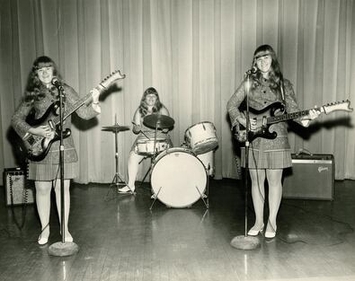
With Zappadan rapidly drawing to a close, I felt it only appropriate to post up what scant videos I could find of the band that Frank Zappa reportedly felt was the #3 best band in history, better even than the Beatles: The Shaggs, starting off with the classic "My Pal Foot-Foot" with a remarkable fan video.
You can (and should) purchase their music at their own website here, or other commercial venues. But to get a sense of the band you really hafta' read their website.
This is the second topic in my ongoing "Family of Values" series.
If you Google the word 'love', you retrieve "about 1,590,000,000" items. The concept or idea of love plays an absolutely central part in our culture and its self-definition. We use the word 'love' to express our affinity for many things, from our cars to our music, from our shoes to our neighborhood, from cherries to aloe tissue paper, from our country to our crown molding, from NY to Hello Kitty, from golf to opera, from our pets to our friends, from our parents to our spouses, from our children to ourselves. We speak about amour propre, amour fou, courtly love, romantic love. We talk about falling in love and loving Jesus. And I could go on and on.
Standard philosophical discussions of love tend to turn to the ancient Greek notions of eros, agape, and philia. If you want to refresh your memory, you can read about them here. These discussions try to make distinctions between sexual, amorous, romantic, platonic, and familial loves. They tend to treat love as an attitude, a feeling or emotion, a valuing. This is a shallow psychological conceptualization, it seems to me, a devaluing of something much more profound.
I think if you asked Tiger Woods if he loves his wife and children, he would probably say yes. After all, in marrying Elin, he publicly professed his undying love for her. After the revelations of the last couple weeks, I think it's also fair to say Tiger doesn't really know what love is. But then, given our polyamorous proclamations, neither do we.
Without getting into the religious aspects of it, I have written here on more than one occasion about my take on the Christian virtue of love as found in the Bible. The actions of the story's hero, Jesus from Nazareth, are a metaphor for love. He and his gang of ruffians trashed the biggest temple/market day of the year in Jerusalem, Passover. Apparently, he was upset about the hypocrisy of the organized religion of the day, and this was the way he led his men in protest. We don't quite know what damage they inflicted on the money-changers and sellers of sacrificial animals, etc., but we know it had to have been significant for the temple police called the Roman guards. They cornered Jesus and his gang in their nearby hideout, a park outside the city, and Jesus manned up and took the rap for all of them—a death sentence, it turns out. Ultimately, he gave up his life so his men could escape and live to tell the tale.
This is a profound definition of real love: giving up one's self for the best interests of one's friends. Stated succinctly: "There is no greater love than that a man should give up his own life for the sake of his friends." That point is stated outright in the Gospel of John 15:13. Theological scholars, i.e., the Jesus Seminar, do not necessarily believe this was an actual saying of Jesus primarily because it comes in a passage in which Jesus calls for loyalty to himself. Still, it encapsulates the theme of Jesus's life and death. For more on this topic, I refer you to my previous post here. And as a definition of true love, it stands the test of time.
The Christian conception of love takes it yet a step further. Giving up what one most prizes, say one's only child, for the sake of others is a love that is worthy of a divinity.
This is a high standard. Fine. It may be an unmeetable standard. Okay. But love is such a central concern of our culture, an absolutely core value, that any but an ideal standard is demeaning not just to love but to who we are as a culture.
What I am talking about here is more than a feeling or an attitude or a valuing. It is pure action, a way of living one's life, a way of acting.
Undoubtedly, at some point, Tiger 'fell in love' with Elin. Falling in love is a feeling, a gushy, gooey, falling all over myself, endorphin spurting kind of emotion. There's nothing to stop someone from falling in love with a different person every day as far as I can tell—or at every tour event. But that is not true love. True love may take its start from there (in the case of spouses and life-partners and such), but it is more than that; it grows, matures, deepens, transforms.
If, e.g., Tiger truly loved his wife and his family, he might choose to give up his selfish interests in bedding every cocktail waitress he meets on the road for their sake. Or not. It may be that Tiger is in love with, or even hooked on, falling in love. Who's to say? If falling in love is nothing more than an endorphin rush, it can certainly be addictive (just like running, e.g.).
So, what does this exalted concept of love have to do with what we mean when we use the word love in statements like 'I love my Jimmy Choo's' or 'I love pancakes' or I love my country' or 'I love my job' or 'I love The Big Lebowski' or 'I am falling in love with her' or 'Love makes me happy'? Are these different things or are they somehow connected by this vaunted concept of giving up oneself?
We can certainly postulate that, on our definition, to love something or someone is necessarily to give up something of one's self (a feeling, an attitude, a valuation [monetary or otherwise], etc.) and that there are degrees of such love. I believe that that is an iron-clad law, kind of like the law of gravity. But is that really meaningful?
We throw the word 'love' around casually, to the point it almost has no more meaning. I wonder if Tiger told any of his 'lovers' that he loved them? Is it possible he did love any or all of them? Maybe Tiger has that much love to give—he certainly has that much money. However, one thing is clear, not all of his lovers were willing to share his 'love', especially Elin who felt—and rightfully by all accounts—that she had an exclusive right to it all.
On the other hand, maybe Tiger was the one who needed more love, more adulation, more worship, than any one of his lovers could give. Maybe he felt that by giving his affections (something quite short of love) so profligately he was gaining something in return—the love and adoration of all these women. To believe and act as though everyone should have your bests interests at heart, as though everyone around you should sacrifice themselves to satisfy your needs and desires is something short of true love. Though it is a sort of self-love, and it can be quite costly, for, ironically, in order to satisfy itself the self in love with itself must ultimately sacrifice itself—something it cannot allow itself to do. That is why, frankly, I fear for Tiger. Unless he faces this paradox down, he could become suicidal. But I digress.
This 'I want to be adored' attitude seems to be a wrongful attitude, at least on our vaunted account of true love. It ignores the true cost of truly loving. In love, one does not give up one's self in the expectation of getting something in return from the objects of one's affections. One does it for and in the best interests of the loved one. One sacrifices one's interests. One hopes one's love is reciprocated, but this can never be guaranteed. To love is to risk everything.
Still, none of us is perfect at love. None of us can be. We cannot give ourselves completely. We are selfish. We are individuals with our own wants and needs. We have boundaries. We are, in short, human—not divine. And we must take ourselves as we find ourselves.
Perhaps it would pay, in this season of love, to remember this one thing: Love is Action. Actions have costs. When we love something or someone, we necessarily sacrifice something of ourselves, whether we mean to or not and whether we know it or not—it isn't always obvious. And we each only have so much to give. Yet, ironically, the more love we truly give, the more likely we are to receive love in return; not the sort of love that feeds our selfish self-love, but love which replenishes and restores us, that has our best interest at heart and that is willing to sacrifice for our betterment (not, say, our ego).
I would like to welcome everyone visiting here from 3QuarksDaily where one of my posts has been selected as a Finalist for the Politics Quark prize. I am honored. Wisdom of the West is not strictly a political blog, but it makes no bones about its views. Please browse around. There are personal essays, literary essays, critical pieces, philosophical musing, aggregations, responses to other blogs, etc. on here as well—as stated in the header. There are also a number of theme posts, such as my fifteen part personal essay "Thyraphobia" about skydiving or the ongoing "Ur-story" series which has close readings and critical essays on interesting and what I take to be important works of fiction. The "Labels" list on the right side should give you a sense of the breadth of discussion topics you can find here.
Comments are welcome, even if just to alert me to the existence of your own blog—so long as it has interests reasonably related to those herein. (For example, I will delete Spam and trolling-for-porn comments. I've been getting quite a few of those lately and hope not to have to resort to those annoying passwords and comment-blocking mechanisms and such.) I try to respond to each and every comment, as reasoned discourse is something I prize.
You will note that my blogroll comprises mostly institutional blogs, including 3QuarksDaily, and hasn't changed much in the two years I've been operating WoW. My two-year anniversary is later this month, and one of the changes I've been contemplating is to add a blogroll of other blogs I read regularly. Look for it.
We present one of the true 'high' priests of Zappadan. This guy never failed to clear the Elton John-, Bad Company-, Grateful Dead-, Kansas-, Peter Frampton-loving types out of my dorm room (that is when "Freak Out" or "We're Only in it for the Money" failed to do the trick), cement my cred, and still leave that sublime last minute just for my ears only.
In which Zappa is one of the least self-indulgent persons on stage for the full 24 minutes. Seriously, Yoko? Apparently, she didn't even know the words to "Sc*mbag" and had to be told. You know, people paid real money for this sort of jamming thing back then. What were we thinking? I mean, the blues thing was simple, easy to improv, and had a decent guitar break, but who was strangling that cat? Dayyum.
Update: Okay, I'm having a bit of technical trouble embedding the video. Veoh is not as simple as YouTube. If you want to see this clip, either slide the side and bottom bars and press the play button above, or go here. Also, I apologize for the commercials: I mean, if any video was ever strictly non-commercial, this would seem to be one.
Further Update: That damned commercial starts automatically every time I open my blog. Forget it. I'm taking it down. Go to the site: http://www.veoh.com/browse/videos/category/music/watch/v8467343PNy5zAnz. There you can see John Lennon (the anniversary of whose murder is today) and Yoko Ono playing with Frank Zappa (whose Zappadan celebration we marked yesterday) and The Turtles, I mean the Mothers of Invention, at the Fillmore in 1971. It sucks, buts it's interesting and interestingly obscure.
As a consolation, here's FZ's take on what happened that night and subsequently:
(h/t to Mitch at MFBlog for reminding us. Mitch has a competing post at 3QuarksDaily's contest. Read it.)
As I mentioned before: One of my readers—Frances Madeson—has nominated my Blunderbuss post for the 3QuarksDaily Politics Prize. Thanks, Frances. I am honored. And even if you disagreed with my opinion on the matter, I ask you to go over to 3QuarksDaily, read the nominated posts, and vote—preferably for me. The nominated posts are in alphabetical order, so mine is at the end. [I will append this message to all my posts until the voting deadline.]
A quick follow-up to this post. In that earlier Family-of-Values post, I discussed the nature of truth as both a political and journalistic value. This clip of Dana Perino, the former spokesperson for the President of the United States (G.W. Bush) illustrates the point.
She is simply and obviously wrong when she states that "We did not have a terrorist attack on our country during President Bush's term." It's a ludicrous statement on its face, but she says it with a straight face as if she believes it. This is why I do not miss the former administration: one could never tell when they were lying or were ignorant, and trying to sort it out was maddening. Recall Scott McClelland telling the press that Karl Rove and Scooter Libby had assured him they had nothing to do with outing CIA operative Valerie Plame when their (and VP Cheney's) fingerprints were all over the operation.
Here, it's not clear whether Perino is lying, or mistaken, or actually believes that 9/11 happened on someone else's watch. And it doesn't matter which. She is simply wrong.
Hannity had an obligation, likewise, to correct the record. Surely he knew different. Yet he said nothing and let the moment pass, doubling the offense.
It's clear neither of them (or the other guest, Varney) cared one whit for the truth of the matter. They are nihilistic with respect to the value of truth.
There are undoubtedly some who watch that program who believe what she said. And others who would like to believe it, forgetting how the conservative administration fell asleep at the switch. It is part of the misleading, revisionist narrative these conservatives hope to weave.
Remember the phrase cui bono? Loosely translated it means "Who benefits?" Who benefits from such a pernicious lapse of truth-telling? Not the current administration or its party. Whenever the Bushians engaged in these sorts of Rovian tactics, it was always for their own benefit. It's odd how self-serving their 'mistakes' always tended to be...
-------------------
On a separate "blegstitution" note, one of my readers—Frances Madeson—has nominated my Blunderbuss post for the 3QuarksDaily Politics Prize. Thanks, Frances. I am honored. And even if you disagreed with my opinion on the matter (JMP?), I ask you to go over to 3QuarksDaily, read the nominated posts, and vote—preferably for me. The nominated posts are in alphabetical order, so mine is at the end. [I will append this message to all my posts until the voting deadline.]
-------------------
Oh yeah, one other thing, following up my Fringe posts. Here I am at mile marker 9. Note the shoes. LOL. ROFLMAO.