Showing posts with label Hate. Show all posts

11 December 2013

Haters Gonna' Hate, Pt .3

(cont'd from here) Some quotes:

“Hate is a bottomless cup; I will pour and pour.” Euripides, Medea

“["F]or it's not possible," [Socrates] said, "for anybody to experience a greater evil than hating arguments. Hatred of arguments and hatred of human beings come about in the same way. For hatred of human beings arises from artlessly trusting somebody to excess, and believing that human being to be in every way true and sound and trustworthy, and then a little later discovering that this person is wicked and untrustworthy - and then having this experience again with another. And whenever somebody experiences this many times, and especially at the hands of just those he might regard as his most intimate friends and comrades, he then ends up taking offense all the time and hates all human beings and believes there's nothing at all sound in anybody.” Plato, Phaedo

“In time we hate that which we often fear.” Shakespeare, Cleopatra.
"Nature seems (the more we look into it) made up of antipathies: without something to hate, we should lose the very spring of thought and action. Life would turn to a stagnant pool, were it not ruffled by the jarring interests, the unruly passions, of men. ... 
"The pleasure of hating, like a poisonous mineral, eats into the heart of religion, and turns it to rankling spleen and bigotry; it makes patriotism an excuse for carrying fire, pestilence, and famine into other lands: it leaves to virtue nothing but the spirit of censoriousness, and a narrow, jealous, inquisitorial watchfulness over the actions and motives of others. ... 
"In private life do we not see hypocrisy, servility, selfishness, folly, and impudence succeed, while modesty shrinks from the encounter, and merit is trodden under foot? How often is "the rose plucked from the forehead of a virtuous love to plant a blister there!" What chance is there of the success of real passion? What certainty of its continuance? Seeing all this as I do, and unravelling the web of human life into its various threads of meanness, spite, cowardice, want of feeling, and want of understanding, of indifference towards others, and ignorance of ourselves, - seeing custom prevail over all excellence, itself giving way to infamy - mistaken as I have been in my public and private hopes, calculating others from myself, and calculating wrong; always disappointed where I placed most reliance; the dupe of friendship, and the fool of love; - have I not reason to hate and to despise myself? Indeed I do; and chiefly for not having hated and despised the world enough." Wm. Hazlitt, The Pleasure of Hating
“Loving someone is different from being in love with someone. You can hate someone you're in love with.” Dostoyevsky, The Brothers Karamazov

“[O]ne captain, seizing the line-knife from his broken prow, had dashed at the whale, as an Arkansas duelist at his foe, blindly seeking with a six-inch blade to reach the fathom-deep life of the whale. That captain was Ahab.” Melville, Moby Dick

“One does not hate as long as one has a low esteem of someone, but only when one esteems him as an equal or a superior.” - Nietzsche, Beyond Good and Evil


“The worst sin toward our fellow creatures is not to hate them, but to be indifferent to them; that's the essence of inhumanity.” - G. B. Shaw, The Devil's Disciple

"We do not like to be robbed of an enemy; we want someone to hate when we suffer. It is so depressing to think that we suffer because we are fools; yet taking mankind in mass, that is the truth. For this reason, no political party can acquire any driving force except through hatred; it must hold someone to obloquy. If so-and-so’s wickedness is the sole cause of our misery, let us punish so-and-so and we shall be happy. The supreme example of this kind of political thought was the Treaty of Versailles. Yet most people are only seeking some new scapegoat to replace the Germans.” Bertrand Russell, Sceptical Essays.

“Suddenly, by the sort of violent effort with which one wrenches one's head away from the pillow in a nightmare, Winston succeeded in transferring his hatred from the face on the screen to the dark−haired girl behind him. Vivid, beautiful hallucinations flashed through his mind. He would flog her to death with a rubber truncheon. He would tie her naked to a stake and shoot her full of arrows like Saint Sebastian. He would ravish her and cut her throat at the moment of climax. Better than before, moreover, he realized why it was that he hated her. He hated her because she was young and pretty and sexless, because he wanted to go to bed with her and would never do so, because round her sweet supple waist, which seemed to ask you to encircle it with your arm, there was only the odious scarlet sash, aggressive symbol of chastity.” Orwell, 1984


“The truly terrible thing about the war spirit, about the fear and hate hysteria it generates, is that it forces us to think and talk and feel in terms of abstractions—those "communists" this time, those "fascists" last time. But those we are fighting and killing are people—men, women and children—not political, geographic or economic abstractions. They are, in the main, as decent and fearful and confused as we are. And they regard us as abstractions as much as we do them.” Sydney J. Harris

"At the very beginning, it seems, the external world, objects, what is hated are identical." Freud, The Instincts and their Vicissitudes, p. 136 (1915).
"Hate of the object involves hate of oneself, you suffer with the object you attack because you cannot give up the object and feel one with it. …
"What is the meaning of hate? It is not the absolute opposite of love; that would be indifference, having no interest in a person, not wanting a relationship and so having no reason for either loving or hating, feeling nothing. Hate is love grown angry because of rejection. We can only really hate a person if we want their love. Hate is an expression of frustrated love needs, an attempt to destroy the bad rejecting side of a person in the hope of leaving their good responsive side available, a struggle to alter them. The anxiety is over the danger of hate destroying both sides, and the easiest way out is to find two objects and love one and hate the other." H. Guntrip, "A Study of Fairbairn's Theory of Schizoid Reactions," p. 351, Psychopathology: A Source Book, ed. Charles Frederick Reed.
(to be cont'd)

02 December 2013

"Has It Ever Occurred to You..."


I want to thank Jerome Doolittle over at Bad Attitudes, a blog of pointed snippets and commentary I've been reading for years, for pointing me to this article on Psychology Today's blogsite.

Normally, I read/skim posts from the Wisblog Roll on the right side of this page, absorb the information, chase down the links, and continue on my merry way. When I read Doolittle's post the subject struck a chord with me, but I didn't have the time to run down the reference. And I was haunted by it the entire weekend. When I got back to my computer, I couldn't remember where I had originally seen it. I had to page through several of my regular haunts until I found it.

Here's the money quote:
Dunning and Kruger often refer to a “double curse” when interpreting their findings: People fail to grasp their own incompetence, precisely because they are so incompetent. And since, overcoming their incompetence would first require the ability to distinguish competence from incompetence people get stuck in a vicious cycle. 
“The skills needed to produce logically sound arguments, for instance, are the same skills that are necessary to recognize when a logically sound argument has been made. Thus, if people lack the skills to produce correct answers, they are also cursed with an inability to know when their answers, or anyone else’s, are right or wrong. They cannot recognize their responses as mistaken, or other people’s responses as superior to their own.”
I realize that PT has what I would call an "empathy bias", that is to say they don't necessarily see the Gohmerts, Palins, and Becks of the world as knaves, but rather as fools deserving of our understanding. They are granted a certain amount of cultural 'authority' by virtue of their having access to the megaphone of politics and media PR and are allowed to say, or repeat, whatever talking point some political handler or PR flack has put in front of them. To PT, their lies are not lies (because they don't necessarily know what they are saying is false), they simply don't know any better and, in fact, because of their self-regard do not even recognize that they could be wrong. More's the pity.

The problem of assertive, self-confident, self-righteous ignorance has long been a puzzler for me. How do you deal with people for whom the concept of a shared, factual reality is foreign? People for whom the notion of truth is simply irrelevant or at least subsidiary to an emotionally satisfying 'gotcha' point? Especially when they are politically aggressive and noisy and well-funded. Especially when they make every effort to avoid inconvenient facts.

This is quite possibly the central problem Socrates (via Plato) addressed 2500+ years ago in the nascent democracy of ancient Athens:
Sophistry + Rhetoric + PR vs. Truth + Logic + Reality.
Quaint, I know, but the Protagoras is still relevant today.

Socrates was famous for asking questions like 'What does it mean to lead a good life?' 'What is excellence (or virtue), and how important is its pursuit in everything I am and do?' and 'What does it mean to "know thyself"?' These are the sorts of questions that any self-aware person should constantly be asking themselves so they don't fall into the trap of ignorance and bias. It is a philosophical attitude. One that helps a person understand when they might be wrong or mistaken.

The authors of the PT article identify the sort of ignorance into which these types of question simply cannot enter.
The Dunning-Kruger effect describes a cognitive bias in which people perform poorly on a task, but lack the meta-cognitive capacity to properly evaluate their performance. As a result, such people remain unaware of their incompetence and accordingly fail to take any self-improvement measures that might rid them of their incompetence.
A correlate of this Dunning-Kruger effect might possibly explain how roughly 40% of Americans believe themselves to be in the top 1% financially and thus how they can be duped by political con artists into voting against their own economic self-interest.

Sure, it's possible to argue over what is or isn't a fact, what may or may not be true, what the nature of reality is, what is or isn't a logical solution. And those are the sorts of arguments we should be having in the public sphere. But when we get into the realm of ignorance, emotional manipulation, blind faith, false premises, preconceived notions, self-serving prejudices, ideologically based propaganda, etc., dialogue—and, more importantly, real societal progress—becomes difficult if not impossible. An emotionally satisfying argument is not necessarily the best.

Critical thinking, logic (Aristotelian/classical/propositional as well as symbolic), rhetoric (its uses and abuses) need to be an integral part of every person's education to help them break out of this vicious cycle of ignorance and prepare them for the public sphere of life in a nominally democratic society such as ours. But the question is: how can we inculcate these sorts of values/virtues in a society/culture in which they are not prized and, in fact, in which there are wealthy and powerful interests arrayed against them?

15 November 2013

Haters Gonna' Hate, Pt. 2

(Cont'd from here)

Like fear, hate is a powerful feature of human emotional life. [For a somewhat lengthy personal essay on the existential value of Fear, see my longish serial post "Thyraphobia, or Purity of Heart is to Fear One Supposedly Fun Thing I'll Never Not Do Again." Remember, it's a blog, so you have to read from the bottom up, and you will have to scroll through several pages to get to the beginning.] Some might say that our very identities are defined by the things we hate.

And, like fear, because it is so fundamental to our identity, hate would seem to have evolutionary import.

Hate involves selection. We hate certain things and like or tolerate certain other things. These choices occur on a spectrum from the gut-level and pre-conscious to the active and rational(-ized).

Hate stems from distinguishing the things we like from the things we don't like. Our friends from our enemies, e.g. Things that are harmful to us from things that are benign or even benevolent. This is, of course, a fairly valuable exercise psychologically and evolutionary. 'Yes, you should hate wolfsbane. It will kill you if you eat it.' or 'Yes, you should hate saber tooth tigers. They will eat you and your babies.' or 'Yes, you should hate the Neanderthals. They will steal your food and rape your women.' Or whatever.

Hate involves a judgment of a certain kind. And it involves some object. It isn't a free-floating feeling. It is hatred of something.

But merely differentiating between things that are helpful and those that are harmful doesn't fully capture the sorts of things we recognize as hate. It is, that is to say, more than a mere judgment.

Hate is more than that. It has an intensity about it. An emotional component.

But is it simply an emotion? Or, stated differently, is it a simple emotion?

When we examine ourselves and what we feel when we hate, we discover that hate is a quite complex set of emotions and feelings. It involves elements of, e.g., fear, anger, fixation, blame, dislike, loathing, contempt, indignation, hostility, disgust, intolerance, aggression, demeaning or devaluation or objectification of the object, desire for schadenfreude (the suffering of the other brings pleasure), wish to harm/destroy the object, and even jealousy (success of the other brings resentment).

There is also the feeling that the object's very existence demeans/diminishes one's own and thus takes on a moral component (rightly or wrongly). The hater tends to see him/her self as somehow victimized by the object of hatred. And, thus, the hater's identity is, paradoxically, tied up/in with the hated.

(to be cont'd)

----------


05 November 2013

Haters Gonna' Hate

Hate is a thing.

It is an important thing. I've written about its institutionalization and employment in a political/editorial context. But it is often poorly understood.

Extreme examples are easy to recognize when we encounter them—genocides, pogroms, e.g, being obvious ones. Other instances are readily typifiable, especially in extremes —bigotry, racism, misogyny, misandry, gay bashing, political or religious extremism, etc.

We've probably all known someone whose entire being was eaten up with hatred for something or someone or some group. So much so that we begin to suspect there might be something comforting, if not rewarding, about it for that person.

But we also find ourselves saying something like 'I hate brussels sprouts,' or 'I hate those shoes', or 'I hate cocktail parties,' or 'I hate having to wake up early,' or 'I hate the Dallas Cowboys,' or even:


We all have our pet hates.

So, what does, say, a food aversion have in common with an effort to wipe an entire race of people off the face of the earth? Are they different in kind or merely in degree?

Let's investigate.

(to be continued)

25 February 2009

Speaking of Hate—And How

Ever wonder how, over the past few years, sometimes when you hear some rancid commentator (Coulter, Malkin, Pat Buchanan or Bay) on a cable "news" show (Hannity, Beck, O'Reilly—that's you FOX) or some bloated talk radio host (Limbaugh, Hannity), or you receive a forwarded "urgent" email from one of your too-political friends making some outrageous claims (Obama's the Anti-Christ, liberals want to take away all your guns), or read an editorial in the Wall Street Journal or New York Post or an op-ed in the Washington Post (Will, Krauthammer) or the New York Times (Brooks, Kristol (his job there's done)) saying there's a rumor out there, or some newsmagazine (Commentary>, New Republic, National Review) comes out with an issue deploring such things, or a new book hits the stands (Regnery Press) and even though its premises seem ludicrous on its face (Bernard Goldberg, Jonah Goldberg, Coulter (yet again), Bennett) everyone seems to be talking about it, and then some congressman stands up and vituperatively mouths the same pithy phrases—ever wonder how and why they all seem to hit certain points on the same week?

The tone of these talking points are usually an aggressive mix of sarcasm and resentment and some form of veiled/coded racism or sexism or xenophobia or other hate-filled bigotry. They often contain a toxic mix of truth, truthiness, lies, and bullshit in such measures as to make them indistinguishable. As often as not, they involve claims that can't be easily verified or make false or misleading sensationalistic assertions that are (probably deliberately) ignorant of countervailing proofs: a minute of bunk that takes (or would take, given the time and expense involved) five more to debunk. One favorite tactic of these bloviators is to accuse their enemies of trying to do the same things they've been doing the whole time or to claim they believe one thing while secretly doing its opposite. It's all about attitude, stance, opinion, villification, outrage (faux, usually), and, in a word, ressentiment. They are maddening.

So, where do these talking points originate? How do all these people keep on the same page? Is it the natural flow of ideas and issues? Or, does some gnome sitting in the Empire State Building or some Heritage Foundation hack send out a blast email to all the connected Blackberries with a list of items of the day? Paul Krugman wants to know, too.

According to Krugman, it seems that during the Bush Presidency*, talking points were distributed by the White House, presumably by its political director Karl Rove. One suspect he had some role in their creation, as well. But now that they don't have the White House?

I came across this recently. Here's one likely suspect: Grover Norquist, direct mail fund-raising champ and head of Americans for Tax Reform. Norquist is famous for his requisite Wednesday morning meetings. He's also the source of the quote that he wanted to shrink government "down to the size where we can drown it in the bathtub." You can read more about him here.

Here's another suspect (though I guess they coordinate their agendas) : Rep. Jack Kingston (R-Ga) from the Savannah area. According to his own web site, it seems Mr. Kingston is head of something called the Republican 'Theme Team': "Known as an effective communicator and a conservative voice, Kingston has served as the Chairman of the Theme Team since 1997." This is another right-wing propaganda organ. Their Tuesday Morning Meetings are well-known and de rigeur in certain circles, as well.

Their charter reads as follows:
THE THEME TEAM
Purpose: To present to the American people a unified message on certain Republican themes.
Tuesday Morning Meetings (10 :30 a.m.):
•  The Theme Team is made up of Members who wish to coordinate a message with Leadership and other groups, including COS, the Wednesday Group, Republican Study, the NRCC, and other Republican Organizations.
•  Ideally, the Theme Team will develop ideas and phrases to be used by all Republicans. Outlets for these themes include one-minute speeches, special orders in coordination with the Communications Advisory Group.
•  The most immediate function of the Theme Team is to organize one-minute speeches. One-minute speeches should convey a single message, be clever enough to catch the attention of the viewing audience, and be clear enough to be effective with the public.
•  One-minutes are written by a variety of speechwriters from the Leader's Office, the Whip Office, Conference, Policy, and other Members' Offices and Committee Staffs .
•  Themes developed by the Theme Team and approved by the Leadership should be communicated to all Members of the Conference through a variety of ways.
•  Themes should be posted in the Republican Cloakroom. The Conference Boarding Pass and other appropriate venues will similarly communicate those themes.
•  The Whip Meeting and the Policy Forums should mention what the Team has developed for that week. And, under special circumstances, the Cloakroom line should be employed to communicate to all Republican offices
what the themes are.
Their use of repetition in forum after forum and media after media only serves to drive home their points:. It doesn't make them true:
"But the most brilliant propagandist technique will yield no success unless one fundamental principle is borne in mind constantly and with unflagging attention. It must confine itself to a few points and repeat them over and over." -- Adolf Hitler, Mein Kampf, p. 184

"The purpose of propaganda is not to provide interesting distraction for blasé young gentlemen, but to convince… the masses. But the masses are slow moving, and they always require a certain time before they are ready even to notice a thing, and only after the simplest ideas are repeated thousands of times will the masses finally remember them." -- Adolf Hitler, Mein Kampf, p. 185
Quotes from Mein Kampf, trans. by Ralph Manheim, (Cambridge, Mass.: The Riverside Press, 1962).
Remember, Pres.* G.W. Bush once gave his own version of his job description as follows:
"See, in my line of work you got to keep repeating things over and over and over again for the truth to sink in, to kind of catapult the propaganda."
Never forget that.


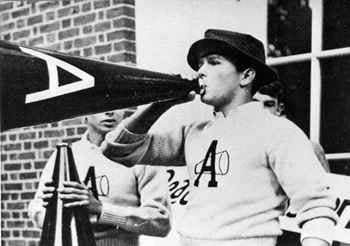
Which raises the question: Without the Dauphin there to "kind of catapult the propaganda," one wonders how they'll be able to sustain. The usual method is the creation of a bogeyman, an "Emanuel Goldstein", an object around which to organize their periodical 'two minutes' hates'.

Look for it! Hate! Coming soon, no doubt, to a theater near you.